child abuse

These stories explore the silent wounds left by childhood abuse — wounds that shape how we see ourselves, others, and the world. They are not just memories; they are echoes that reach into adulthood, often without words. But in naming them, in writing them, we begin to reclaim the power they once stole.

Chapter 2: Becoming a Ghost In my Own Story

After my grandparents died, the house grew colder. Not in temperature, but in spirit. The small sense of safety I’d known vanished, and in its place was silence—mine. By junior high, I was no longer just a shy boy. I had become a ghost in my own story. I sat in classrooms for years without speaking. Not once. I learned to disappear so well that I even convinced myself I had chosen it. But I hadn’t. What I had chosen—without knowing—was survival. Because silence was safer than wanting, and wanting something—friendship, affection, love—meant risking the confirmation that I didn’t matter.


Family and Friends

I had Paul as my best friend in the neighborhood, and that gave me immense confidence. I could stand my ground and know that he would rescue me if anyone dared to try to mess with me. As I mentioned, Paul moved into the neighborhood in 3rd grade, giving me confidence at school for at least one year; perhaps it carried over into 4th grade.


The problem was that it was obvious to my mother that I preferred my cousins and my aunt to them. It should not have been surprising. My mother had such a temper.


Kathy, my mother, would punch, slap, kick, push, and throw things at me when she lost her temper. Her rage was a physical force which somehow didn’t leave obvious bruises that would have gained the attention of our extended family. .


I made a vow in the quiet of I I ddmy childhood bedroom:

  • I will never become like them.
  • I will never lose my temper.
  • I will never let anyone feel unsafe because of me.

I would spend my whole life keeping that promise, even when it meant swallowing my own pain.


I did share the stories about the abuse with my aunt, my cousins - Sharon and Karen - and with Barbara, the daughter of Karen. Barbara was about my age. And it wasn’t like it was normalized. Barbara never suggested that her mother, Karen, ever hit her. Sharon worked at the Department of Social Services and so it seems like she would have been obligated to report suspected abuse.


I spent my time trying to predict whether there was a pattern to when my mother, Kathleen Whealton, would lose control and become violent. Was it PMS?


No. It was strange that as an early teenager I was having to think about things like this!


I had wanted to be removed from this family and placed in foster care. I wanted out. I wanted to escape. I wasn’t as brave as my friend Paul who chose to leave his parents and move into our fort in the woods.


Anyway, getting back to the extended family…


At every family gathering, I was thrust into the role of entertainer for my younger cousins who demanded supervision—if they were to wander off to the park down the street or venture into the woods to climb trees, I had to be there. In those charged moments, every laugh and every small adventure ignited a fierce yearning within me. I was beginning to understand a burning truth: I wanted to be a parent well before adulthood when such things would be possible. With every tiny life I looked after, I felt an almost desperate surge of being needed, of being significant—of finally being seen.


The child in me was also set free. I could see a child wanting that from their parents - a chance to connect in a real way with one’s adult parents.


I did spend time with Dan from time to time, though those encounters came with conflicting emotions. I vividly remember one time when he invited me to join a brutal game of tackle football—a violent, raw display of physical contact that tore open memories of my mother’s explosive anger, mirroring her harshness in every potential collusion with another person. I couldn’t really tackle anyone and I hoped no one noticed that.


But what truly consumed me was the time I spent with Barbara. We would simply be together, wandering the stark, fluorescent halls of the mall or just lingering in the sanctuary of her downstairs bedroom. There, as she prepared herself—dabbing on makeup or trying on outfits—I would sit silently, yearning for the quiet validation that came from merely sharing the same space. In that unspoken communion, every blink of her attention made me feel less like an invisible shadow and more like a living, breathing presence.


Deep down, an undercurrent of anxious shame stirred—a twisted fear that someone might misconstrue my longing for validation as something else, something forbidden. She was very pretty, and though I sometimes wondered if my feelings were misread, the truth was far simpler: she saw me, she acknowledged me, and for a moment, I could believe I mattered.


Then there was the overwhelming salvation of my extended family—a lifeline in a world that had been frozen by the callous indifference of my parents. The stark isolation that left even my sister distant was suddenly broken by the warmth of my cousins and aunt. I craved human contact with an intensity that bordered on desperation, and even the slightest gestures—a hug from Aunt Maureen, Karen, Sharon, Linda, or Barbara—filled that cavernous void within, feeding my hunger for connection in ways I could barely articulate.


Yet the bitter taste of validation was always accompanied by the sting of neglect. When Barbara canceled plans—perhaps to be with someone else, someone not bound by familial ties—the cold, cutting voice of my mother echoed in my mind: "They have their own lives." Those words were like a knife to my heart, reinforcing the painful notion that my existence was barely worth a moment's consideration. It was a brand of rejection that threatened to shatter my fragile sense of self, feeding the seeds of an ambivalent attachment that scarred me deeply.


And then there was that haunting moment when my mother, tangled in jealousy and bitterness, suggested that I was naïve to expect refuge from my cousins—perhaps she meant Sharon, Karen, or Aunt Maureen. "Do you think they are going to let you live with them?" she snapped, her words dripping with disdain. In that moment, a brutal reality cut through me: I was stranded in a barren wilderness with no sanctuary for the wounded parts of my inner and true self.


I wasn't wanted. Yet, a part of me hoped I could still find my way to belonging.


Caught in that unwantedness, I began to see the foundation of who I might become—a person yearning to matter, to be noticed, to be chosen. Yet, I was conflicted, wondering if I would ever truly unlearn the painful lessons of my childhood, find a voice that had been silenced, and emerge visible after years of being unseen.


Breaking Free from My Shell


In the neighborhood and after school, unmistakable signs emerged that I was shattering the confines of my shell. I hurled myself into the whirlwind of sports like kickball, soccer, and hockey, playing in the streets, our yard, or on our driveway. Kickball, our most frequent game, awakened a softer side within me. A revelation struck me like a bolt: when my team clinched victory, the opposing team tasted bitter defeat, a blow that could crush their spirits. This empathetic insight, one that psychologist Carol Gilligan notes as typically more feminine, struck me profoundly even before I had ever read her work and resonated even more deeply later in life.


I also embarked on a relentless paper route, delivering newspapers to over 50 houses every single day. Each morning, I'd venture out, sometimes before the first light of dawn. Later, collecting payments from countless clients with Paul by my side, I unearthed a flair for humor and a daring streak to entertain. On a scorching summer day, when temperatures soared past 100 degrees, we pulled a wild stunt—donning winter coats, hopping on our bikes, and approaching doors to collect payments. The real kicker was when someone didn't even blink at our outrageous attire.


An uproarious tale from my life is about landing my first job at 16. Just prior to that, I drove my brother and his friends to the movies in a nearby town, only to end up hopelessly lost on the way back. Hours slipped by before I finally stumbled home, a comic misadventure in its own right.


Even more ironic was the nature of the job being offered to me by Jack Donlon, the owner of the Medical Mart living right across from us, who wanted to hire me. The job? Delivering supplies to customers in New Britain—a task demanding navigation skills I had yet to master. Yet, it wasn't long before I became adept at wielding maps, pinpointing every house with precision. When the deliveries were cumbersome, there were two of us, giving me a chance to connect, socialize, and indulge in mischief.


Thus, there existed vibrant exceptions in my life that defied the confines of my proverbial shell.


Boy Doesn't Meet Girl

By the time high school rolled around, I had long accepted that I wasn't one of the guys who got noticed. The idea of dating was so far removed from my reality that I didn't even consider it.


But I did watch movies.


One movie in particular haunted me—Carrie.


I watched it repeatedly, but I always halted just before the notorious prom scene, before the blood spilled, before the terror erupted.


Because to me, it wasn't a horror film.


It was a vision.


Carrie was my mirror. She was silent. She was invisible. She was abused, not only by her peers but by her own mother, though, in my case, my peers never abused me - I was just invisible.


My own mother had been venomous in a myriad of ways. This inevitably instilled a deep, corrosive shame that gnawed at the very essence of my being.


And then Tommy saw her.


It didn't matter that he had a girlfriend. That wasn't the point. The point was that he noticed Carrie. He saw something in her that no one else did. And not only that, but he was kind. He asked her to accompany him to the prom, not as a joke, but because he wanted to make things right. And for one night, Carrie was part of something. She was wanted. She was special.


I wanted that.


Not the prom, necessarily, and definitely not the supernatural revenge. But I wanted to be seen. I wanted someone to look at me the way Tommy looked at Carrie—like I mattered. In that dream, there would be a girl who would fill a role like Tommy did for Carrie.


I also wanted to be held close in the warm arms of someone just like Tommy did for Carrie when she was on the dance floor. I would have felt so profoundly uncomfortable on any dance floor because I NEVER had anyone wrap their arms around me and hold me... then look at me and kiss me. This very thought made my heart race with equal parts longing and terror.


I was not bullied in school. No one stuffed me in lockers or tripped me in the hall. I wasn't tormented, I was just ignored.

But even that stung like salt in an invisible wound.


I didn't go to prom. I didn't go to parties. I didn't go out on dates. I watched from the sidelines as other people lived those moments, and I wondered what they have that I didn't?


I knew the answer, of course.


Confidence.


They knew how to talk to people. They knew how to ask a girl out without their voice catching in their throat. They knew how to dance without feeling like every eye in the room was watching, judging.


For me, that wasn't an option. I couldn't even raise my hand in class. How could I approach someone and ask them to spend time with me?


Even the kids who were teased more than I was had girlfriends. Even they had found someone who saw them.

I waited.


Maybe someone like Tommy would come along—a girl who saw something in me that others didn't, a girl who would notice me first.


That didn't happen.


Maybe I had a phobia of rejection. Maybe the preverbal script I followed unconsciously held me back. I would have to wait until college to figure this out.


I know that social skills are important, and I could not have learned any social skills when I was growing up. I didn't know it, but my life and career direction would require social skills—but I am getting way ahead of this story.


And so, high school passed, and I left it the same way I entered—unnoticed.


For some, high school is where they meet their first love.


For me, it was where I realized I was invisible.


Chapter 1: The Birth of Shame

Before I ever knew the word for "shame," I had already absorbed its weight. Not from a single moment of humiliation, but from a slow erosion of safety—emotional neglect that left me starving for comfort, for gentleness, for someone to notice my fear and say, "You're okay."

The earliest years of my life are not defined by memories but by their absence—by the hollow space where warmth should have been. And in that silence, shame grew. It would shape the way I spoke—or didn't speak—the way I looked at others, and how I would eventually disappear from my own life without realizing I was gone.

One might think that "nobody remembers the earliest years of their life," but I am talking about what I knew when I was very young—that I would not have fond or happy memories with my parents.

The earliest years of life can only be discerned from secondhand stories we're told. As a toddler, my parents bought me a fire truck, and when it made a sound, I was terrified. I can only imagine, from the story and my later experiences, that I wouldn't have received the comfort I would have offered a child myself. No soothing words telling me everything was okay and that I was safe. Instead, my parents told this story with frustration, lacing their voices.

It's the opposite of how I respond to my cat when a pot or pan falls to the floor and startles him. I gently call him back with soothing sounds: "Come here, Kitty, it's okay, you're okay." Yes, I named my cat Kitty.

These were the years of emotional deprivation.

The Birth of Shame

My earliest memory is of water.

Learning to swim with an instructor who was in her late teens or early twenties. I am four or five. The indoor pool at the Y. The warmth of the water against my skin. The vastness of it—stretching beyond my reach.

I remember floating near the wall, small and weightless. Swimming toward the instructor. Then, a moment of panic. The deep end offered no bottom to secure myself. My arms flailed; my breath caught in my throat.

I saw the instructor was nearby. I don't know what gave me courage, but I leapt. I wrapped my arms around her, clinging to her like my life depended on it. She steadied me, her arms firm, unshaken. My heart pounded against her shoulder, but she didn't let go.

I was safe.

But something else lingered. Not just relief. Something deeper. Something I wasn't meant to have.

I wasn't supposed to know what it felt like to be held. To be protected. To be cared for. And even at four or five years old, I knew that.

That is the birth of shame.

This was the first time I knew what it felt like to be held—and the first time I knew I wasn't supposed to want it. The indifference I knew from my family told a story about who I was and how I should think of myself.

The House of Unspoken Rules and Child Abuse

I don't remember my parents ever holding me like that swimming instructor.

In my family, affection was something distant, implied rather than given. Love was duty. Gratitude was expected. Respect was mandatory and not earned.

My father, Bruce Sr., was a man of unshakable silence. He believed actions spoke louder than words, but his actions were cold efficiency—he provided, and that was enough. My mother, Kathy, was a storm you learned to anticipate, never knowing when lightning would strike.

There was a chill in the air, a tension that wrapped around me like a vice. It was the kind of silence that demanded submission, not understanding.

I never looked directly at my father's face. I kept my gaze down, or slightly averted, as if instinctually avoiding something dangerous. The thought going through my mind was that I should not expect an easy explanation of what I did wrong. My mother's nature was more volatile, though that would become more obvious later in life.

I felt that I was being met with a general sense of disapproval for being.

Later in life, I would become incredibly skilled at reading people's body language. I had so much to learn because I purposefully chose to avoid observing the looks of general disapproval.

Refuge and Frailty

Our maternal grandparents were our refuge, our shield. They moved in with us when we were very young. Grandpa had my mother when he was 48 and my Grandma was 40, which meant that when I was born, my grandmother was 66 and Grandpa was 72. For whatever reason, they didn't age well, which shaped my impression about what it meant to get old.

On one hand, they were a refuge just by their position as parental figures to my parents. On the other hand, they were frail. My grandfather had lost his vision. This created a sense of distance that is uncomfortable for me to write into words. I remember the skin hanging off my grandmother's arms, her legs were discolored, and she had a scar or mark on her leg. Grandma was staying in the dining room that had been converted into a bedroom. She needed a walker to get around. Grandpa stayed upstairs.

In retrospect, I wonder now what could have reduced them to such weakness. This distance that existed as a result of me seeing them as old and unhealthy kept me from having the true relationship that many children have with their grandparents. To this day, I am shocked to discover that some people are grandparents who don't bear any of the signs of what "old" was imprinted upon my childhood mind to mean.

I remember Grandma standing up for me—her frail voice telling my parents, "Don't hurt him." I might have been 10 years old at that time. That small moment, that whisper of resistance, was the only time someone tried to intervene.

Grandpa would worry about me lifting too much when I joined him to take out the garbage once a week, stacking the garbage pails in a way that would ensure dogs couldn't get into them. He was very protective of me and worried about me getting hurt. I was concerned about not being a wimp or a sissy—which is not what Grandpa intended—but being a tiny boy made me feel a pull away from being seen as weak.

The Art of Hiding

I began to hide. In Kindergarten, I literally hid behind a chair instead of walking up to the front of the room with my milk money.

We lived in Southington, Connecticut, near the end of a dead-end street. There were woods around our home, a small mountain (Ragged Mountain), and trees to climb. This offered a way for me to hide by myself in the woods.

Around this age, there was one incident where a few boys taunted me. This would not be repeated. My life was not defined by any form of bullying or torment from other kids.

I recall at about age 8 or 9, my mother ushered me out to play with the neighborhood kids after school. I found a telephone pole and hid behind it, my small body pressed against the rough wood, hoping no one would notice me. The world felt too big, too loud, too dangerous. Maybe if I just stay here, no one will notice. Maybe if no one sees me, I can't get hurt.

A Brief Respite

Then the world felt safe in third grade. I was still thin, but I wasn't afraid. I had a friend, Paul Plourde, and that made all the difference. His presence was like armor—with him beside me, I could face anything.

One day, I sat at my desk in Mrs. Felt's classroom when a girl named Donna stood up and declared, "I like Bruce!" My face burned crimson. Then, to make things worse, she leaned in and kissed me on the cheek. Back then, before 5th or 6th grade, boys didn't like girls. The age-old idea of girls having cooties was part of our culture, this bizarre notion that we could get infected by being touched by a member of the opposite sex who was the same age as us.

When Donna said this, the class erupted in giggles. Heat crawled up my neck, spreading to my ears. I didn't know what to do, so I said the first thing that came to mind, the thing I thought boys were supposed to say: "I hate girls."

Mrs. Felt chuckled and turned to the other teacher in the room. "Aren't they a cute couple?"

It's strange, the game we played when we were kids. When did it change—by 5th or 6th grade, when it was suddenly okay to admit that you liked girls?

Preface

Audiobook Preface

Preface

I spent twenty-two years learning to be visible, only to discover that becoming real is not the same as staying real.

As a very young child, I hid behind a telephone pole when my mother told me to go play with the other kids. Not because I was playing hide-and-seek, but because without a secure base at home, I didn't know how to reach out to the world. I climbed trees and disappeared into the woods—not to escape the neighborhood, but to escape my parents. From the sudden punch or kick that could come out of nowhere. From parents who built a pool and took us to Disney but never once asked if I was happy, never seemed to notice or care who I actually was. 

Even as a child, I could see the disconnect—the performance of family for the outside world, the indifference behind closed doors. By fourteen, I was asking questions I had no language for yet: Why are you doing these things for us when you don't actually care? The only time I remember being held was around age three or four, in swimming lessons, my arms wrapped around the young instructor's neck, and even then I felt certain I didn't deserve it.

By high school, I had perfected invisibility. I sat silent in classrooms, never called upon, a ghost among my peers. I went away to college and immediately started counseling—not because I believed I could change, but because I couldn't keep living this way. I set goals: speak in class, ask someone out. 

For most of my undergraduate years, I remained the third person with every couple—best friend to both the boyfriend and girlfriend, even best man at a wedding, but never part of a couple myself. I finally got two dates my senior year—one date each with two different people. I never spoke in class. I'd come so far, but something fundamental was still missing.

Then, in 1990, after graduating from Georgia Tech, I was seen through the eyes of love. For the first time in my life, I had proof that I was special, that I mattered, that I was real. It was the missing piece—the experiential knowledge that no amount of therapy alone could provide. She died at the end of that same year, and for a time I wondered: what good is it to find this love and have it taken away so suddenly? But something had awakened in me that couldn't be undone.

In April of 1992, I took a microphone and read poetry, choosing to be the center of attention for the first time in my life. Three months later, I met Lynn. What followed over the next eight years—from 1992 through 2000—were years of success and joy beyond my wildest dreams. Graduate school in 1993, becoming a therapist in 1996, full licensure in 1998. Leading therapy groups and counseling couples despite having gotten only two dates in all of college. Building a life with Lynn—enduring love and earned secure attachment, learning in adulthood what I should have known as an infant. 

I want you to understand what's possible. I could have become like so many others who can only connect with narcissists like their parents because it's familiar. I want to show you that it doesn't have to be that way. That even from a childhood like mine, you can find real connection, meaningful work, genuine love. The kind of success that looked, for all the world, like I'd been cured of my past.

By July of 2000, everything seemed perfect. By September, I'd lost it all.

And that's when I learned what I'm still learning now: psychological wounds don't heal like broken bones or diseases cured by vaccines. You can grow, transform, build a beautiful life—and then lose it and discover that all your old patterns are still there, waiting. Letting my parents back into my life recreated the trauma of childhood. By my mid-fifties, I finally did what I should have done decades earlier: I cut off all contact with my family. This is the story of learning to be real, forgetting I was real, and finding my way back—not to where I was, but to something I'm still discovering. This time, with tools I'm learning to use.

My Invitation

Have you ever felt invisible? Not just shy or like a wallflower, but truly unseen—not noticed, not known for who you really are? Noticed social anxiety in yourself? This book is for you.

You might also recognize yourself here if you grew up in a home where you had many things, but your feelings were never validated or didn't seem to matter. Where everything looked normal from the outside - maybe you even say things were good, you weren't abused—but somehow you became responsible for a parent's happiness or emotional needs. That's called covert narcissism, and it's more common than you might think. And narcissistic patterns don't only show up with parents, they can appear in partners and other relationships throughout our lives.


This isn't about blaming parents. It's about understanding what happened and finding your way forward. As the title states, this book covers Complex-PTSD and/or Developmental Trauma—regardless of where those wounds originated.

You may not relate to everything in these pages—everyone's experiences manifest in different ways. Because we have much to cover, take it slowly. I hope you'll relate and know you are not alone.

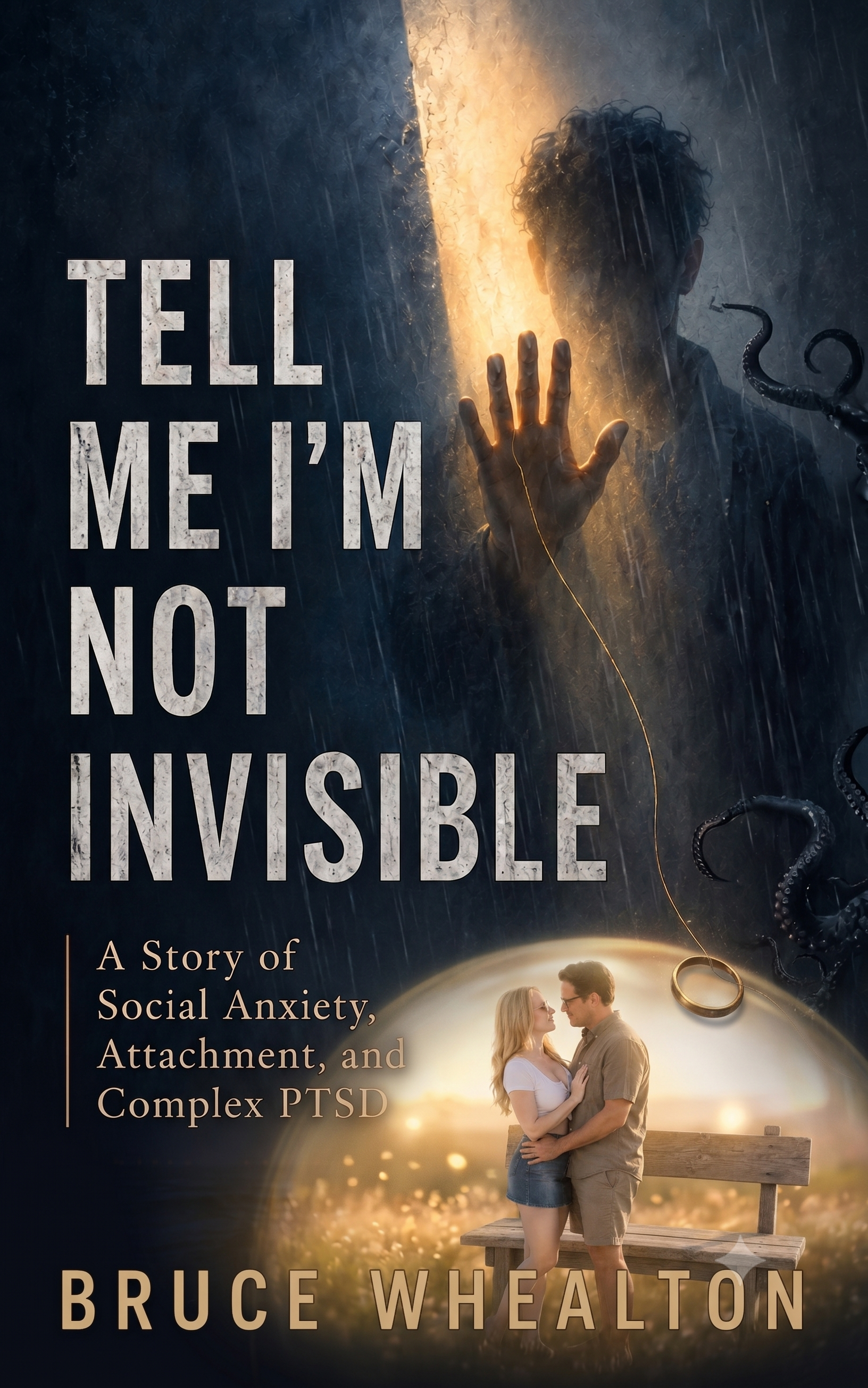
Tell Me I Am Not Invisible: A Story of Social Anxiety, Attachment, and Complex-PTSD

A Memoir About the Necessity of Connection


Tell Me I’m Not Invisible is a memoir for anyone who’s ever felt unseen, unloved, or alone.


Bruce Whealton grew up in silence. His childhood was defined by emotional deprivation, physical abuse, and a family that made him feel like a ghost—unseen, unwanted, unworthy. For years, he believed what that world taught him: that he wasn’t enough.


That he wasn’t loveable.


And then something miraculous happened.


He found love.


Chapter 11: After Celta: From Tragic Loss to hope and escape.

In the last chapter, I told you about the joy I found in finding someone to love and someone who loved me. I told you about the experiences I had, and I hope it was clear just how meaningful this was in my life's trajectory. It was so important to present the profound and positive impact this had on my life.  

This was life-altering.   

The experiences I had growing up, in my home environment, were toxic to the development of the kind of self-confidence and self-worth that I would need to achieve my career goals. Something had been missing despite all the improvements I had made in my sense of worth.

It's hard to know what you need to overcome a problem that has existed throughout your life. My therapist or counselor in college was very talented, competent, and profoundly helpful. However, we failed to fully appreciate all the negative impacts of abuse and devaluation that I had experienced in my home life from my parents.  

Then I met Celta, and something happened. She seemed to be delighted in me. She was so interested in my experiences. She also was concerned about my well-being and happiness. I knew she was thinking about me for most of the day each and every day! Her diary-style, stream of consciousness letters told me this.

I knew she was thinking about me for so much of her day, each and every day, because of the letters she wrote to me - her diary of sorts composed with me in mind as someone she wanted to share her life with. I had realized that I previously thought that I was not that important to anyone. This is what I meant by seeking a relationship with some aspect of exclusivity or the idea that I could be the most important person to someone.

I knew that I was the only one that Celta loved the way she loved me. Previously, I had friends, but they all had a boyfriend/girlfriend or spouse, or the relationship wasn’t as close.

After I was with Celta, I felt like I was ten feet tall... confident... worthwhile, and deserving. My self-esteem was higher than it had ever been in my life. I also felt safe trying new things. This idea might seem unexpected. She was just a small girl (woman). I sensed that she deeply cared about me and thought about me and that was transformative.

It's important to underscore these important points before I move on with this story.       

When I say that our relationship was platonic, I mean that we were not boyfriend and girlfriend. We didn't have a physical relationship. That being said, we did exchange "I love you" on a daily basis or whenever we talked on the phone or saw each other. We were close and perhaps somewhat intimate and physical but not in a sexual way.

Late in December, something happened. I had moved to kiss her as I was leaving. It was impulsive. Her lips were so thin that I didn’t feel what I imagined I would feel. This was my first kiss. I felt confused. She had not turned away or signaled in any way that she didn’t want me to proceed. So, why was I uncertain? I didn’t have to be shy with Celta. But I didn’t want to use her for my own personal “experience.”

I would play this back in my mind as I drove away. Yes, I wanted to kiss her. Having decided now for sure what I wanted, next time I would kiss her. 

Sometime later I pictured my face turning to the right and moving closer to her as she moved toward me. I had been in sync with her and felt so comfortable. I knew that she might have said that one time that she was not in love but when we were together there were so many times when she had that look of someone who was so happy, comfortable and it sure looked like she was in love. Well, she definitely had “romantic” feelings. 

Also, when I was with her, I could see myself and my feelings. You just know those things. There were so many subtle behavioral cues that told me what she was feeling and how she was responding to my touches… how I held her… where I touched her. Everything had been welcomed. I played back memories of how when I touched her she moved closer to me.

As I replayed the imagined kiss – next time - I would begin to tilt my head to the right, bend down, she would be acting on instinct, without taking the time to over-think it – that’s what I would do, and she was my mirror. Sometimes we do things as if the moment is such that it is inevitable. She would move to meet my lips… she would be transfixed upon my eyes and I hers. I felt excited as I replayed this in my mind. 

It was as if it had happened already, almost. 

It would never happen. 

On New Year's Day of 1991, I got the worst news of my life. A phone call. I was in my room on the second floor of the house owned by my parents. "Celta died last night," I was told.  

"How?"  I asked as if this wasn't possible or real. I was stunned. I wanted my willpower to make it not real!

"There was a fire... she died from smoke inhalation."  It started from an exposed electrical cord on a TV. 

My mind registered information about the funeral, its location, and time but I could not find the words to begin to convey any sense of what I was feeling. I had spoken a few times to the man previously. He was friends of the family. Tears were flooding my eyes. I just said, “Okay, I’ll be there but I can’t talk…” my voice breaking. I needed the family to expect me.

I dropped the phone and began to cry so bitterly.

I hurt so much! 

I cried so much as I drove the way to the funeral. Just before the funeral, I looked at the closed casket and was overcome. Someone was standing by it and for a brief second, some part of me wanted to open the casket and find out that it wasn't Celta that was inside.

At the funeral, I cried more than everyone else combined. I didn't care how I looked.

It was at the Episcopalian church where I went with Celta and where I would sit down next to Celta's mother and Celta. I was still Christian, meaning I went to church on a regular basis.  

Standing outside after the funeral people were talking. I was looking at the closed casket unable to believe this was real. I was still crying. Celta's mother instructed me not to come to the burial. She could tell that I was not going to make it through that event. My state of mind was such that I needed to be told what I should do now.  

At the burial the one person who loved Celta most, who felt a visceral sense of grief above and beyond that felt by the others... that one person would be missing. I would not be there. I had followed the directions of Celta's mother and left Athens (Athens Georgia).

I certainly felt betrayed and abandoned by God. However, I did go to grief counseling at the Catholic hospital in Augusta, Georgia. A nun was leading a grief counseling group – spiritual counseling. She was using guided imagery, relaxation techniques, prayer, and biblical references. I met with her a few times and asked for tape recordings of the sessions. 

In the group sessions, she spoke about the stages of grief. We were encouraged to bring in things that were mementos of our experience with our loved ones. I listened intently as the others spoke. I was by far the youngest. I had studied the grief process in a psychology class at Georgia Tech. I read some more about this from a “clinical” standpoint. I was keeping reality at a distance.

I was in denial at times and at other times I would be overwhelmed with the idea of not being able to see Celta ever again and I would cry and cry. 

So much is strange about this time period. The struggles with my parents were never intentionally instigated by me out of anger for anything. They just seemed uninterested in me and my life, other than to tell me what I ought to do. 

I suppose I wanted to share the fact that someone had loved me to explain what had changed. It was surreal that there was such denial that anything had happened or changed. I might be in denial as a symptom of grief but I wanted to celebrate the relationship that I had. Where would I begin?    

Family dysfunction and the loss of a relationship with my brother (a flashback) …

Child Abuse by My Brother John Whealton...

Maybe I am forcing him out of my mind. Years later his daughter told me that my brother had done something that was potentially abusive. Then I saw him throw her up against a wall like she was a rag doll. I asked Child Protective Services to look into the matter.

I expected them to be discreet and assumed they would not reveal who called. I wasn’t trying to hurt him and wondered if anything would come of the matter. 

My brother found out and never spoke to me again. 

I heard later from my father that they were afraid I would call Child Protective Services again!

 I was asked by the agency that looked into the matter to write a piece about the cycle of abuse.

That was in 2002. 

It’s bizarre how things happen. He was the only one in the family who got aggressive in response to our parents' physical abuse or threats of violence, but they chose to invite him and his wife to visit on holidays and disinvite me ever since. Our family is so dysfunctional! I have an adult niece who doesn’t know anything about me.

Anyway, getting back to 1991, to cope with the tragic loss, I started drinking. A lot.

I was put on a tricyclic anti-depressant by a psychiatrist. I had developed panic attacks as well. The anti-depressant had the effect of creating a sense of positive feelings even with my mother standing there one morning ironing something for work with my father getting ready too. Those fake feelings were only transitory. It is reminiscent of the song by REM titled "It's the end of the world as we know it."... and I feel fine. I guess I felt “high.”

The days flowed around me like a mystical experience in which I flowed in and out of my body. I wasn't fully alive or so it seemed... betrayed even by God.  

It was all a blur. My entire existence. 

Somehow, I did get a job finally that could have made my parents satisfied. Everything was always about them. They never asked about anything that was happening to me. So, they never inquired about why I was going for grief counseling because they had no knowledge of this.  

Anyway, I got a job at the National Science Foundation as a contractor. I was developing a network for the museum and that involved network programming in the C programming language. I was a software engineer. I did accomplish a great deal in that job capacity and my supervisor was very impressed with my talents.  

Again, this was not at all interesting to me. Yet, I was making sure that I successfully met all deadlines and deliverables. 

I vaguely remember a summer trip to Las Vegas. The company paid for this to cover some training related to my work. It was amazing. I had this incredible per-diem rate where I was paid my salary plus extra money for expenses that exceeded the cost of the hotel room.  

Vegas was probably the worst place for me to go with so much free cash and free drinks in the casinos. Somehow, I made all the presentations for the training that I was sent there to attend. In the evenings and free time, I hit the casinos and made some decent money. Nothing to write home about. Gin or vodka was an escape but somehow, I didn’t drink so much so as to get sick at night or even the next day.

As I try to write this now, I have only momentary snapshots with no full running narrative memory. Just random disconnected sensations. My hands were unable to touch the leather inside a car. The sun shimmering on the pavement. Casinos. Drinks. Sitting at a poker table. Pulling a lever on a slot machine.

I must have done what was expected of me. I don’t remember any complaints from my boss.

Yeah, I moved through time like a robot.

The job was going well, as I said. I was proud of how well I was doing.

I was drinking more and more during this time period after the trip to Las Vegas. Everything except beer. Vodka with tonic or orange juice. Gin and tonic. Whiskey with ice, water, or coke. Not so much wine.

I was passing out and once or twice I would puke. I really hated throwing up, always.

I did meet this girl from the home office of the company that was paying me. She lived in Alabama and I was in Augusta, Georgia and we decided to meet in Atlanta, Georgia where I had graduated not long before that.         

My supervisor was joking that I had "jungle fever" because I was a white guy who was going to date a black woman. He was black, as well. I didn't let that bother me. Spike Lee's film "Jungle Fever" had been out, and it was an important film. I have always been fine with having a conversation about race if that was something that was desired.  

My mother actually asked about my date. I suppose her name sounded ethnic and my mother asked about that guessing that she might be Italian. I said, "no, she's black.”   

I remember that this was the first time I kissed anyone other than a brief kiss that Celta and I shared back in December of the last year. I mentioned that above. 

This was extremely passionate. She brought her kid and left him in the car and parked near the Student Center - the same building where I worked on the bottom floor in the post office.  

We were looking for someplace to sit or be as private as possible outside after dark. I remember making out at a few locations here and there. I could feel her large breasts against me, and I was aroused.  

My first passionate kiss. Before Lynn. We'll get to that later.

Did I feel guilty about dating so soon after Celta? Maybe. But I wasn’t actually feeling nor was I “aware” during this time period. I was so numb that I needed to feel something. To wake up! I was trying so hard to wake up. The tricyclic antidepressant made me feel good for a few moments. That didn’t make it a meaningful experience. 

Then later there was the fact that she said in December that she loved me but wasn’t in love with me. I had only known her for one year, from January through December 31 or 1990. I do know that countless times she had that look like someone in love when she looked in my eyes. I was fairly certain she was trying to protect me from being hurt. But I never got a chance to ask her.

And that kiss? I had stopped, not her. It was my first time kissing anyone and I should have been aware that her lips were so small that if I didn’t feel anything at first I should wait or stay there. I was always comfortable with Celta. She had never rejected any of my touches. 

My mother had made me feel so not okay and so had my father somewhat. This “date” was a way to get out of the home and to appear normal to my mother. If I was going out with someone from the company that employed my services, it made me appear less worthy of the criticism I had been getting from my parents. That’s how I figured it. It was an escape.

Some people with Borderline Personality Disorder or trauma disorders will cut their own skin with razors or something sharp just to feel something. The date was something like that. 

There wasn't a second date. I had expressed my concerns about pre-marital sex. We weren't even in a committed relationship. I drove to Atlanta to meet her for a second date, but she never showed. I was frustrated out of embarrassment. Then I just forgot the entire matter by the next day and never thought about the matter further.  

The various medications and the alcohol impeded grieving and dare I say reality testing. People who are grieving are in such a state of denial that it is almost like a temporary psychosis. From what I was reading and hearing in the stories of grief that I studied, “normal,” healthy people did for a while embrace denial to such an extent that it bordered on delusional thinking.

The loss of Celta could not be washed away with alcohol, grief counseling, or an intimate date. 

Poetry as an outlet…

I can thank my mother for introducing me to Martin Kirby, who went to our church and he was a professor of English Literature and related subjects at a college in Augusta, Georgia. He would become my writing/poetry mentor.  

I would show up on a regular basis for poetry readings where I shared my poetry and got feedback, advice, and guidance on writing good poetry. He also heard me write about my experiences with Celta and listened to my experiences. This was very helpful because I had no other outlet for this or place to talk about Celta and my relationship with her.

He said he thought it would take about 10 years for me to be able to write good poetry about Celta because the feelings were too raw.

I was living in a difficult environment with my parents.  I was dealing with a major tragedy and yet the name Celta wasn't even being mentioned.  

Between drinking, the different medications I was put on, and the panic attacks, I had to go to the Emergency Room (ER) on two occasions.  

The psychiatrist tried me on a major tranquilizer, and I had these horrifying muscle spasms that twisted my body up into contortions that made me think my bones were going to be broken in my neck and elsewhere. The doctor said that in higher doses the drug is used for psychotic disorders but somehow it would help with my depression, I guess. That was the reason I was taken to the ER once. My father took me.  

Another time I had a panic attack and again my father took me to the ER. It's strange that they weren't asking why all this was happening. Nothing like this had ever happened to me. NEVER!

The only ones listening to my stories about Celta were Martin Kirby and his wife as well as the attendees at the grief support group. Again, my parents were not interested to learn anything about this matter. They never seemed to have any awareness that I was even going to grief counseling.  

This is so utterly astonishing! I had not deliberately been trying to keep everything a secret about what was going on with me. On the contrary, I looked for an opening to discuss the matter. I wanted to repair and improve the relationship. I wanted to share the fact that I had found someone who loved me.  

With all this going on, all the problems I was having, I began to doubt that I could achieve my goals in life, my career goals. I wondered how I could help others when I had so many problems myself.  

It should be noted that while I was put on a major tranquilizer, my psychiatrist NEVER said he thought I was psychotic. We knew I had problems coping with overwhelming stressors.  

There is a positive aspect of this time period of 1990 to 1992 that I did not mention. My parents had friends that had adopted a young girl who was about 12. I have always been great with kids. I love kids and enjoy the chance to be like a big brother.  

I was so impressed that she wasn't shy at all when I first met her. I went to visit with my parents, and they invited us to come swim. It was either 1990 or 1991 when I met her. I was like a big brother and I had a great time doing so many things with her.  

After the job with the National Science Foundation ended, another opportunity presented itself in March of 1992.  I was offered a job in Wilmington, North Carolina, to work with Corning as a Technical Writer. They wanted someone with a technical background. 

This would change everything. I was about to be on my own again. Finally!  

My perception that I had long-term "problems” would disappear as if by magic, literally - it was unbelievable. My problem had been living in a toxic environment and that was complicated by the grief and the effort I had made to ignore, suppress, or deny the natural process.

My own doubts about my ability to achieve my career goals in life were contributing to the problems I was having.

It’s hard to believe that I had only known Celta for one year – the year 1990 and when that year ended, so had Celta’s life.

The tragic loss of Celta did not erase the positive impact she had on my life. There were other positive experiences during this time. I had become more confident.

I had been writing poetry about the experiences I had with Celta and I wanted to share that with others. I had been sharing that with Martin Kirby my poetry mentor but now I wanted to share this with others. It was so important and meaningful!


Chapter 8: Assaulted!

Image depicting my sister Carrie Whealton assaulted by Bruce Whealton Sr. (my father) and Kathleen Whealton (my mother)

During and just before my senior year in college, as an undergraduate at Georgia Tech (as opposed to my later graduate studies), I was assaulted with some shocking news. 

Let me fill in a few tidbits that will be important to consider later. Just before I started my senior year in college, I got a call from my sister. She reported that she had been assaulted by both of our parents. She was extremely emotional and distraught. She was about 19 and had started going to a community college in Florida after graduating from high school.  

Let’s back up a bit. After I started at Georgia Tech, my father got laid off and then got a job in Florida. Carrie, my brother John, and my parents related to Hobe Sound Florida from Connecticut. This was a long-distance move of 1300 miles. Carrie was still in high school when this happened.

I got the call as I was starting my senior year at Georgia Tech. I was glad to be someone with whom she felt she could share this news. She described what she and her friend had discussed. I knew which friend she meant as she described the matter. To be honest, I didn’t know this girl that was friends with Carrie, but I can remember it was the friend that was incredibly sexy. I’m just saying this to fill in the most minimal of cues.

Obviously, by now, dear reader, you understand that I am not shallow, but I do notice things. I had some conversation via email with Carrie last year in 2020 about this and at first, it sounded like she was going to tell me she forgot it. So, I blurted out, “you had talked to your friend who was that sexy girl.” 

Anyway, back to 1988. Carrie was attacked but she said they didn't call the police. She and her friend had decided when they are talking after she was attacked by both our parents that "next time they would have to call the police."  Instead, she moved.  

We used to fight growing up but then we got closer to each other. The fact that she told me something so emotional never left my memory over all these decades. 

They had said "Next time."  Yes, there would be a "next time."  We had been abused growing up.    

Sadly, Carrie NEVER had a meaningful relationship in her life! I cannot give you the name of one single guy who she ever mentioned in over fifty years!

I remember not knowing how to act around our parents when I came there for Christmas and before the next quarter at Georgia Tech. If I was too friendly with Mom and Dad, would Carrie think that I condoned what was done to her?  She definitely knew that I knew this was so wrong!

My brother had an easier time because he was 5 foot eleven and could stand up to our father.  

There are other things that I remember about that time period that might have indirectly created problems between my parents and me.  

I started feeling good about myself because of the support I was getting at school/college from both my counselor and some very good friends, Thomas and Jo Lee. I don’t have clear memories of what I shared but just that I discussed the various forms of abuse with both of them.  

Anyway, when my parents came to my graduation, Thomas and Jo-Lee were there as well. I had not told my parents that I had needed to reach out to friends for support. The way in which I grew in self-esteem made me feel so much better about myself. I had self-compassion. As such, I felt the confidence and comfort to share my experiences with my good friends.  

At my graduation, Jo Lee made the most effort to be cordial with my parents. She had her "feelings" though about the things that happened to me which they caused and about me having been hurt. For my friend Thomas, it was much harder to act friendly and cordial because of what he knew. He was a much quieter person than Jo Lee. So, what was interesting was that after graduation, my mother said that she got along fine with Thomas, but she didn't feel comfortable talking with Jo- Lee.  

If she only knew how much more intensely Thomas felt toward them, she would have been even more shocked. Obviously, she picked up on the tension, and put two and two together. However, her way of dealing with it was to deny, deny, deny among those who had been present like my siblings and me. I am NOT saying that the topic of abuse was ever broached at all by any of us. Thomas, Jo-Lee, my parents, and I had tried to find things to talk about, but you could sense the tension. 

In terms of her denial as a coping mechanism, I began to realize she even fooled herself into forgetting things.

It was against this backdrop that I moved in with my parents after graduation without realizing or considering the tension that would characterize our very strained relationship during the next two years, and a few months before I moved on to live on my own when I got a job in a new city - Wilmington, North Carolina.  

In the next chapter, I will begin to discuss this next chapter of my life.  The next chapter would be a life full of far greater joy, love, and success than I had already known.  

Chapter 12: From General Population to Protective Custody

In the early months of my captivity, I fiercely rejected any suggestion of being taken to a psychiatric hospital for evaluation. The mere thought of using mental illness as a defense for my actions made me sick. I wasn’t going to allow it to be said that there was validity to what Ana claimed but there was an explanation.

Despite Ana's accusations, I stood firm in declaring my complete innocence and victimhood. I refused to succumb to her manipulative tactics and never wavered in my claims of being mentally sound and guiltless. To even consider entertaining such an idea would be to admit defeat and give Ana exactly what she wanted – power over me.

No, I would not allow her or the detectives who questioned me to strip me of my agency and reduce me to a mere pawn in their twisted game.

I wrote in a letter to my lawyer that I did not have a dissociative disorder. I told him that I had not been trying to play a game with the detectives. With Ana’s lies they were the writers and directors of a sick game.

My landlord, with a sinister smile on his face, had taken away all of my possessions, leaving me with nothing… as if I had never existed, never collected anything that I might want to keep forever.

My precious memories in the form of photographs and letters from those I loved were now lost forever, buried under the weight of my shattered identity. Every cherished reminder of the life of joy and success was gone!

I was left with nothing - no clothes, no mementos, no sense of self. It was as if my very being had been erased.


Alone, Abandoned and Scared

When I was in my cell, I would desperately try to catch the attention of the guards to be taken to see a nurse or doctor. But I was just another inmate in a sea of faces, drowning in my own extreme anxiety. Every moment felt like an overwhelming wave crashing over me, suffocating me with its intensity.

The guards, cold and unfeeling as machines, would pass by our cells without a hint of empathy or compassion. In their eyes, I was nothing but a number, a nameless entity locked away in this hellish prison. They didn't see me as a person, let alone an innocent one who was suffering in distress.

Their robotic footsteps echoed through the halls, sending chills down my spine. It was as if they were inhuman creatures, devoid of any shred of humanity. And trapped in this environment, my body began to react in strange ways. Panic attacks would grip me with such force that I thought I was going to die. My heart raced and my breaths came in short, labored gasps.

I would frantically push the button in my cell, pleading for someone, anyone to come and help me. But my cries fell on deaf ears. The guards saw me as nothing more than a nuisance, an inconvenience to be ignored and dismissed.

My captivity was slowly breaking me down, piece by piece. But no one seemed to care about my suffering. To them, I was just another prisoner in a cell, forgotten and discarded by society.


Moving to Protective Custody

After two or three months, I was transferred to a different part of the jail called protective custody. I wasn't entirely clear why.

There were three inmates who were not only in this area called protective custody but they only left their cells for about an hour to shower and never when anyone else was out. They were going to testify against fellow gang members.

During my stay in protective custody, I met an older man who was also being held there. He had been caught printing photographs of young children, possibly both boys and girls, in various stages of undress – perhaps even nude. The crime was heinous and unforgivable. I couldn't bring myself to feel any sympathy for him.

What kind of person does this to innocent children? I was curious about the details of his crime, but I knew better than to ask him directly. Unlike me, he was not adamant and ready to explain how he would never harm anyone.

I also crossed paths with a man whose intellect was severely lacking. He had strangled his wife or girlfriend to death. His parents were very supportive. He always had money in his canteen, and he would share something if I didn’t have anything. His family kept his canteen stocked with cash, unlike the indifference offered by my family.

I thought they would offer me a place to stay when I was released. Who knows if that was a good idea, but it never panned out. 

I remained in this section of the prison for several months until I was finally released in May 2003. The Protective Custody unit was smaller than the general population area and most cells housed only one person, making it a safer environment.

I also discovered new things about my gender and how we think of gender. I met a very effeminate person who went by the name Lulu. She was born male but identified as female.

She was a striking African American woman, born into a man's body. While I couldn't help but know that she must be male, it was her soft and feminine legs and face that caught my attention. In one particular moment, none of my prior beliefs about sexual orientation mattered. I just needed human contact, someone to be close to. And she was kind, so sweet and understanding as I sat next to her on a couch in the shared open area.

As our hands touched, fingers intertwining and arms pressed together, I couldn't deny the comfort and connection that I felt. But this was no secret encounter - we were in plain view of anyone who happened to pass by. Despite the comfort she provided me in such an unbearable situation, there was no escaping the harsh reality of what was going on. Every second felt like an eternity as my entire life hung in the balance, consumed by fear and desperation.

Lulu may have been a small flicker of light amidst the darkness, but there was no changing the fact that I was trapped in this hellish place with no end in sight. My pleas for help to my "family" went unanswered, leaving me to wonder how long they would have left me here to rot. It became clear that they had no intention of coming to my aid - I was completely alone in this fight for survival.

Toxic shame had been an outfit I began to wear four years ago. It began with losing Lynn, the love of my life, and continued as I lost my career, my license, and ultimately my home. Being alone in the world for so long only compounded this toxic shame, making me feel like I was fundamentally flawed.

I felt like I had been turned into a creature deemed unworthy of basic human treatment. My situation was degrading and dehumanizing.

I had prayed without ceasing (still a believer back then). I repeated the plea to God, “you know I did no wrong. Please do something. Show me something today.”

The fact that my sister sent me books was a source of support but deep-down parts of me wanted her to do more. Convince Mom and Dad to act like parents.

I didn’t even get visits from my family at all! No words of comfort. Never did I feel a sense that I had a family that was in any way concerned with my circumstances nor did they seem to care about my chances for a normal life later.

If they were not going to act out of concern for me, I knew that appearances mattered in my family. I carried the same exact name as my father. This name would now be emblazoned in stone for historical reference and associated with a heinous crime!

They had acknowledged that I could not possibly have done what I was accused of doing.

Despite that, their silence, their lack of support, could not help but make me feel worthless, a pathetic person who deserved to experience shame.

I was not now, nor would I ever be in a position where I could forgive or forget the decision made by my parents not to pay bail to get me out and to pay for a good lawyer. This experience would always remain in my mind as something so shockingly painful that it would never be possible for me to excuse the inaction of my family.

I spent seven months in jail! Seven nightmarish months.

I was released finally, in May, to await the trial. My lawyer got the bond or bail removed so that I could be released without having to pay anything but with an expectation to return for trial and other court appearances. 

Of course, my so-called family had not even tried to get any clothes at all for me to wear when I got out. They had known that every single item of my own was gone other than the bloody clothing I wore when I was assaulted seven months earlier.