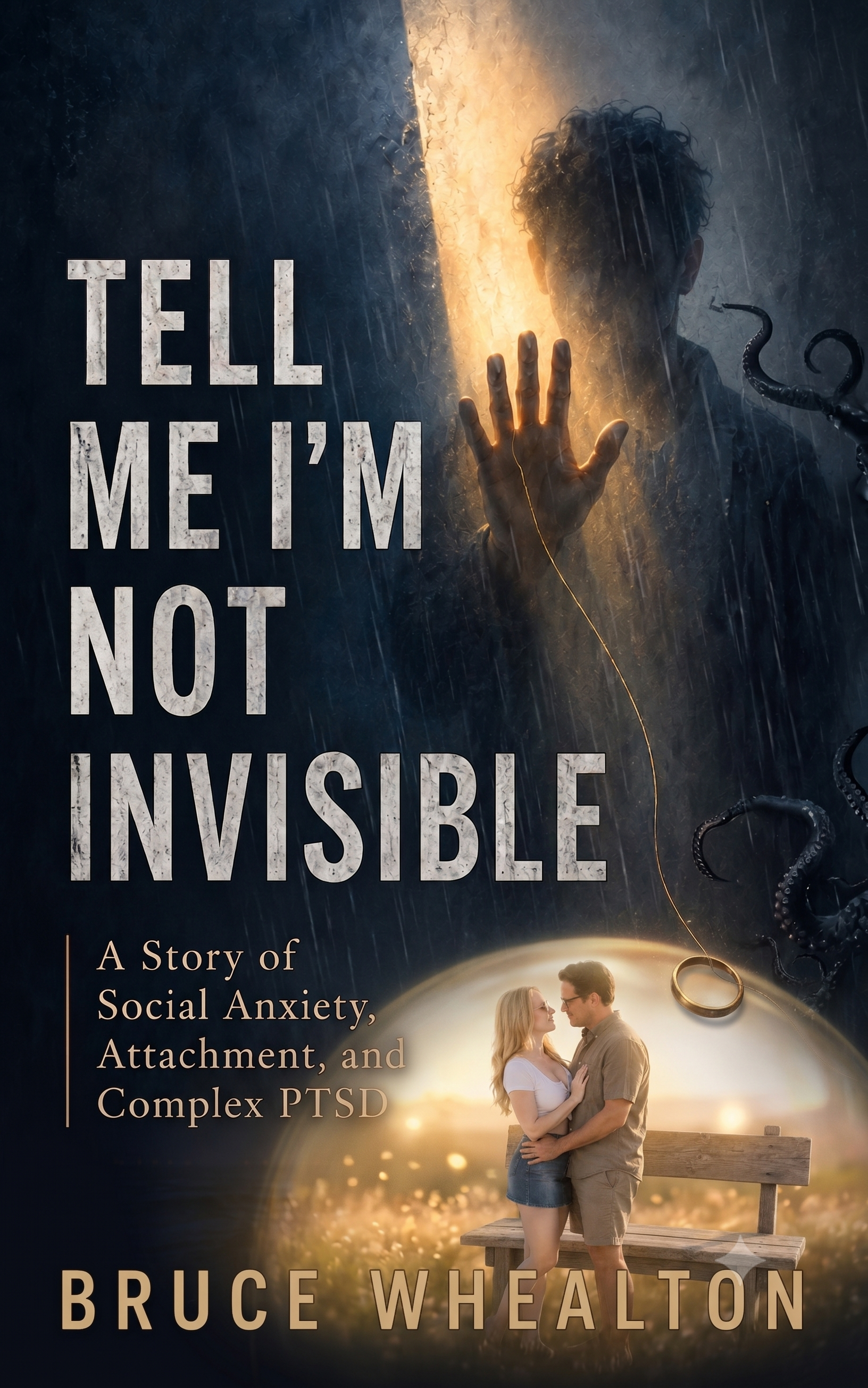
Attachment trauma

Chapter 4: Boy Meets Girl - The Five-Year Journey

Let me be clear about something: it took me four years of weekly therapy to ask a girl out. Five years. That's not a casual mention - it's the central fact of my college experience. While my engineering classmates were designing circuits and solving equations, I was learning something far more fundamental: how to be human in the presence of another human being.

The details of this time period are a blur to me. As much as psychology was helping me overcome the past life that was defined by being invisible and hiding, I was still living a life that was not very memorable for the most part. It’s not that I have a bad memory but there was so little that would create lasting memories for me.

By my senior year, when I finally worked up the courage to ask Michelle for lunch, I had become a different person entirely. Not just socially - fundamentally. The transformation was so complete that sometimes I couldn't believe the terrified, silent freshman and the confident senior were the same person.

But I'm getting ahead of myself. The point of starting with this scene - me asking out the girl with the John Lennon glasses who worked at the campus post office - is to show you what was possible. Because when I first sat in the Counseling and Career Planning Center as a desperate freshman, dating existed as a vague goal, but my self-esteem was so low that actually asking someone out seemed as far outside my capabilities as designing a computer processor. I could see that others were doing it, just like others were designing computer chips, but they knew something I didn't yet know.

The Weight of Never

Throughout high school, I hadn't dated. Not once. It wasn't that I didn't want to - the longing was there, sharp and constant. But wanting something doesn't mean you believe it's possible. For me, the idea of approaching a girl, of risking rejection, of exposing my fundamental awkwardness, felt impossible.

I carried the unbearable weight of shame over my shyness and my crippling inability to converse - a secret burden I couldn't share with my parents. Their departures from Georgia Tech were curt, mechanical, laden with the same cold detachment I had always known.

What I understand now, through the lens of trauma therapy, is that my dating paralysis wasn't really about rejection. It was about attachment. Having never experienced secure attachment with my primary caregivers, I had no template for intimate connection. The very idea of being chosen, of being someone's first choice, felt not just unlikely but literally incomprehensible.

I was avoiding situations that might trigger anxiety, which meant I wasn't blushing or experiencing racing hearts around girls - because I never got close enough to them for those symptoms to emerge. Avoidance was my primary defense mechanism.

If I didn't know for sure that someone was interested, I wasn't going to take the chance. But how could I ever know for sure without taking risks I wasn't equipped to take?

The Therapeutic Journey

Every week for five years, I sat across from my counselor and dissected human interaction like we were studying a foreign language. Because that's what it was for me - foreign.

We talked about "free information" - those casual conversation starters that neurotypical people seemed to access effortlessly. Weather, classwork, current events. Things that didn't require deep vulnerability but could open doors to connection.

We practiced active listening - reflecting, rephrasing, asking open-ended questions. I took notes. I had homework assignments. Learning to connect became as structured and deliberate as learning calculus.

The therapy group was revelation. Here were other Georgia Tech students - brilliant engineers and computer scientists - who felt as lost as I did in social situations. We role-played conversations, practiced assertiveness, and slowly built the courage to speak up in class.

I carried a pad of paper everywhere, using the Three-Column Technique from Cognitive Behavioral Therapy. Column one: the catastrophic thought ("She'll think I'm weird"). Column two: the cognitive distortion (mind-reading, fortune-telling). Column three: the reality check ("What's the actual evidence for this belief?").

Page after page, I battled the voices in my head that told me I was fundamentally unlovable.

The Post Office Girl

Michelle intrigued me. She was quiet like me, but there was something warm in her demeanor that suggested the quiet came from thoughtfulness rather than fear. She wore those distinctive round glasses that reminded me of John Lennon, and there was something mysterious about her - a depth I wanted to explore.

We worked together at the campus post office during my senior year. By then, I had learned to make friends easily with my coworkers. I could joke, share stories, be open about my feelings - as long as I knew romance wasn't on the table. Friendship felt safe. Dating felt like stepping off a cliff.

But Michelle was different. I noticed she never seemed to have a boyfriend picking her up after work. I noticed how she struggled with eye contact the same way I did. I recognized something in her - a familiar shyness that felt like looking in a mirror.

For weeks, I would stand outside the student center after our shifts, trying to build the courage to ask her to lunch. The Three-Column Technique worked overtime:

Column One: "She'll say no and think I'm pathetic." Column Two: Fortune-telling, mind-reading. Column Three: "She's been friendly every time we've talked. The worst that happens is she says no, and then I know."

The First Date

When I finally asked - "Do you want to go for lunch?" - and she said "Okay," I felt something I'd never experienced before. Not just relief, but a kind of bewildered joy. Someone had said yes. Someone had chosen to spend time with me.

Walking across campus together felt surreal. I kept scanning the crowd, looking for friends to witness this moment - not out of pride exactly, but out of disbelief. Was this really happening? Was I really walking with a girl who had agreed to spend time with me?

Then came the money situation - me fumbling through my pockets, realizing I hadn't brought enough cash. The shame was overwhelming. Not just because I'd broken some dating "rule," but because it confirmed every fear I had about not being enough.

When Michelle offered to pay her part, she wasn't angry or disappointed. She was understanding. But I couldn't receive that grace. The critical parent voices in my head - actual recordings of my parents' disapproval - played on repeat. I had one chance, and I'd blown it.

I never asked her out again. That might have been worse than forgetting the money.

The conversation that never happened

I've played over in my head the fact that I never did anything other than drown in embarrassment for forgetting to have enough money to buy lunch. What I could have said that might work could go like this:

"Michelle, can I explain something?" I would ask.

"Sure," she would answer.

"I am thinking that I can't ask you out again because of the thoughts going through my mind. Let me explain. It's embarrassing. You see me looking confident as I talk to people at the post office, the way Mike and I laugh. I speak up with the manager and others.

But I am shy. I wish I had made sure I could pay for our lunch when I finally invited you. I was feeling so good as we walked across campus. Being seen with you..."

"Can I try this again tomorrow? Otherwise, I will wonder if this was even a date and I will be too embarrassed to ever try."

Realistically, it is probably worth noting that with all the changes in our culture, inter-racial dating is still not as commonplace as one might imagine. And back then, I was told by a white friend that she and her black boyfriend that it wasn't safe to travel outside metro-Atlanta.

To me, I saw Michelle as beautiful and attractive. I may have made an unwarranted assumption that others agreed. I probably thought, "let me just get a date and later I can worry about whether people will approve and if not what they would do."

Chapter 1: The Birth of Shame

Before I ever knew the word for "shame," I had already absorbed its weight. Not from a single moment of humiliation, but from a slow erosion of safety—emotional neglect that left me starving for comfort, for gentleness, for someone to notice my fear and say, "You're okay."

The earliest years of my life are not defined by memories but by their absence—by the hollow space where warmth should have been. And in that silence, shame grew. It would shape the way I spoke—or didn't speak—the way I looked at others, and how I would eventually disappear from my own life without realizing I was gone.

One might think that "nobody remembers the earliest years of their life," but I am talking about what I knew when I was very young—that I would not have fond or happy memories with my parents.

The earliest years of life can only be discerned from secondhand stories we're told. As a toddler, my parents bought me a fire truck, and when it made a sound, I was terrified. I can only imagine, from the story and my later experiences, that I wouldn't have received the comfort I would have offered a child myself. No soothing words telling me everything was okay and that I was safe. Instead, my parents told this story with frustration, lacing their voices.

It's the opposite of how I respond to my cat when a pot or pan falls to the floor and startles him. I gently call him back with soothing sounds: "Come here, Kitty, it's okay, you're okay." Yes, I named my cat Kitty.

These were the years of emotional deprivation.

The Birth of Shame

My earliest memory is of water.

Learning to swim with an instructor who was in her late teens or early twenties. I am four or five. The indoor pool at the Y. The warmth of the water against my skin. The vastness of it—stretching beyond my reach.

I remember floating near the wall, small and weightless. Swimming toward the instructor. Then, a moment of panic. The deep end offered no bottom to secure myself. My arms flailed; my breath caught in my throat.

I saw the instructor was nearby. I don't know what gave me courage, but I leapt. I wrapped my arms around her, clinging to her like my life depended on it. She steadied me, her arms firm, unshaken. My heart pounded against her shoulder, but she didn't let go.

I was safe.

But something else lingered. Not just relief. Something deeper. Something I wasn't meant to have.

I wasn't supposed to know what it felt like to be held. To be protected. To be cared for. And even at four or five years old, I knew that.

That is the birth of shame.

This was the first time I knew what it felt like to be held—and the first time I knew I wasn't supposed to want it. The indifference I knew from my family told a story about who I was and how I should think of myself.

The House of Unspoken Rules and Child Abuse

I don't remember my parents ever holding me like that swimming instructor.

In my family, affection was something distant, implied rather than given. Love was duty. Gratitude was expected. Respect was mandatory and not earned.

My father, Bruce Sr., was a man of unshakable silence. He believed actions spoke louder than words, but his actions were cold efficiency—he provided, and that was enough. My mother, Kathy, was a storm you learned to anticipate, never knowing when lightning would strike.

There was a chill in the air, a tension that wrapped around me like a vice. It was the kind of silence that demanded submission, not understanding.

I never looked directly at my father's face. I kept my gaze down, or slightly averted, as if instinctually avoiding something dangerous. The thought going through my mind was that I should not expect an easy explanation of what I did wrong. My mother's nature was more volatile, though that would become more obvious later in life.

I felt that I was being met with a general sense of disapproval for being.

Later in life, I would become incredibly skilled at reading people's body language. I had so much to learn because I purposefully chose to avoid observing the looks of general disapproval.

Refuge and Frailty

Our maternal grandparents were our refuge, our shield. They moved in with us when we were very young. Grandpa had my mother when he was 48 and my Grandma was 40, which meant that when I was born, my grandmother was 66 and Grandpa was 72. For whatever reason, they didn't age well, which shaped my impression about what it meant to get old.

On one hand, they were a refuge just by their position as parental figures to my parents. On the other hand, they were frail. My grandfather had lost his vision. This created a sense of distance that is uncomfortable for me to write into words. I remember the skin hanging off my grandmother's arms, her legs were discolored, and she had a scar or mark on her leg. Grandma was staying in the dining room that had been converted into a bedroom. She needed a walker to get around. Grandpa stayed upstairs.

In retrospect, I wonder now what could have reduced them to such weakness. This distance that existed as a result of me seeing them as old and unhealthy kept me from having the true relationship that many children have with their grandparents. To this day, I am shocked to discover that some people are grandparents who don't bear any of the signs of what "old" was imprinted upon my childhood mind to mean.

I remember Grandma standing up for me—her frail voice telling my parents, "Don't hurt him." I might have been 10 years old at that time. That small moment, that whisper of resistance, was the only time someone tried to intervene.

Grandpa would worry about me lifting too much when I joined him to take out the garbage once a week, stacking the garbage pails in a way that would ensure dogs couldn't get into them. He was very protective of me and worried about me getting hurt. I was concerned about not being a wimp or a sissy—which is not what Grandpa intended—but being a tiny boy made me feel a pull away from being seen as weak.

The Art of Hiding

I began to hide. In Kindergarten, I literally hid behind a chair instead of walking up to the front of the room with my milk money.

We lived in Southington, Connecticut, near the end of a dead-end street. There were woods around our home, a small mountain (Ragged Mountain), and trees to climb. This offered a way for me to hide by myself in the woods.

Around this age, there was one incident where a few boys taunted me. This would not be repeated. My life was not defined by any form of bullying or torment from other kids.

I recall at about age 8 or 9, my mother ushered me out to play with the neighborhood kids after school. I found a telephone pole and hid behind it, my small body pressed against the rough wood, hoping no one would notice me. The world felt too big, too loud, too dangerous. Maybe if I just stay here, no one will notice. Maybe if no one sees me, I can't get hurt.

A Brief Respite

Then the world felt safe in third grade. I was still thin, but I wasn't afraid. I had a friend, Paul Plourde, and that made all the difference. His presence was like armor—with him beside me, I could face anything.

One day, I sat at my desk in Mrs. Felt's classroom when a girl named Donna stood up and declared, "I like Bruce!" My face burned crimson. Then, to make things worse, she leaned in and kissed me on the cheek. Back then, before 5th or 6th grade, boys didn't like girls. The age-old idea of girls having cooties was part of our culture, this bizarre notion that we could get infected by being touched by a member of the opposite sex who was the same age as us.

When Donna said this, the class erupted in giggles. Heat crawled up my neck, spreading to my ears. I didn't know what to do, so I said the first thing that came to mind, the thing I thought boys were supposed to say: "I hate girls."

Mrs. Felt chuckled and turned to the other teacher in the room. "Aren't they a cute couple?"

It's strange, the game we played when we were kids. When did it change—by 5th or 6th grade, when it was suddenly okay to admit that you liked girls?

Section One: The Past and Early Years of My Life

Dear Reader,

I've spent years studying the craft of writing, and I know that a compelling narrative should evoke emotion and draw you into the story through vivid scenes and immersive detail. I've also been studying the latest research in psychology and neuroscience that has profoundly influenced how I understand and tell my story. Yet for this first section, I must break a cardinal rule of storytelling—I will be telling you rather than showing you much of what happened.

This isn't a failure of memory or craft, but a consequence of survival.

Through a combination of dissociation (what laypeople call "blocking out memories") and years of intensive therapy, the specific details of repeated physical assaults by my parents—and yes, I use the word "assaults" deliberately, as these were not punishments but acts of violence—have been processed, metabolized, and in many cases, dissolved. What remains are the memories of having nightmares about these events, the somatic imprints of fear, and the knowledge that these things happened without the accompanying sensory details that would make for gripping narrative.

When my sister engages in gaslighting about our childhood, the confusion isn't about which particular incident she's disputing—it's that there were so many that they blur together in a haze of normalized terror.

This section chronicles my journey through shyness, social anxiety, and what might be best characterized as social phobia – a fear so complete that it required total avoidance. Paradoxically, by avoiding what I feared most, I never experienced the typical anxiety symptoms others describe. No sweaty palms, no racing heart as I contemplated asking someone on a date. Instead, there was simply... absence. A void where connection should have been.

I'll share stories from my college years, including my experiences with two young women I dated—each relationship lasting exactly one date—as I began the slow work of emerging from my invisible shell.

The background in this section is essential groundwork. At twenty-three, I experienced what felt like waking up for the first time in my life. We're not there yet. That awakening, that full immersion into living—that begins in Section Two, where the narrative becomes what you'd expect from a memoir: immediate, sensory, emotionally resonant.

Recent research, as Lisa Feldman Barrett explores in "How Emotions Are Made," reveals there are no single necessary characteristics of any emotion. This understanding has been crucial in making sense of my own experience—why my anxiety didn't look like textbook anxiety, why my trauma responses were more absence than presence.


For now, I ask for your patience as we traverse this necessary landscape of context. Think of this section as the foundation upon which the house of my story will be built. Some details might feel sparse, but they represent what remains after the essential work of healing has been done.

Preface

Audiobook Preface

Preface

I spent twenty-two years learning to be visible, only to discover that becoming real is not the same as staying real.

As a very young child, I hid behind a telephone pole when my mother told me to go play with the other kids. Not because I was playing hide-and-seek, but because without a secure base at home, I didn't know how to reach out to the world. I climbed trees and disappeared into the woods—not to escape the neighborhood, but to escape my parents. From the sudden punch or kick that could come out of nowhere. From parents who built a pool and took us to Disney but never once asked if I was happy, never seemed to notice or care who I actually was. 

Even as a child, I could see the disconnect—the performance of family for the outside world, the indifference behind closed doors. By fourteen, I was asking questions I had no language for yet: Why are you doing these things for us when you don't actually care? The only time I remember being held was around age three or four, in swimming lessons, my arms wrapped around the young instructor's neck, and even then I felt certain I didn't deserve it.

By high school, I had perfected invisibility. I sat silent in classrooms, never called upon, a ghost among my peers. I went away to college and immediately started counseling—not because I believed I could change, but because I couldn't keep living this way. I set goals: speak in class, ask someone out. 

For most of my undergraduate years, I remained the third person with every couple—best friend to both the boyfriend and girlfriend, even best man at a wedding, but never part of a couple myself. I finally got two dates my senior year—one date each with two different people. I never spoke in class. I'd come so far, but something fundamental was still missing.

Then, in 1990, after graduating from Georgia Tech, I was seen through the eyes of love. For the first time in my life, I had proof that I was special, that I mattered, that I was real. It was the missing piece—the experiential knowledge that no amount of therapy alone could provide. She died at the end of that same year, and for a time I wondered: what good is it to find this love and have it taken away so suddenly? But something had awakened in me that couldn't be undone.

In April of 1992, I took a microphone and read poetry, choosing to be the center of attention for the first time in my life. Three months later, I met Lynn. What followed over the next eight years—from 1992 through 2000—were years of success and joy beyond my wildest dreams. Graduate school in 1993, becoming a therapist in 1996, full licensure in 1998. Leading therapy groups and counseling couples despite having gotten only two dates in all of college. Building a life with Lynn—enduring love and earned secure attachment, learning in adulthood what I should have known as an infant. 

I want you to understand what's possible. I could have become like so many others who can only connect with narcissists like their parents because it's familiar. I want to show you that it doesn't have to be that way. That even from a childhood like mine, you can find real connection, meaningful work, genuine love. The kind of success that looked, for all the world, like I'd been cured of my past.

By July of 2000, everything seemed perfect. By September, I'd lost it all.

And that's when I learned what I'm still learning now: psychological wounds don't heal like broken bones or diseases cured by vaccines. You can grow, transform, build a beautiful life—and then lose it and discover that all your old patterns are still there, waiting. Letting my parents back into my life recreated the trauma of childhood. By my mid-fifties, I finally did what I should have done decades earlier: I cut off all contact with my family. This is the story of learning to be real, forgetting I was real, and finding my way back—not to where I was, but to something I'm still discovering. This time, with tools I'm learning to use.

My Invitation

Have you ever felt invisible? Not just shy or like a wallflower, but truly unseen—not noticed, not known for who you really are? Noticed social anxiety in yourself? This book is for you.

You might also recognize yourself here if you grew up in a home where you had many things, but your feelings were never validated or didn't seem to matter. Where everything looked normal from the outside - maybe you even say things were good, you weren't abused—but somehow you became responsible for a parent's happiness or emotional needs. That's called covert narcissism, and it's more common than you might think. And narcissistic patterns don't only show up with parents, they can appear in partners and other relationships throughout our lives.


This isn't about blaming parents. It's about understanding what happened and finding your way forward. As the title states, this book covers Complex-PTSD and/or Developmental Trauma—regardless of where those wounds originated.

You may not relate to everything in these pages—everyone's experiences manifest in different ways. Because we have much to cover, take it slowly. I hope you'll relate and know you are not alone.