
assault

Introduction: Starting At The End & Suicidal Ideations

Dear reader: This book is a true story of the life I have known. I am writing to you to share this story in the hopes that we can make sense of things. I will share with you this story on the web, and you will have a way to respond to the questions that will arise.  

I do have a favor to ask you though as we discuss these events. Please, be very specific. I will do the same for you. What I mean is that I won’t use platitudes about how “there is hope” or “things will work out.”  I am going to tell you about some very specific experiences that I have had, and I am going to speak with brutal honesty. I am going to be detailed and explicit - meaning, I must apologize if you are someone who thinks in terms of certain abstract ideas.     

Something amazing happened to make it possible for me to bring this story to you. It was Monday, December 16, 2019, and someone saved my life tonight. So, if I sounded bitter in the previous paragraph, I apologize. Let me tell you how someone saved my life. Then we will see how that relates to love, kindness, nurturance, compassion, and empathy.

I was in the hospital at the University of North Carolina Medical Center in the psychiatric unit. I had meant to end my life a few days ago. My ex-wife found out because I told her. I had expected that it would be too late when she got the message.

On this Monday morning just after midnight, I was absolutely convinced that nothing can be done to change my circumstances and that there is no hope. I knew that I would be released soon and then I won’t fail in my next suicide attempt. Visions of a slip noose swings in my mind along with other ideas – pills.

I can’t sleep. I’m restless… sitting in a large, darkened room just past midnight – a common room. The hospital is quiet. 

My ex-wife had been angry that I considered suicide, but she understood why I had been that desperately depressed. Yes, I have been through hell but that was in the past. This is not about past pain. That doesn’t matter. No one can help remedy the situation because no one understands. 

This is what was going through my mind when this girl came out. 

“You can’t sleep either?” she asks and takes a seat next to me to talk. A simple question that started a process that made this book possible!

This is interesting… because for some reason, I am thinking that I should tell her my story. I have no idea where that idea arose. I am listening to her. I remember her name is Kirra. No, I’m not going to tell you her last name or why she was there. Confidentiality is important. 

She seemed at the time to be drawing a story out of me. I felt compassion and empathy for her situation as well. There is something about the problems she has been facing that reminds me of someone who was very special in my life in the past. I can’t say what that is because it would reveal something about her that should not be made public with this book.     

I felt an overwhelming need to tell her how I had been harmed in the past. I told her how I had been victimized by a woman who brutally attacked me and then lied and said that I attacked her!  And if that lie was not bad enough, she said I tried to undress her which meant that I was charged with a sexual offense! 

I explained how I would NEVER do anything to hurt someone. I was a therapist who understood how traumatic events affect people. And in fact, dear reader, you will see this when I show it to you throughout this book. 

She said, “I believe you, one hundred percent.” She had demonstrated understanding of what I had been feeling – empathy.

My first reaction was a thought that floated through my mind, “of course you do… what person who has spent any time at all with me would think I would harm a person.”  That is what I was thinking.   

I had held the weight of this pain for more than a decade and a half. I held it almost all alone. I asked questions about how it is that we come to know these things about a person. Indeed, there are subtle cues or clues that we pick up that tell us about danger. She used the word “vibes.” 

She seemed like she wanted to help me and to be my friend. She was much younger than me, so I wasn’t thinking in romantic terms about this friendship. She just said she wanted me to join her and sit with her at breakfast in the morning and at other meals. Love takes many forms.

She also understood why events from the past did have a tremendous impact on my life in the present. I had described my passion for helping others and working as a therapist… and working in the mental health/psychiatric field. 

I wondered why this wasn’t so clear to everyone. 

My plans to end my life suddenly evaporated. I had hungered for this as truly as we can be starving for food or air! 

I came alive. So much more was offered to the patients on the unit during the week. I arrived on Friday night and there were not many therapy groups over the weekend. I started connecting with others during therapy groups, at meals, and as we, the patients, socialized.

 It was a transformative experience. The world had seemed like a very dark and cold place devoid of human compassion, but I was observing how caring people here were. I’m talking about the other patients that I was meeting. 

A couple of days later, we were asked to pick a feeling word to describe how we feel or what we were experiencing. For some reason, I chose to use words like “outsider,” “alone,” “unnoticed,” and “invisible.”

The response from the group caused my jaw to drop. I was told that I was actually like a “social butterfly.”  That I had been at the center of all the action. Another person said I persuaded and encouraged him to come to the group. 

Indeed, this was a transformative experience. I had been noticing others and listening to them. I had encouraged someone to come to the “group” because I was concerned and also, I felt that it works better if we can be there together for each other.

There was one other important and memorable event. Some of us were watching Law & Order: SVU. There was an episode that portrayed a teacher who loved teaching children who were falsely accused of sexually molesting one or more children. The visceral pain of this was exquisite. As someone who worked as a clinical social worker, I could recognize that pain from the way it was portrayed to the way we think about having that happen to us or another person.

I wanted to tell some others the experience I had and how I had been harmed by a lie of this nature. I approached two people who stepped out during a commercial break and I said I wanted to share something with them.

I explained how I had been falsely accused and falsely convicted. By that time, they knew that I had worked as a therapist. They knew how much I loved that kind of work or those kinds of activities and experiences. 

Beginning with Kirra and then with others I was telling my story and finding the support that I had needed for so long. I had tried to carry this burden all alone and now I was finding opportunities to unburden myself of this exquisite pain. They and others in the hospital, patients, and staff showed love, compassion, and empathy which is precisely what motivated me to go into psychiatric social work.

So, many people would tell me that the terrible events were in the past and that I shouldn’t let it bother me now. I shouldn’t dwell on the past.

Excuse my language dear reader, but that is such bullshit! The lies of that woman who attacked me in 2004 – the false accusations, the false conviction – affect every aspect of my life in the here and now. Those lies are etched into stone metaphorically speaking. Before we talk more about love and empathy let me add a few points. Bear with me just a moment.

The pernicious lie suggests that people should worry about did or might do in the future. It’s on a North Carolina Public Safety website. This is the modern equivalent of something being etched in stone.

The criminal record presents me as the perpetrator of the crime, but it has no basis in reality. I had been the victim! It’s still out there and I had been told by a law firm that there was no hope for me that I would ever get justice… When I heard that cold statement from a lawyer that no one could do anything, I didn’t hear the full story. I just heard no one can do anything – there was no hope!

You may disagree strongly with my choice to try to end my life in 2019 but ironically that was the only way that I was able to have this transformative experience. The world had seemed to be dark, cold, and devoid of caring people… devoid of compassion and empathy. The empathy, love, compassion, I developed over a lifetime would not be available to anyone were it not for what started with “a story.”

So, that’s what I am giving to you as a gift – a story.

Over the next year I continued to write “my story” and this is what you are reading now. I hope you understand, dear reader, why abstract ideas and platitudes are not every helpful to me. When I hear “things are going to be okay” said to me without first acknowledging the pain and without pragmatic statements about how things are going to be okay, I just think you are not offering empathy and compassion. 

In my life experience, I have learned how to specifically figure out what a person needs or desires. I have learned to understand how that changes from moment to moment. I have learned how to recognize needs, things that we hunger for and desires almost instantly. 

This is how I act from a place of love!

As a psychotherapist, I have developed certain instincts that are almost like common sense for me now. I would NEVER imagine telling a client or a patient what I think is good or a good life. I learned about active listening.

I know for a while there it seemed like I was angry but that’s not the full story! We haven’t gotten to love if we stop at anger and that’s all you see or hear.

Human beings are imperfect and the systems we create are imperfect. So, it’s not good enough to just go home and say we didn’t break any rules. The bigger issues begin with a question like did we act with love? Did you consider that you could be wrong? Did you consider how that might affect another person?

I would argue that love can be a quality that is the foundation of all societies and all people everywhere in one form or another. A psychotherapist or psychologist might use the word unconditional positive regard.

Certain social workers will speak of social justice because we recognize what happens to people and how they feel, how they experience life when it is lacking. That’s empathy.

True empathy, true love, and true compassion reject ideas like “nothing can be done” or “that’s just the way it is.” That’s injustice. 

Love comes in many forms though. A mother and father's love are demonstrated in the way they nurture a child. I know I didn’t have that growing up. So, I hungered for it. You will hear about some special people in my life. A special friend, a girlfriend, a fiancée, a wife. Sadly, there was some tragedy in my life so you will hear about a second wife.

When I was immature, I thought I wanted a strong protector. The seed of change in that regard was planted in my mind first by a grandmother that was very week and an elderly grandfather. Their strong love and concern for me showed me there was more than strength that matters – at least more than physical strength.

You’ll hear about my first special love with a young woman named Celta who cuddled with me, nurtured me, comforted me – loved me. We were drawn together by the love language of physical contact and spending time together. By physical contact, I am not necessarily speaking of sensual contact.

In my twenties and thirties, the love of my life, Lynn Denise Krupey, like me, recognized that we felt love through physical contact and spending time together.

There are many ways forms of love but those needs, desires or what I hunger for, may have influenced my choices when it came to romantic or certain forms of emotional love that we feel with someone of the opposite sex.

Obviously, I played other roles in life. I was a Clinical Social Worker, a psychotherapist. I didn’t cuddle with my clients. However, I did recognize the strivings and desires of people – the motivating forces. I recognized desires and needs that change from moment to moment. As a social worker, if someone is hungry for food, you try to get them food. You get the idea.

You will notice a theme in this book related to my exquisite awareness of the needs, desires, feelings, and emotions of others. These are things that can change very rapidly. Believe me, I have seen people’s emotions change in fractions of a second. I had those capacities firmly in place when the bad things to which I alluded to above occurred. Someone like me would not be the cause of harm to another because I would know what another person is experiencing.

I will show you how I instinctually react to the needs and desires of others instantly.

As a way to help you get a sense of the many experiences of love, we can start with an example. There are many forms of love. However, if I tell you I’m going to tell you a love story, you get an idea as to what I mean. Maybe you are already feeling a sense of anticipation. Yes, love stories feel good. So, let’s start there.

A Love Story

I was once so paralyzed by shyness that I honestly never believed I would EVER find anyone to love. Luckily, I was wrong - I fell madly and passionately in love.  

July 4, 1992. Nearly three months since I moved to Wilmington, North Carolina.  

I was with Lynn.  

There is a jetty that runs out to a tiny island south of Carolina Beach where the Cape Fear River meets the ocean. It is the farthest point south if you drive down Highway 421/Carolina Beach Road from Wilmington, North Carolina.

It was our first date. Sort of. If you can call it that way. I never had any dating experience, mind you. And I reckon Lynn never had a great deal of experience either. Since I was driving, I asked if she wanted to go to this scenic spot. She agreed.

So, I parked the car near the beach there near that jetty.

We were talking about how during low tide the jetty acts as a bridge over to a tiny island that is like a mini-animal conservation area. The water gently washes against and over the rocks but if the tide is low, like today, we could walk out to the island.

The jetty is not on the open ocean, so the waves only gently lap against the beach and the rocks that form the jetty. It is just a bunch of rocks that have been stacked against one another to make a bridge of sorts. The pavement that layered the stack of rocks made the bridge more accessible.

A photo of one such jetty/bridge is shown below.
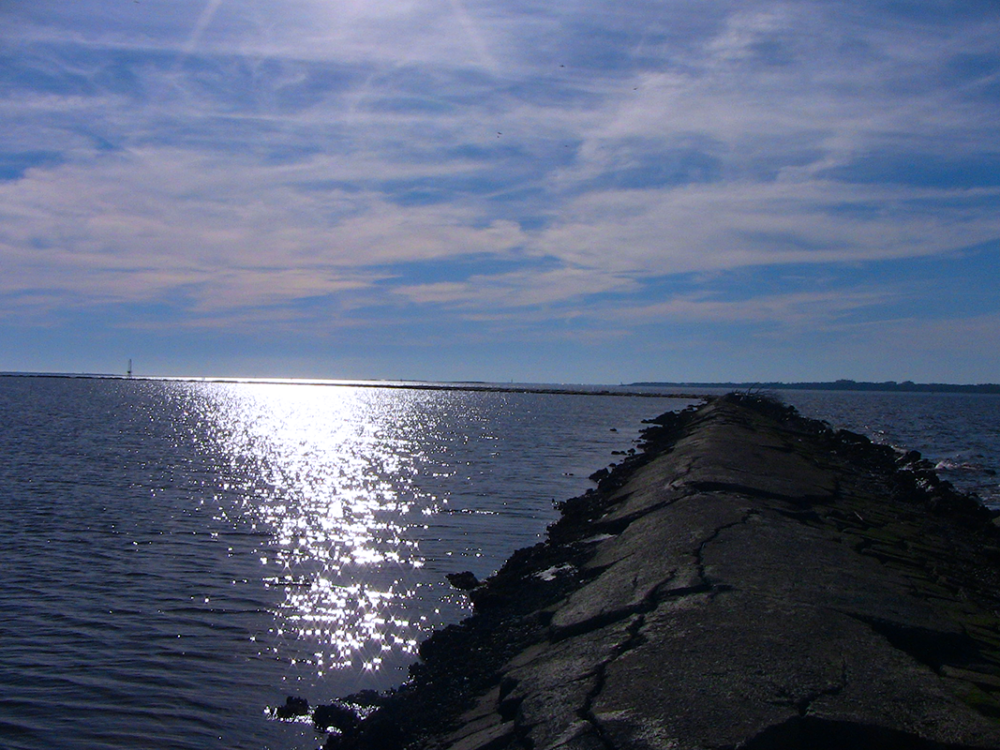
The Jetty visited Lynn and Bruce Visited on their first date

I had just moved to Wilmington in April and I wanted to get to know the people there. So, I started attending poetry reading sessions. They were held at the lounge on the fourth floor of the convention center which overlooks Cape Fear River.

There was something serene about the setting that made it comfortable for me to get up in front of a group of people and read my poetry. The sun would reflect across the Cape Fear River casting the soft rays into the room. Dusty, the emcee for the poetry reading sessions who works at the center, made it easier too. She has that magical quality of attending to the guests of the Convention Center whether they were there for the poetry or not. Her caring ways equivalent to that of a loving mother always make us feel welcomed and comfortable.

Sharing my poetry in front of a group was an impossible accomplishment. As a psychotherapist, I would have to lead therapy groups so being able to read my poetry to a group was perfect evidence of my ability to accomplish something that had seemed impossible. My ability to get up in front of a room of people every week was an amazing feat. This was something I never had the guts to do when I was younger. I never wanted to place myself at the center of attention.

I would see Lynn every Sunday at the poetry readings at the Coastline Convention Center. For me, she stood out among all the attendees that were present there. She was thin but shapely.

Cystic Fibrosis – a genetic disease. I overheard her talking about that. That was why she was coughing all the time.

I had come sharing poems about Celta, someone I had loved, and lost. I wasn’t expecting to make a romantic connection. Something about Lynn caught my attention.

What was it about her? Did I already think that she was the most beautiful girl imaginable? Do I dare admit to myself that I am entertaining such irrational thoughts? I never thought of it as some kind of love-at-first-sight but there was something about her that intrigued me. Of all the people I held in high regard, Lynn was that one person that seemed to challenge that perspective.

Her voice was hypnotic and alluring. She had all the things that one considers in feminine beauty and shape or so it seemed to me early on. She seemed perfect. I loved her voice - both when she was at the microphone and when I was close to her. And her face, her skin, her legs seemed like gentle features I might have created in my own mind if I had the imagination to do such a thing.

Yet, I noticed she was alone. I guess that was one of the reasons why I was so lucky.

It took me some three months to find the courage and the right words to ask her out. I waited to see if she already had someone else. I wanted to avoid being rejected. I can still feel the fear now as I write this some twenty-eight years later. I guess that was a sign of how much I wanted this to work out. It was scary.

Asking Lynn if she would spend time with me was an accomplishment.

So, here we are, at this gentle beach on July 4th.

I did not expect the pavement to be this slippery. It was a cause of concern for me but not because I was afraid of falling. It was imperative that I must not let her slip and risk bruising or scratching her perfect skin. Putting my nervousness aside, I offered my hand.

She took my hand.

She took my hand!

Wow!

You must be thinking that I am exaggerating but this was amazing! Her gentle hand around mine!

“Do you want to keep going?” I asked.

"Sure," she said, pausing to take in the scene with me. Her straight blonde hair swayed in the gentle wind.

We walked a little further but then decided that this was getting too slippery. And dangerous.

What's next, I thought. Jean works at Fort Fischer, a Civil War museum site, and they have a tour around the historic site. We could go there.

It was an amazing day. The first of an amazing weekend that we would spend together.

We saw the fireworks in downtown Wilmington that night, over the Cape Fear River and near the Battleship. My friends regarded me as a pacifist. I suppose Lynn was too.

After the fireworks, we were walking back to the car, passing by the place where she worked along the way. Some co-worker asked her if I was her boyfriend. “No, we are just friends,” she said.

Darn. I thought this was a date. Nevertheless, we were still just friends.

I can wait.

It was the 4th of July 1992, and everything would change from this day forward.

Time has a way of changing fates. We became more than just friends. Over time, we fell madly and passionately in love. Two years after this day in July of 1992, we were picking out an engagement ring for her.

Oh, and I was in graduate school in Social Work. Everything was falling into place. It was perfect.

More than that, I felt things I never knew I would or could feel. It is impossible to comprehend what I felt that day when she first held my hand.

The world was full of hope for me. Anything seemed possible. I had clear ideas about what I wanted and where I was going. So, while it might seem that this was just about my social life and making friends, it was also a vision of life for me in some sense of the bigger picture of what really matters to me.

We would get a home together north of Wilmington on Brucemont Drive. Her mother bought the home and we rented it from her.

I became successful in social work. I became a Licensed Clinical Social Worker - a psychotherapist. I opened my own private practice. I gained respect from my colleagues who told me that Wilmington was a saturated market, meaning there was no need for an additional therapist in the area. The person who warned me that Wilmington was a saturated market and that an additional therapist is not needed had the best of intentions, but it was so great to know that despite all the challenges I found success.

I saw a life with Lynn Denise Krupey. I proved to myself that I could accomplish my dreams. It was all built around me and my family. I dedicated my life to helping others to get back on their feet. I had everything I wanted. I certainly had no intention of changing anything at all. I could not imagine anything different or anything better than this other than more of the same.

Halfway through 2000, a meteor would come crashing down on this life I had tirelessly built upon. The shocking events that began to transpire that year would incinerate everything in my world leaving ashes to blot out the sky. I saw only darkness, the fog of ashes blowing fragments of the familiar home, the furnishings, the words, and dreams.

I was in desperate need of compassion, empathy, kindness, and love but I wasn’t thinking too clearly about where to look for these things and where to find them.

I still believed my so-called family had a capacity for providing what I was needing. I wasn’t thinking clearly. To understand why I should NOT have turned to my parents or siblings, we need to consider what life was like growing up.

Chapter 8: Victimization - Part I

This is a deeply traumatic and disturbing story, one that is both painful to relive and challenging to put into words. As I write, I imagine you, dear reader, sitting beside me—offering quiet support as I share this chapter of my life. What you’re about to read marks the beginning of the most terrifying, unexpected, and surreal events I have ever faced.

Losing Lynn rivals the pain of these events, but it was not beyond my imagination of things that can happen in life. Lynn had been born with a genetic and terminal disease and therefore, while it still surprised me how suddenly things took a turn for the worse with her health, it was not beyond my imagination.

The date was October 1, 2004. I had been evicted and appealed the decision. I just wanted a place to put my belongings. I also was aware of ways in which I could get financial assistance to pay the landlord, Jimmy, what he was due. Back then, everything was not up there in the cloud.

Every written and drawn item from Celta was priceless to me. Every photograph of her and of Lynn and the life we shared... all these things were on film and on CDs. All I had were memories.

I was teetering on the edge of homelessness once again.. My search for shelter led me to what was referred to as a “boarding house” at 721 Holloway Street in Durham, NC. The area had a reputation-it was known as a drug-infested, crime-ridden part of town.

Even Eric Peters, my Vocational Rehabilitation counselor, had reservations about the move. He cautioned against starting a home-based business there, but I had no other options. The boarding house was affordable: we paid weekly, and little to no security deposit was required. That was all I could manage at the time.

Living there quickly proved as precarious as its reputation suggested. The building lacked basic security—doors to the outside were rarely locked, leaving everyone vulnerable. One evening, I made the mistake of allowing a woman into my room. She crossed a line immediately, behaving inappropriately and bending over to expose herself. Snapping to my senses, I asked her to leave.

What followed was surreal and frightening. As I walked to the store, she followed, shouting threats and warning me about someone who would come after me if I didn’t pay her. Pay her for what? I had nothing to pay for.

Discarded needles were on the street in front of the building. I knew it was some form of drug paraphernalia. I have NEVER used illicit substances myself.

I had to run for safety when getting off the bus when I was being harassed on a recent occasion. I was robbed at knifepoint while living there. I had someone indicate they had a gun in their pocket at night on a different occasion.

I had confided in my sister about needing help after being robbed multiple times, but she didn't seem to understand. It would have been difficult to explain to her the concept of not having a car and living in a dangerous city like New Britain, which was closest to our hometown in Connecticut.

She had only experienced leaving work and walking to her car; she couldn't comprehend the struggle of living in a high-crime area because it was all I could afford. Like my sister, I never imagined myself living in such conditions, relying on public transportation instead of owning a car. Mentally, I was in unfamiliar territory and completely unprepared for the challenges I faced.

Despite all the threats I faced and the repeatedly frightening experiences, I had not been physically assaulted, yet.

Not yet!


Jimmy, The Landlord Wants to Know About Dissociative Identity Disorder

There are a few other important facts to know. One is that I had a conversation with Jimmy, the landlord, in which he was asking about my experience treating people with dissociative identity disorder (DID). This used to be called Multiple Personality Disorder (MPD). He, Jimmy, didn’t want to know about the incredibly disturbing trauma that people with this disorder experienced or how emotional and traumatic it was for me to help any victim to cope with this because of my capacity for empathy.

I just mentioned that people with DID have personalities that have different names. I recalled that as a child, my grandpa called me Brucie. Using that example, I said that if I had DID, which I don’t, I might name a child personality or have a child personality named Brucie.

I had the opportunity to see Jimmy’s wife partially when she was inside his pickup truck. It’s important to note that I did not recognize her as the attacker, but I am getting ahead of the story.

This detail is very important - the conversation about what DID (pronounced D, I, D) is all about. I would hear about this conversation later.

I did meet a friend of the family named Grace. I would join her and her two children at Durham Bulls baseball games, and I helped her with her computer. She was a safe and decent person. I once thought Jimmy was decent. She was very attractive, far more so than anyone directly associated with the landlord, which is only relevant to her later encounter with the police.

I had been dumpster diving near the library up the street and had acquired many books, which other homeless people appreciated.

I had books in piles all over the room. My apartment was just a room in the house.

The room is about 18 feet wide by 18 feet from the front door to the back of the room. A wall is set back about eight or nine feet from the door to the apartment room. The wall has an opening on the right and the left as you investigate the room from the door. Behind the wall is a mattress on the floor where I slept.

There was barely enough room in the apartment today. My computer was set up on a desk against the wall, to the right as you entered the room.

About six to eight feet from the door, there is a couch.

I was waiting for a friend to arrive today. She was a black woman, and the woman I was seeing romantically was also black. Let me describe the apartment building better before I explain what is about to happen. Looking at the house from the street, there is a front door and a driveway to the left. Around the back, there is an apartment. Scott stayed there. He got a discount on rent, just like I was getting free rent for working on Jimmy's website. We paid our rent weekly to Scott, and he gave us a receipt.

There is a door on the side of the building that leads inside from the driveway. If you go through that door, you will see the kitchen, which is a common area for cooking meals. Past the kitchen is the bathroom with a shower. An apartment was also down that hallway.

Turning right, you would come to the vending machines that Jimmy kept stocked with sodas and snacks. Before you came to my apartment room, there was an apartment on the right and another two apartments on the left.

Across from my room was the stairway that leads to four apartments upstairs. Next to the foot of the stairs was another apartment.

It was an all-male boarding house, but females were there offering sex for money. I mentioned an unsuccessful attempt by one woman to get me to accept her service(s).

I had come to feel like the perfect victim. It’s not untrue that people can sense vulnerability. The urban scowl is something a more confident person might use during the day to walk quickly and with purpose if they found themselves in a potentially dangerous part of town. I had sensed danger at night and had run as fast as I could to my “home” - imagining that getting inside this boarding house at 721 Holloway Street would be safe.

However, getting inside was not always safe. In addition to the encounter with the prostitute, I had seen the police use tear gas to get a gun from a resident.

My door was open as I expected my new friend to arrive.

I learned about a phenomenon called the "cocktail party phenomenon" years ago. When you hear your name, it can penetrate the cacophony of other sounds. We can hear our name if it is called out, even in a busy and somewhat loud room full of people talking. Something causes us to immediately turn in the direction where we heard it.

I noticed this instant attention-grabbing effect years ago after I first learned about it. I was walking to class, deep in thought, when I heard "Bruce." Immediately, my attention was caught, and my head turned in the direction of where someone had called out my name. The person must have been a couple of football fields away.

That is what happened next. With my door partially open, I heard the words, “where’s Bruce?” coming from outside my room.

Without thinking, I opened my door, stepped into the hallway, and said, "I'm Bruce."

A woman stood a few steps up the stairway leading to the second floor. She was NOT the person I was expecting. She was standing half-way up the stairs, asking Danny who was just another tenant that lived on the second floor. Other than her being white and not who I was expecting, there was nothing distinctive about her, and I had no idea who she was or why she was looking for me.

Time froze for about one second… enough for me to register my confusion and to wonder who is this person that seems to know me?

Her eyes locked onto mine and she charged at me, coming down the stairs and around a corner as if propelled by a ferocious determination. I was frozen in shock, unable to react before she burst past me, entering my apartment.

I stumbled after her, walking past her and into the room just as she slammed the door shut and turned the lock, trapping us both inside. Before I could assess the situation, her fist collided with my cheek in a brutal punch that sent me reeling.

The blows kept coming, one after another in a flurry of violence that sent my glasses flying across the room. I could feel blood beginning to flow down my face as she continued to unleash a relentless assault on my face, leaving me battered and disoriented.

I was dazed and shocked. I staggered backward with each blow. There wasn't much room between the door and the couch where I fell. I was shocked by the fact that a woman would lock herself in the room with me, then attack me (someone who I didn’t even know), and I was shocked by the blows to the face.

She shouted, "Why do you keep calling me?"

I answered, immediately, "Who are you?" with genuine shock in my voice. I was wondering who the heck was attacking me. And why?

I was hurt badly. Blood was pouring out of my nose and across my face almost immediately.

Was she high on drugs?

I managed to get to my feet and noticed that there was a distance between us. I used the opportunity to move forward and unlocked the door that she had just locked. Then, I pulled her toward the door, trying to get her out of the room.

At some point, I brought my hand to my face and noticed my hand was smeared with blood. As I pulled her toward the door and outside, I touched the door frame for balance and I left a blood-smeared thumbprint on the door frame with my right thumb.

She didn’t have a scratch on her. I had not even hit her at all or defended myself in any way. I had always been non-violent, peaceful. I had never been attacked at all much less in such a bloody way.

One might ask why I didn’t fight back? There was something instinctual in me about not hitting girls or women. I never had to consider a moment like this.

At this point, I had no idea that it would be crucial to know that she was not bleeding at all. She was all perpetrator and attacker. I couldn’t defend myself if I wanted to do so.

I had no idea that none of her blood being anywhere in the room or on the property would be important.

In fact, as I was trying to get her outside, I was worried about hurting her!

This happened so incredibly fast and could not have taken more than 60 seconds. I wanted to establish safety from this crazy person so I could call 911.

As I tried to shut the door, she was pushing the door to get back inside!

I couldn't close the door.

I couldn't believe it. What more did she want to do to me?

I reached my hand to try to push her away. My hand connected with her face, and it might have been partially closed into almost a fist.

This was the closest thing to acting in self-defense. It seemed like all I had accomplished was pushing her away from the door so that I could lock it and finally feel safe inside my apartment room. Here I was worrying about worrying about hurting her because she was female! Those rules were probably not meant for situations like this.

I had not used anywhere near enough force for it to be considered self-defense.

Like every victim, I immediately picked up my phone and dialed 911. I then waited for the police… still bleeding profusely.

My mind flashed back to what had just happened. The door had been open partially in case my friend had shown up and didn’t know what room I was in. But she was black. My girlfriend sometimes showed up to see me. She was black as well.

The person I encountered halfway up the stairs was white. Who was she? Who was this attacker and why did she do this? Was she high and had she mistaken me for someone else?

Some of the guys who lived in the house had been returning from work. The voices outside must have given me the sense that she had left. Some had witnessed the commotion from outside my apartment room. Unfortunately, they would not have seen what happened after she locked the door.

There were several people in the hallway or on the stairs who looked with shock at me. These would be witnesses. Someone advised me to look in the bathroom to see how badly I was bleeding.

Another tenant, Joachim, told me to go look in the mirror. He was the most friendly guy I knew at that residence along with Danny.

I was shocked at how profusely I was bleeding across my face. I wondered why I was not bruised as opposed to seeing my face sliced up like this. I was trying to stop the bleeding.

The lacerations were not deep. The cuts were more like the way one gets cut up when shaving… I was not getting nauseous or feeling faint like after being accidentally cut with a knife in the past or on a glass window - occasions which had made me feel faint.

Joachim asked me, "So, you don't know her from Adam?"

"No, I have no idea who she was," I answered.

I registered some comments by the residents. I heard the words, “Why would you let her inside your apartment if you didn’t know her?”

I was pacing between the bathroom to look at my cuts, the hallway to talk to the tenants and my room. In the room I saw my blood on the floor and another place where my hand had smeared blood from my face onto the wall, in addition to my own bloody thumbprint on the door frame.

Obviously, she didn’t leave any bloody marks or any evidence to help the police find her! She had done all the violence. She had left without a cut or scratch!

Joachim and Danny could see my blood in my apartment room, places where my blood was on the floor, my bloody thumbprint on the door frame.

Looking in the mirror, down the hallway, in the bathroom, I was shocked by the extent to which I was cut. I was still bleeding from cuts on the left and right sides of my face. I had never been assaulted in this manner in my life. I had never known any violence in my life, only threats of violence.

Blood was also coming from my nose and mouth. I believe I was in such a state of shock that I was not aware of feeling any pain. I knew that the mind had dissociated from feeling anything at all physically or emotionally.

It was hard to stop the bleeding with so many cuts. I was wearing a dark-striped, green short-sleeved shirt; it was covered in blood. I was wearing shorts, and those were covered in blood as well. Even my socks and shoes were bloody. Within just a few minutes, my shirt, shorts, socks, and shoes had soaked up blood that had drained off my face.

Chapter 12: From General Population to Protective Custody

In the early months of my captivity, I fiercely rejected any suggestion of being taken to a psychiatric hospital for evaluation. The mere thought of using mental illness as a defense for my actions made me sick. I wasn’t going to allow it to be said that there was validity to what Ana claimed but there was an explanation.

Despite Ana's accusations, I stood firm in declaring my complete innocence and victimhood. I refused to succumb to her manipulative tactics and never wavered in my claims of being mentally sound and guiltless. To even consider entertaining such an idea would be to admit defeat and give Ana exactly what she wanted – power over me.

No, I would not allow her or the detectives who questioned me to strip me of my agency and reduce me to a mere pawn in their twisted game.

I wrote in a letter to my lawyer that I did not have a dissociative disorder. I told him that I had not been trying to play a game with the detectives. With Ana’s lies they were the writers and directors of a sick game.

My landlord, with a sinister smile on his face, had taken away all of my possessions, leaving me with nothing… as if I had never existed, never collected anything that I might want to keep forever.

My precious memories in the form of photographs and letters from those I loved were now lost forever, buried under the weight of my shattered identity. Every cherished reminder of the life of joy and success was gone!

I was left with nothing - no clothes, no mementos, no sense of self. It was as if my very being had been erased.


Alone, Abandoned and Scared

When I was in my cell, I would desperately try to catch the attention of the guards to be taken to see a nurse or doctor. But I was just another inmate in a sea of faces, drowning in my own extreme anxiety. Every moment felt like an overwhelming wave crashing over me, suffocating me with its intensity.

The guards, cold and unfeeling as machines, would pass by our cells without a hint of empathy or compassion. In their eyes, I was nothing but a number, a nameless entity locked away in this hellish prison. They didn't see me as a person, let alone an innocent one who was suffering in distress.

Their robotic footsteps echoed through the halls, sending chills down my spine. It was as if they were inhuman creatures, devoid of any shred of humanity. And trapped in this environment, my body began to react in strange ways. Panic attacks would grip me with such force that I thought I was going to die. My heart raced and my breaths came in short, labored gasps.

I would frantically push the button in my cell, pleading for someone, anyone to come and help me. But my cries fell on deaf ears. The guards saw me as nothing more than a nuisance, an inconvenience to be ignored and dismissed.

My captivity was slowly breaking me down, piece by piece. But no one seemed to care about my suffering. To them, I was just another prisoner in a cell, forgotten and discarded by society.


Moving to Protective Custody

After two or three months, I was transferred to a different part of the jail called protective custody. I wasn't entirely clear why.

There were three inmates who were not only in this area called protective custody but they only left their cells for about an hour to shower and never when anyone else was out. They were going to testify against fellow gang members.

During my stay in protective custody, I met an older man who was also being held there. He had been caught printing photographs of young children, possibly both boys and girls, in various stages of undress – perhaps even nude. The crime was heinous and unforgivable. I couldn't bring myself to feel any sympathy for him.

What kind of person does this to innocent children? I was curious about the details of his crime, but I knew better than to ask him directly. Unlike me, he was not adamant and ready to explain how he would never harm anyone.

I also crossed paths with a man whose intellect was severely lacking. He had strangled his wife or girlfriend to death. His parents were very supportive. He always had money in his canteen, and he would share something if I didn’t have anything. His family kept his canteen stocked with cash, unlike the indifference offered by my family.

I thought they would offer me a place to stay when I was released. Who knows if that was a good idea, but it never panned out. 

I remained in this section of the prison for several months until I was finally released in May 2003. The Protective Custody unit was smaller than the general population area and most cells housed only one person, making it a safer environment.

I also discovered new things about my gender and how we think of gender. I met a very effeminate person who went by the name Lulu. She was born male but identified as female.

She was a striking African American woman, born into a man's body. While I couldn't help but know that she must be male, it was her soft and feminine legs and face that caught my attention. In one particular moment, none of my prior beliefs about sexual orientation mattered. I just needed human contact, someone to be close to. And she was kind, so sweet and understanding as I sat next to her on a couch in the shared open area.

As our hands touched, fingers intertwining and arms pressed together, I couldn't deny the comfort and connection that I felt. But this was no secret encounter - we were in plain view of anyone who happened to pass by. Despite the comfort she provided me in such an unbearable situation, there was no escaping the harsh reality of what was going on. Every second felt like an eternity as my entire life hung in the balance, consumed by fear and desperation.

Lulu may have been a small flicker of light amidst the darkness, but there was no changing the fact that I was trapped in this hellish place with no end in sight. My pleas for help to my "family" went unanswered, leaving me to wonder how long they would have left me here to rot. It became clear that they had no intention of coming to my aid - I was completely alone in this fight for survival.

Toxic shame had been an outfit I began to wear four years ago. It began with losing Lynn, the love of my life, and continued as I lost my career, my license, and ultimately my home. Being alone in the world for so long only compounded this toxic shame, making me feel like I was fundamentally flawed.

I felt like I had been turned into a creature deemed unworthy of basic human treatment. My situation was degrading and dehumanizing.

I had prayed without ceasing (still a believer back then). I repeated the plea to God, “you know I did no wrong. Please do something. Show me something today.”

The fact that my sister sent me books was a source of support but deep-down parts of me wanted her to do more. Convince Mom and Dad to act like parents.

I didn’t even get visits from my family at all! No words of comfort. Never did I feel a sense that I had a family that was in any way concerned with my circumstances nor did they seem to care about my chances for a normal life later.

If they were not going to act out of concern for me, I knew that appearances mattered in my family. I carried the same exact name as my father. This name would now be emblazoned in stone for historical reference and associated with a heinous crime!

They had acknowledged that I could not possibly have done what I was accused of doing.

Despite that, their silence, their lack of support, could not help but make me feel worthless, a pathetic person who deserved to experience shame.

I was not now, nor would I ever be in a position where I could forgive or forget the decision made by my parents not to pay bail to get me out and to pay for a good lawyer. This experience would always remain in my mind as something so shockingly painful that it would never be possible for me to excuse the inaction of my family.

I spent seven months in jail! Seven nightmarish months.

I was released finally, in May, to await the trial. My lawyer got the bond or bail removed so that I could be released without having to pay anything but with an expectation to return for trial and other court appearances. 

Of course, my so-called family had not even tried to get any clothes at all for me to wear when I got out. They had known that every single item of my own was gone other than the bloody clothing I wore when I was assaulted seven months earlier.

Section Two – Victimization and Questioning by the Police

This section dives into one of the most harrowing experiences of my life: not only surviving a violent assault in my own home but also the devastating aftermath of being disbelieved by the very people sworn to protect me. Here, I recount the assault by Ana—a sudden, unprovoked attack while I was simply minding my own business—and the surreal nightmare that followed when I found myself treated as a suspect rather than a victim.


That night, instead of feeling reassured by the presence of law enforcement, I faced an interrogation that felt more accusatory than investigative. It was a disorienting experience, one I could barely process as it unfolded. In my naivety, I assumed the detectives were simply gathering information to understand what had happened. I believed they would approach the situation logically, with an open mind. Instead, I quickly learned how skewed their perspective could be.


Adding to my confusion and frustration, there were witnesses—people who saw Ana enter my home and leave just moments later, unscathed. They weren’t in the room when she locked the door behind her, but they saw enough to corroborate my account. Still, their testimony did little to alter the course of events that night.

Chapter 1: Growing up 

My earliest memory is of water. Learning to swim.

I am four or five. The indoor pool at the Y. The warmth of the water against my skin. The vastness of it—stretching beyond my reach.

I remember floating near the wall, small and weightless.

Then, a moment of panic. I lost my grip.

The deep end swallowed me whole. My arms flailed, my breath caught in my throat. Then, I saw her.

She was close—my instructor, a girl in her late teens or early twenties, afloat in the deep end.

I don’t know what gave me the courage, but I leapt.

I wrapped my arms around her, clinging to her like my life depended on it. She steadied me, her arms firm, unshaken.

My heart pounded against her shoulder, but she didn’t let go.

I was safe.

But something else lingered. Not just relief. Something deeper.

Something I wasn’t meant to have. I wasn’t supposed to know what it felt like to be held. To be protected. To be cared for.

And even at four or five years old, I knew that.

That is the birth of shame.


The First Lessons in Isolation

When I was a toddler, I was terrified of firetruck sirens on the firetruck that my parents bought me. My parents told the story often—laughing as they described my panic. I don’t remember them ever soothing me.

I have no memory of them saying, "It’s okay, you’re safe." I suspect they didn’t.

Now, decades later, I find myself instinctively comforting my own cat when he startles at a loud noise. I kneel down, stroke his fur, whisper, "It’s okay, everything is okay."

Something in me knows what I never received. I give to a pet what was never given to me.


The House of Unspoken Rules and Child Abuse

I don’t remember my parents ever holding me like that.

I was abused, physically. I was assaulted. That didn’t start right away when I was very young.

In my family, affection was something distant, implied rather than given. Love was duty. Gratitude was expected. Respect was mandatory and not earned.

My father, Bruce Sr., was a man of unshakable silence. He believed actions spoke louder than words, but his actions were cold efficiency—he provided, and that was enough. My mother, Kathy, was a storm you learned to anticipate, never knowing when lightning would strike.

But there was a chill in the air, a tension that wrapped around me like a vice. It was the kind of silence that demanded submission, not understanding.

I never looked directly at my father’s face. I kept my gaze down, or slightly averted, as if instinctually avoiding something dangerous. The thought going through my mind was that I should not expect an easy explanation of what I did wrong. I was wrong.

I felt that I was being met with a general sense of disapproval for being.

Later in life, I would become incredibly skilled at reading people’s body language. I had so much to learn because I was purposefully choosing to avoid observing the looks of general disapproval.

Our maternal grandparents were our refuge, our shield.

I remember Grandma standing up for me—her frail voice telling my parents, “Don’t hurt Bruce.”

That small moment, that whisper of resistance, was the only time someone tried to intervene.

Grandpa would worry about me lifting too much when I joined him to take out the garbage once a week and stack the garbage pails in a way that would ensure that dogs couldn’t get into them.

And then they died.

With them went the thin barrier between us and our parents’ unchecked cruelty.

What haunts me more than any specific moment of cruelty is the void—the absence of tenderness.

We went on vacations to Disney World. We had an in-ground pool. Yet, I have no memories of joy with my parents. They did things for us, but never with us.

It was not love. It was obligation. And obligation demanded respect, not warmth.

The First Vow: To Never Be Like Them

With no one left to shield us, the full weight of their anger fell upon me. Each harsh word, each slap, each moment of being made to feel small carved deeper into me.

I made a vow in the quiet of my childhood bedroom:

  • I will never become like them.
  • I will never lose my temper.
  • I will never let anyone feel unsafe because of me.

I would spend my whole life keeping that promise.


The arrival of a protector

Paul and his family moved into the neighborhood in 3rd grade. He and I became friends. And I saw him increasingly as a protector. I had come out of my shell for a while in school during 3rd grade. Laughing and joking.

When Donna said she liked me in 3rd grade and kissed me, I felt like I had to put on a show that I didn’t like girls. Obviously, these rules change later.

By junior high, I didn’t have Paul in my classes but I hung out with him in the neighborhood.

I did have another protector in junior high school. Thomas from the neighborhood where we lived earlier said that the 9th graders might pick on the 7th graders and I should tell him if that happens.

No one really did pick on me. There were a few minor incidents that were handled by Paul. I didn’t have to go to any great effort to convince him to help me.

It might have been a few years later but Paul even sensed my fear when a dog came out to chase us on our bikes as we were going riding and peddling up a hill, moving slowly. I must have appeared frozen with fear. Paul got off his bike and chased the dog across the yard that was the dogs home! This was the dogs territory and yet it was running away in fear.


The Arrival of Family – And A Deeper Shame

In junior high, something changed.

My mother and her estranged sister suddenly reconciled, and a world I had never known opened up: extended family.

I met my first cousins—Linda, Sharon, and Karen. They were adults, but their children, Barbara and Dan, were my age.

I was drawn to Barbara.

I told myself it was because I preferred talking over roughhousing.

Dan played tackle football—a game of brute force. I didn’t want to tackle or dominate or crush someone to win. Winning had never felt good to me.

Even in childhood games of kickball, I remember the uneasy feeling in my stomach when my team won, because it meant another had lost.

The elation of victory never came.

Yet, I wondered: was something wrong with me?

The world told boys to compete, to fight, to dominate. But I wanted connectionnot conquest.

And so I gravitated toward Barbara. We talked. We laughed. We hugged.

And then, shame crept in.

It came in the form of my mother’s jealousy.

"Do you think they’re going to let you live with them?" she snapped, her voice dripping with scorn. She was referring to Karen or Sharon who were the only cousins who could have taken me into their home.

I had never thought about it before, but now the thought seemed… wrong.

She planted a seed—a toxic, gnawing thought that I was a burden.  That I was wanting too much.

I had already learned that needing comfort was shameful. The pool memory had taught me that.

Now, I learned that even wanting closeness with my own cousins was wrong.

And so I learned to doubt every warm moment, to question every innocent connection, to second-guess every embrace.

Another aspect of the family get togethers that I truly enjoyed was the opportunity to spend time with the kids. Dan and Barbara were the first cousins once removed that were about my age but Tracy, Jaime and Wayne were little kids, relative to my age. I would be available to watch them and spend time with them… somehow I gravitated into this role. If the kids needed or wanted to go outside (maybe go for a walk or go somewhere nearby) and no one else was available to go with them or watch them.

I suppose I was always meant to be a parent. Even while I was just a teenager, a child myself, it was evident.

Had the events of this book not come to pass the way they did, I would have surely found a way to be a parent. This was on my mind later in this story.


An Invisible Shell: The Complete Silence of Selective Mutism

By junior high, my selective mutism was complete.

At school, I couldn’t speak. Who knows what I feared. Perhaps the scared part of me that hid behind my chair in Kindergarten instead of walking up front with the milk money. What was it that I feared?

That part of me that was hidden in my unconscious knew. Later in studying psychology, I would learn ideas like the wounded inner child, ego states, and parts that were frozen in time. Growing up, I just didn’t speak.

The silence was suffocating.

Speaking felt like exposure. Like a spotlight on shame itself. And so I withdrew.

I wandered the woods, hiked Ragged Mountain, disappeared into nature.

I was aware of the yearning for contact when I saw my cousins..

And yet, in the neighborhood, I had a paper route. I could talk to customers. I worked at the Medical Mart for my neighbor, where I had to speak to strangers.

Outside of school, my voice existed.

Inside school, it was buried beneath layers of shame.

As I grew, I became aware of the power I had—the power to hurt. When I fought with my sister, I would raise my hand or my foot to strike her—but something always stopped me.

Then later, I saw her fear. And that changed everything.

I made another vow:

  • No one will ever fear me.

In a home where fear was a weapon, I rejected it.

With my mother’s jealously over my desire to prefer my cousins and aunt over my parents, this created a toxic sense of shame in which I had to second guess how things might look.

But it wasn't just physical touch that I craved. I relished in playing with our youngest cousins, dreaming of being the loving parent that I never had.

After my elementary school years with Paul in the same class with me all day, I existed inside an invisible shell. My selective mutism was complete at school. I often retreated into the woods, spending so many hours alone, hiking, enjoying the view from Ragged Mountain, throughout my childhood through age 18.

Despite this, I did gain a degree of limited confidence in the neighborhood.

I had a paper route and had to collect payments from customers in the large and extended neighborhood. I shared this with my friend Paul and my sister Carrie. I developed a confidence that allowed me to do this.

I also got a job working for the Medical Mart - a store owned by my neighbor Jack Donlon - it was a family business. He and his wife lived directly across the street from us.

I did come out of my shell as required for this job. I had to meet with customers and deliver products to them.

I also nurtured a very strong bond with my cousins.

This was the opposite of what my family created for me. I had been coming out of my shell.

I also learned that I didn’t want to be like my parents. I knew that fear of a parent is different from respect.

My mother revealed her jealousy over my preference for my cousins and aunt then my parents. She asked if I thought they were going to let me live with them. Kathy would also say, “they have their own lives” making me feel less valuable or less worthy of being included in the lives of my cousins and aunt.

This would have been occurring in my later teenage years.


The Final Realization

My mother called me a house devil and a street angel.

She meant it as an insult, but she was right. At home, I was silent, tense, wary.

Outside, I was kind. I saved my kindness for those who deserved it.

Because I had wanted parents.

Just not mine.