I was just trying not to believe that it was really happening. The life that I had known for years could not end so quickly, could it? It was mid-September and I had nowhere to go.
A meteor had come crashing down upon the life I had known, obliterating everything.
I kept thinking about how everything had been so right and normal yesterday – not literally yesterday but that’s how it felt.
Then everything changed and I had not seen it coming. I would have done something surely if I had seen danger ahead or if I had known that life would become so extremely challenging.
It wasn't long after Lynn first stated that she might not come back to me. How could this be? I NEVER imagined a life without her. I also had not foreseen the problems I was having in my career. Who would believe that some fraudster - John Freifeld - would be able to do anything to hurt me or my career and reputation with my clients?
No one who had not come in contact with Freifeld was complaining about my competency or performance as a psychotherapist. I did have problems and had noticed over the past month and a half I had not been myself or at my best. It didn't seem that anyone actually noticed that I could not still provide psychotherapy for them.
People were still calling me for appointments, but I had to close down my private practice.
The fact that there were grievances at all made me think that I better put all therapy sessions on hold for a while. I didn't know where to turn for help though. It had been a few months since I had an appointment with any of my previous therapists.
I then heard from Diane, Lynn's mother, that she was planning to sell the house she had bought for Lynn and me to rent.
I had to move out of our home.
It seemed like just a few weeks ago everything was perfect in my life and in the lives of Lynn and me. But it also seemed like it was during another lifetime. How can things fall apart so fast?
My mind went to that song by Don Henley called "New York Minute." It was just the first week of September of 2000. The lyrics went through my mind.
"He had a home The love of a girl But men get lost sometimes As years unfurl One day he crossed some line And he was too much in this world But I guess it doesn't matter anymore"
And then Don Henley sings
"If you find somebody to love in this world You better hang on tooth and nail."
I had tried so hard to hold onto Lynn!
Then Don Henley says
"And in these days When darkness falls early And people rush home To the ones they love You better take a fool's advice And take care of your own 'Cause one day they're here; Next day they're gone"
Darkness was all I knew now.
And finally, the most poignant lines from the song read
"I pulled my coat around my shoulders And took a walk down through the park The leaves were falling around me The groaning city in the gathering dark On some solitary rock A desperate lover left his mark, He said "Baby, I've changed. Please come back."
What the head makes cloudy The heart makes very clear"
I was that desperate lover crying out to Lynn "Please come back!" My head might have been cloudy, but my heart was so desperately clear in what I wanted and needed with every fiber of my being.
I used to think about this many years earlier after Celta died in a fire. I had just spoken to her the previous day. Now, with those words from Lynn that she might not come back, I was lost in darkness without a compass or guide.
Not long after that, Diane, Lynn's mother, announced her plans to sell that house. I had moved out already.
A meteor had come crashing down upon my life. The home we had known was being obliterated. My home!
On September 7, 2000, I was summoned by Diane to retrieve what I might want from the home. I wanted Lynn. I didn't want to see these boxes. Lynn wasn't even there. I wondered how she was doing.
The kitchen table was still there. The living room couch still sat where we had it along with the chairs. This is where we would entertain guests - our friends - and family.
I felt like I was dead - literally. I know that might sound hard to imagine.
When we experience stressors in life, our minds and bodies react in different ways. We might become anxious and the fight or flight response kicks in. It's like being on the plains of Africa and seeing a hungry lion. Our bodies need to prepare us to run. Something like that happens in response to any type of stress that humans face - we respond based on our thoughts as if we were in physical danger.
There are other responses like the freeze response which animals use as well. One might imagine an animal playing dead as a survival mechanism. We might also think of this as a turtle withdrawing into its shell and hoping not to be noticed by a predator.
Something like that happened to me on that day when I showed up to gather what I might want. I wanted Lynn.
I was so overwhelmed, and my body felt like it was shutting down. I went into the room where we had the computer and the bookcase. It was around the corner and not visible from the living room. I put my back up against the wall on the left next to the closet with the mirrors on it.
I slid down the wall and raised my legs up at the knees and stared blankly ahead. I was vaguely aware that Diane was frustrated and angry at me.
I was supposed to be doing something. She needed to sell the place. I was expected to act. But instead, I just stared ahead blankly. Like I was dead. I wasn’t trying to be difficult or putting on an act of defiance. I felt dead!
I could vaguely register that she had called my mother when I didn’t respond at all.
Diane was either mad at me for acting this way or frustrated.
Everything I had known was here... This was our home. It felt comfortable for me and now it was being packed up and put into boxes.
Life as I had known it was disappearing like ashes from a fire. The love of my life, Lynn, fading away. It couldn't be. My home being deconstructed and taken down as if it had no meaning.
I wasn’t being told that Lynn didn’t want me to keep visiting her at her mother’s place.
It was too easy to deconstruct the life we had. Somehow, somewhere along the way, Lynn had lost her ring.
There had been no wedding and no official marriage certificate.
We weren’t talking about what this meant. There were no goodbyes.
It was a reverse of the first few years but all in the space of two months.
Lynn and I never had to talk about “are you seeing someone else?” She brought up the issue of whether we were more than just friends, one year after we started seeing each other. But it was just a formality. Everyone and anyone who saw us knew we were more than just friends back then.
The engagement happened without actual planning. I mean it was just a part of us saying to each other, “I’m in love with you.” I remembered how I had given her the ring and she was in tears – tears of joy – as I opened the box. I had been shocked because I had thought she knew I was bringing her ring over that day.
We had NEEDED to live together after that. As much as Lynn needed as much oxygen as she could get so had we needed to be together.
So, when Lynn said she might not be coming back, I didn’t have to ask what that meant. I wouldn’t ask or speak it!
No, no, no, no!
This is NOT happening! This is NOT happening!
What happened next, I don't remember. The next few days were dream-like. I was seeing the world as if I were looking through smoke, ashes, and fog. And all I could do is watch.
Some people have questions like what happened to my first wife, Lynn. She died in 2015, I found out. From cancer. There had been no "we" for all these years. Merely talking about her and what happened has been so painful.
Before I met Elee, my second wife, I had tried to get back with Lynn, but it never worked out. As I said in the last chapter, the times when I saw her down in Wilmington were very awkward and surreal. What could my friend Thomas do? Other than understanding what I must have been feeling.
I couldn't say anything when she was right next to me.
I had been more comfortable with her than with anyone else in my life. We had trusted each other implicitly. We had such a connection. I had stated the fact that I would have done anything imaginable to hold onto a relationship with Lynn. That fact cannot be understated.
I should have said something when she was right next to me. I had previously tried so hard. I didn't want to call her after a certain point about three years after we had started living our own lives - she with her mother and me in another city.
I had asked others to contact her and convey how much I felt for her. Obviously, those who heard my story were moved to call her and to convey this information. I had hoped to get some information that might lift my spirits.
I believe it was too painful for her to have to move on without me. I didn't want to cause her more pain. I don't know how she dealt with the memories of when we were in love.
I am so sorry!
Lynn had this survivalist instinct due to her illness. After we watched "Titanic" we were discussing the movie with a friend of hers who had cystic fibrosis like her. Her friend and I had agreed that we would jump back into the boat as the girl did to be with the guy.
Lynn disagreed. We had been living together for years at that point. So, I guess she was saying that she would not jump back into the boat to be with me. I know with one hundred percent certainty that I would jump back to be with her if she was in peril instead of getting into the rescue boats that would result in my near-certain survival.
I would NEVER be able to go to safety on a rescue boat with Lynn in a sinking ship. She would not find any justification in dying on a sinking boat just to be with me a bit longer. She might have found it senseless to stay on a sinking ship. I would have done anything to be with her, to help and protect her, no matter what.
So, there was a combination of factors that kept me paralyzed from contacting her from 2003 until her death in 2015. I had not wanted to make her life more painful. What I was going through was extremely traumatic for me and she was in survival mode.
There was another occasion when I almost spoke to Lynn during another awkward moment, years after we had been apart.
It was in late 2009.
Jean had invited me to come to a lounge on a Saturday evening in downtown Wilmington. He told me he was having a workshop for poets. We would share a poem to be workshopped. We would read it and ask for support or feedback from the group.
I had called him earlier that afternoon from Wrightsville Beach near Johnny Mercer's Pier.
I had been here at this location not long ago... up at the front area is where they have the poetry readings and music. I don't think this place existed in the 90s.
I have some videos of me reading some poetry at that location.
This next one here is a video of Jean Introducing me.
I heard Lynn would be there.
My mind had been racing with ideas about what I would or should say to Lynn if I said anything. This would be an interactive event... My heart raced throughout the next few hours as I headed in that direction.
What would I say?
Recently, I figured out in my mind that I had been a good person - always. So, the idea that I was undeserving of her was a false belief I had back then. It's sad that I figured this out after she died!
I had gotten so close to saying something on another occasion earlier as I mentioned in the previous chapter.
That evening came... I was told to go to the room in the back by Jean.
A few people were talking and then they left the room. Lynn was standing there - alone. I was right nearby.
Had others planned this? Left us in a dark, quiet, private room.
I was thinking and at the same time, my mind was trying to muster the willpower to do or say something. I was thinking of something to say. My heart pounded hard in my chest. I felt frozen – not cold but motionless. I was composing thoughts "I... I what?"
I imagined myself saying "I love you." and her answer would be "I know."
Wow! I just realized what a cliché that would be. It's right out of "The Empire Strikes Back" when Han Solo is being frozen in carbonite and Lea tells him. "I love you."
I'm sure I would have broken down, falling to my knees, weeping bitterly, crying "I love you so much. I NEVER stopped being in love with you."
My mind's a bit blank as I think back to what happened after that uncomfortable moment when I was there alone, close enough to touch Lynn.
Others filed into that room from the front. They took seats. Four to my right. Jean is the "leader" – he sat on the right. Three on my left. And then Lynn. My hands and arms were trembling. My breathing was fast and shallow. I'm sure others could hear me nearly hyperventilating.
The rotation was coming around toward me. I had selected a poem that I wrote called "Fugue State." A fugue state is a symptom of some dissociative disorders. I said they are caused by "trauma", but I could have just said extreme stress or distress. I had written this about the dark times I had known not too long ago.
Sometimes I don't know what I want to say until I say it. Below is the poem that I wrote. It's in free verse.
(I realized later that it was the imagery of dreams, disorientation, desolation, and despair are that I was trying to convey. I didn't know how to do this with rhyme or metered verse.)
Holding the poem in my hand I begin to read.
Fugue State:
In the dream... I think it's a dream - I'm not sure how I got here or where I was going.
It's dark. I look at the street signs that I walk past, and for a time I'm not finding any that I recognize.
Then I begin to think that things look a bit familiar but I'm... uncertain. I want to run but I'm tired and unsure how far I have to go.
I try to remember but nothing comes to mind to explain how I got here... where I am going... where I live - where my home is - or if I have a home.
I don't seem to be injured. I want to remember... I begin to question whether I even know for certain who I am?
The people I pass look unfriendly - not dangerous; they just don't convey anything resembling kindness or friendship. They don't know me. They don't pay much attention.
What should I say anyway? Ask them to tell me who I am? Or ask where I am? I cannot ask how to get where I am going because I do not know that.
I don't know if I am afraid of the ridicule or convinced of the futility in even trying to get help.
I want to fall down on my knees and cry... cry out to someone, "Please help me!"
But I'm paralyzed by my fear and all I can do is keep walking and hoping that somehow things will become clear and make sense.
--------------
I can't remember the feedback that I got.
When it came around to her, to offer feedback on my poem, she said "I pass."
I got up moments later, the feelings were overwhelming me. I walked out into the night, moving fast. I stopped into a bookstore and looked at some books. I got a call from Thomas, who was on the way.
"Okay, I'm heading back there, I'll see you in a little while," I said to Thomas.
I returned and took a seat near Jeff Wyatt in that front room near the bar. He had been friends with Lynn and me just like Thomas had been. He went into massage therapy at some point.
Here's a video of Jeff Wyatt reading poetry at the Word Salad Poetry Event. Lynn wasn't at the lounge that particular evening.
I suppose that my last words to Lynn were "Fugue State." My life had been like a bad dream... I had existed without an identity for a while... lost... without direction... without a sense of where to go or where my home was or where it might be someday.
I had not thought that was a very good poem until recently. As I read this recently within the past year or so, I thought "wow, that was good... that is poignant in the way that I convey such feelings and experiences that are so hard to convey."
I wasn't even mentioned in her obituary.
To this day that hurts so much to think about it.
I mean it really hurts. My tears blur my eyes and roll down my cheeks as I write this in 2021. It feels wrong that I didn't try harder when she was right next to me.
There was no closure. I had failed to just say those words. I love you!
And with that, I will end this book.
Please look for more of my memoirs. This is part of a series of memoirs or autobiographical stories.
I dedicate this chapter to my dear friend Thomas Childs, who continues to live in me and in my memories of a very important part of my life. There is a Thomas-sized hole in me that I will never fill in; it's my way of keeping him alive.
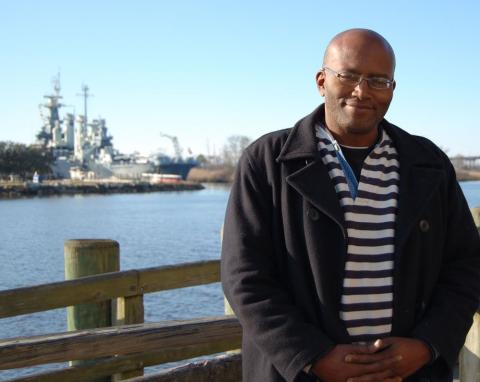
I took the photograph of Thomas above in 2008 down by the Cape Fear River near the Battleship.
Sadly, Thomas passed away in 2010, or he would be writing a recommendation for this book. He would recommend this like he recommended my poetry collection, which you can find on Wattpad also - it's called "What Really Matters."
Just like he did for that book, he would say that he is "honored to be asked by me to recommend that you read this." Trust me. I know my friend.
Some of my most meaningful and lasting relationships of mine were formed beginning in the early 1990s. Second, only to Lynn and Celta, was my friend Thomas Childs and my second wife who hasn't been introduced yet. Obviously, my connection to Lynn had a romantic component that was lacking in all other types of friendships such as my friendship with Thomas. However, that doesn't exclude him from being considered a part of my family.
As I write this, I am thinking of the song Empty Garden by Elton John. The lines that stand out are "a gardener like that one, no one can replace... and I've been knocking... most of the day...and I've been calling."
This was a time when I felt really connected to a group of people - a social circle. That being said, some of us really clicked. Thomas was one such person in particular with whom I felt really comfortable. We felt a sense of belonging to each other. This was my family. I felt at home in this life that I had.
It's amazing when you can sit down together and not worry about stilted conversations. Not worry about what you should say. Not worry about if you are okay or not. Not worry about whether you made the grade or are good enough.
I could talk to Thomas on the phone for hours when we connected sometime after I had been through my own dark time, or dark night of the soul as it were. I wish I had reached out to Thomas during those dark years. We could have supported each other.
Lynn had wished I kept in touch with our friends when she became ill in 2000. I felt like I had abandoned my friends. For those dark years that began in 2000 and lasted until sometime in 2006, I tried to make it on my own.
That was the biggest mistake I ever made in life!
Then in late 2006 or early 2007, I came down to Wilmington from Chapel Hill. I met Jean - a mutual friend - at the bus station and I asked about Thomas.
We picked up as if no time had passed. I would speak for hours on the phone with my dear friend. We had the same interests of course and so we could find things to share. TV shows or movies that we should watch.
Current events. Our writing. Things to laugh about together. Commentary on things. Philosophical ideas. Reminiscing.
"Oh, dear Thomas, I could have used your help, my friend. It was so hard when Lynn got ill in 2000. She said she wished I had kept in touch. I could have just picked up the phone.
"I was so scared. This wasn't supposed to happen to Lynn at just 34. We had a life planned; it was perfect."
"The biggest mistake was not calling and telling you what was happening, my dear friend."
Instead, I wallowed in the misery of what was happening.
Had I called Thomas, I would have discussed the challenges I was facing in my practice and in my career, as well.
I used to share some of the things I was learning with my friends.
Let me tell you more about this, dear reader. About this part of my story. It's about the importance of friendship.
It's so important in times of stress. Emotional support is key.
We had a social network of friends, as I was saying. This was from the poetry scene. I was part of this group. This was my social life. We felt we were doing something important, together.
Indeed, we were. Thinking. Writing. Sharing ideas. Creative ideas.
Our group included in the beginning, Thomas Childs (my friend), Lynn Krupey (girlfriend, fiancée, wife), Dusty (didn't catch her last name), Jean Jones, David Capps, Jeff Wyatt, (David) DJ Ray. I could live within the sanctuary of these people and the scene, as it were.
There was something comfortable, safe, and meaningful about this reality.
This was our time to become something. I was going to be defined by all of this and the relationships that I was building. I was growing up and forming a family... a family of choice.
Arriving on the Scene and Necessary Balance in Life
I could have been afraid and failed to attend that poetry reading at the Coastline Convention Center in April of 1992, and thought to myself, "I can't read my own poetry in front of others."
What good would it be to show up and be a ghost? What good would it be to sit there and watch others all the while thinking about how I don't fit in?
I can't imagine how my life would have been if I had not come out for this poetry reading that first week. I might not have met Lynn and shared a life with her. I might not have had the confidence to pursue my dreams.
That confidence grew out of the events that happened when I did decide to attend that poetry reading. It demonstrated to me that I could speak in front of a group and be the center of attention. I learned that I had something special to offer to others.
Through my relationships and connections with others back then, my life was transformed. I had not been in a good place before that time when I first arrived in Wilmington. Friendships like I had with Thomas and the relationship I had with Lynn were so valuable and they nurtured something special in me. I was able to give that to others as well.
This book might not have existed and you dear reader, might not have known me at all. I came with ideas about what might or would likely bring me happiness and meaning in life. And that is what I found.
That's what shyness can do. It can paralyze you and prevent you from making the connections.
Yet, I felt a need to share. To give my gifts as Dusty would say. Dusty was the emcee who worked at the Coastline Convention Center.
Dusty said that we were "sharing our gifts." I thought I was sharing something personal. Lynn wrote for herself; I would grow to learn. But Dusty said these were "our gifts." Wow!
Indeed, sharing something of yourself with another is a gift.
Some might say that we were a bunch of idealistic artists, but I had come there with a degree in engineering, which would be the springboard for graduate education in Social Work and toward becoming a Clinical Social Worker.
It might be more accurate to say that I have had values, passions, and interests than to say I was just idealistic.
The creative side of me might have been somewhat aligned with the values that drive a person to pursue a career in social work.
To us who work in the field of mental health, we need the support of others. The work can be rather frustrating. The work can also take a toll on you as you support those who have been hurt by life or harmed by others.
Spending hours with people who are overwhelmed by major depression and anxiety disorders can and does take a toll on you. You need balance and support in life. Emotional support.
In order to be a social worker, I learned social skills and how to deal with what I called shyness. Those same skills allowed me to share myself with others in my personal and social life outside school, training, the job, and everything else.
I wrapped myself in the warmth of the friendships I had formed. Back in the 90s, the welcoming nature of Dusty was always a source of comfort. I could show up for drinks at the Coastline Convention Center if I was feeling overwhelmed and alone, and Dusty would make me feel welcome and expected.
She would seem to have this genuine interest in me and was so glad that I showed up. Later, she would ask about Lynn, of course. I would feel less and less alone but occasionally overwhelmed by things in life.
I remember the warmth of Lynn would envelop me as we sat on the beach at Wrightsville Beach during cold winter nights. That memory would sustain me as well.
Then it was the comfort of a friendship like I had with Thomas. Again, our conversations were so comfortable, and the time together felt comfortable. Not stilted or desperately searching for something to keep the conversation going.
In a larger sense, this was a time and place that I knew was something amazing. Everything seemed so right and comfortable. I knew I was on the right path and that everything was going right.
I had a sense of belonging.
I knew who I was and what I wanted. We as friends would talk about the struggles, challenges, and doubts which existed from time to time in our lives.
Changes in the Late 90s and Into the Next Century
At some point, I regrettably got over-invested in the job beginning in mid-1999. I only allowed time with Lynn and those times when her family came with their kids which I mentioned earlier in this book.
So, unfortunately, I allowed myself to stop spending time with my friends, and my social life of writing and attending poetry readings was not happening. It was a crucial missing piece.
Fast forward to the summer of 2007, and I started visiting the area again. Life in Durham had not been rewarding in any way.
Anyway, on one of those visits back, Jean was having a poetry reading in celebration of a new chapbook of his poetry being released.
This was one of those visits back to the place I had called home. I was happy to see my new friend, Ryan. I was thrilled to see my new friend, Ana – obviously not the Ana that attacked me. I was thrilled to see Thomas and Jean. I was happy to see David Capps (he had been part of the scene back in 1992, though he was inscrutable to me).
Here is a video of Ana Ribeiro reading poetry at the Word Salad Poetry Magazine Event in Wilmington in October of 2009. In the video, we are at the lounge where I saw Lynn again as described in the next chapter. This is not the same location where Jean was releasing his new chapbook, so it's a different evening than what I am describing.
Here is a video of David Capps reading poetry. He was there this evening that I am describing but the video is from a different evening.
I knew Lynn would be there and so it was a bit surreal. There was no longer a "we" which was what made this surreal. It's hard for me to explain. I felt queasy and I had a knot in my stomach.
This was a reality that I had never envisioned. She had gotten new lungs and so she was still living, but there was no "we."
The autobiography of my life would need to include this reality. Thomas was that glue in that he had been our mutual friend - a dear friend who had been part of "our" shared life together.
He had navigated the roads of time maintaining a relationship with us both. Jeff Wyatt had been a mutual friend as well, but I seemed to sense that he was a bit colder than he had been in the past. I couldn't quite put my finger on it.
Thomas, Lynn, and I had been mutual friends but now there was no "we" that was Lynn and me. This wasn't supposed to happen, and it just felt so uncomfortable for me.
There had been no breakup and things had been so vague and confusing all these years.
Knowing Lynn was going to be there made me tremble, my heart was racing with anxiety. A good bit of alcohol made this only slightly more bearable.
I could sense Lynn nearby while I spoke to David Capps. My face was flush not just from the alcohol. My heart was racing, pounding.
I wanted to find something to say to Lynn with every fiber of my being. But I couldn't do it. I just felt uncomfortable. Lynn and I talked about everything – we even fought and got over it. Thomas and I had not argued nor had Celta and me before that. It seemed to me that being able to get into an argument and get over it, move past was a sign of how much more comfortable I had been with Lynn than anyone else.
This was frustrating so I stepped outside through the side door as people were milling about. I had noticed Thomas step outside. Ana was there too, talking to Thomas. Ana had not been part of the scene in the 90s.
I tried to bring up the topic of my discomfort with Thomas. This wasn't the first time I brought up the topic with him. What could he do? What could he say? I couldn't make sense of this new reality.
I did remember how in the early 2000s, I had enlisted people I met on Facebook to contact Lynn prior to this evening. They heard the story and were moved to call Lynn. She was polite but we never got anywhere.
I was still carrying the weight of profoundly low self-worth. I had no sense of worth as a person and whether we call it shyness or something else, we have to take action, or nothing will happen.
Sadly, Lynn might not have known that I still loved her or was in love with her...but she probably did.
I mean whoever these people were who called her they were moved with such a profound feeling of inspiration to want to connect Lynn and me again.
Life Changes
Later, Thomas had been happy to find out that I met someone else that I was going to marry.
Her name is Elnaz Rezaei Ghalechi (Elee). We got married in Ankara, Turkey. She had been submitting poetry to Word Salad, which was being published by Jean and me. Word Salad Poetry Magazine was started by Lynn and me in 1995. Later, Jean became the co-editor and co-publisher.
Thomas was a brilliant poet as well. I am sure we published some of his poetry.
Elee and I married in November of 2010 and when I got back, I found the news on a voicemail and on Facebook.
My dearest friend Thomas had died. He had died of a heart attack.
When I first heard the news, it didn't register. I had just seen him. I had spoken to him and he was happy for me. We had so much more to discuss!
No!
Elee responded appropriately. She was on the other side of the world and yet she understood better than my own sister. Elee consoled me as anyone would respond to news of this nature.
I started drinking when I heard the news about Thomas. My mind became a smooth flowing river. I thought this was a way to cope but it wasn't. It just made me sick.
Whatever was inside me wanted out and I clutched a table to stay alive. I fell to my knees due to a combination of grief and what the alcohol had done to me.
I had not made it to the funeral. I felt such shame for that. Would I have found the strength to speak to the crowds at his funeral? I think I might have done so. I wasn't the same person I once was but I could and would have had words to say. Or maybe I would have cried and cried.
Both.
It's hard to describe the hole that is left by a dear friend. It's hard to describe friendship and the love that we felt.
For someone like me to be at a loss for words is something in itself! I'm usually rather verbose... but what words can convey the specific things that connect two people and create that comfort among one another?
Had I made it down there, I would have found the words. I would come to feel great shame for years... To not even make it to the funeral of your dearest friend!
Anything I would have said about his brilliance should have been known by anyone there, but I would gladly repeat and confirm it. I can say that he is not gone! He lives in me and can't be taken away as long as I live and can write.
That's what I would tell his family!
That's the point of all these chapters that move between the past and the present... in this single chapter, I've covered events that have spanned eighteen years in this chapter, and each year, month, or day flow around one another in one stream of consciousness full of sound and fury, signifying everything!
What I most wanted to say was something only Thomas would understand. What we had was ours! It was for us and it was epic!
Dear reader, did you expect something less hyperbolic to come from me? You should know me better by now!
Writers like me are loath to employ trite statements that just sound like what you are supposed to say when you speak of someone who has passed. No, when I write, I mean it quite literally and explicitly.
There are so many times in which I have thought, "this reminds me of Thomas," "I would love to talk to Thomas about this" or "I should talk to Thomas about this, he would appreciate it."
The past is there in me. We are all together in that home that Lynn and I shared on Brucemont Dr. in Wilmington... or at a bookstore... maybe a coffee shop down by the Cape Fear River. I am haunted by the ghosts of the past, but that's a good thing!
I'm not going to try to summarize a friendship that began in 1992 and lasted nearly two decades until his death. The formality of a funeral has passed. On such occasions we find the necessary strength and words to speak.
Later, we realize how much was left unsaid and how much cannot be known by anyone besides the one we lost, in this final paragraph of this chapter, that person is Thomas Childs.
It had been months since I had any contact with John F. As mentioned previously, he moved in with Mrs. D who spoke to me following that initial conversation that I had with John when he said he thought she might have dissociative identity disorder (DID). It had seemed from the reports I heard from clients who went to that residence that he was setting up a treatment room and was providing therapy. I had a therapy group for people with DID at one meeting Mrs. D brought him.
Somehow he had connected with those clients of mine who had come to that therapy group.
I had last spoken to him when I called on behalf of Tracy who had come down to Wilmington from New Jersey, where she was hoping to find safety from an abusive spouse. John had made her life miserable, and she felt unsafe after rejecting his sexual advances. The way it transpired demonstrated to me that those things that I was hearing about him and reading about him online were true.
With the complaints to the licensure board, the malpractice claims, and everything else that had happened with Lynn, I was forced to suddenly and unexpectedly close down my practice. Lynn’s mother had been selling the house after Lynn had said, “I am not coming back.” There was never any closure. I just knew what was meant by what she said. Neither of us talked about breaking up, or the relationship being over. It was just surreal.
It began with John Freifeld, a wannabee therapist doing bad therapy. He was a psychopath.
After harming vulnerable people, for some reason he became obsessed with me, an actual therapist.
He had written a complaint statement and had five of my clients sign it… alleging things like how I had planted memories of Satanic Ritual Abuse. And how my clients with a serious condition – dissociative identity disorder – were not getting better. Of course, not, with his treatment, they were getting worse.
Much worse!
They forced me to get a psychological evaluation.
Decades later, a psychologist would tell me I should have sued the psychologists who conducted the evaluation for malpractice. But at the time, I just wanted to survive.
I was overwhelmed. The shame was crushing. I was being sued for medical malpractice too.
Being so overwhelmed with everything that was happening, with Lynn staring down death at 34, I even let the claim that I lacked empathy stand when I signed a Consent Decree.
Then as if that was not enough, I was given a citation by the police for court as John F. had accused me and making harassing phone calls - a totally fabricated lie. He just made it up! How crazy is that?
I was ordered to get a psychological evaluation. Decades later, I was told by a psychologist that I should have sued the psychologists for destroying my life and malpractice. They went into the assessment with confirmation biases about the claims that were made. They also NEVER inquired about whether anything at all had happened in my life. I knew enough to ask a question like that long before I started graduate school and only had an engineering degree.
I was overwhelmed with everything happening in my life. I was assigned a lawyer by the company that provided malpractice insurance. My malpractice lawyer encouraged me to sign a Consent Decree where I would surrender my license while explaining that I could present evidence in the future to defend myself against the claims and concerns.
I can’t believe I let the document include the words that I might lack empathy for others. That is not something that I ever doubted – my capacity for empathy. I knew I had seen evidence that I had a tremendous amount of empathy. If anything, I might have had too much empathy because I was too overwhelmed to use the skills I had learned.
Then as if that was not enough, I was given a citation by the police for court as John F. had accused me and making harassing phone calls - a totally fabricated lie. He just made it up! How crazy is that?
I hadn’t even been worried because I knew there was no evidence—no phone records, no recordings. I assumed the case would be dismissed outright. I went along with a public defender who was ready to go to trial right away.
But then, without a shred of evidence, the judge found me guilty.
I was livid when speaking to my court-appointed lawyer. Listening to him speak about getting the phone records…
He hadn’t thought of that? He should have been the one to know that without a shred of evidence, someone could just make stuff up and the victim of a false accusation like this could be found guilty!
When my public defender, unprepared and careless, asked if I wanted him to appeal, I said “Yes,” emphatically. There was no mention of a penalty for being found guilty but it was the principle of the matter.
Why do we even have lawyers when simple things like getting the phone records occur as an afterthought?
He also claimed that I had engaged in something called cyberstalking. The definition of cyberstalking would be something I had to look up. It was broadly defined. The things others had posted about John might possibly have met a broad definition but I wasn’t posting things about him. This accusation had been dismissed.
I was given a public defender for the “trial” in front of a judge. John seemed to represent his story on his own. My lawyer was eager to go to trial right away – he was overly eager and unprepared.
Leaving the Area
I had met some people online - a couple. One of them was one of the victims of John F. They invited me to move up to Durham, NC from Wilmington. This was my home and I didn’t want to leave.
When I lost another job as a result of John calling my employer and mentioning the issues with my clinical license (which was not required for that job), the company had to dismiss me. So, reluctantly, I decided to pack everything I had and drive up to Durham to stay with my new friends.
Feeling so overwhelmed by everything, I moved to Durham with my new friends.
I had previously tried dating, using online sites, but I was still in love with Lynn, and I was in such shock, still traumatized, and not able to connect with others in any real way.
When I moved in with those friends up in Durham, I kept doing the same thing – using dating apps to try to find dates.
I applied to the Division of Vocational Rehabilitation (VR) soon after moving to Durham. They encouraged me to pursue a different career direction. It seemed like my mind was in a fog, and I was not in touch with thoughts about who I knew myself to be and what type of career would be a good match for me. If that were not the case, I would have remembered that Web Design and Development was not a good match for me. If it was all about creativity alone, it might be a match.
In the meantime, I started working at Eckerd’s in the photo lab. One day, I was asked to work at the main register. Based on everything that I had experienced, I was dealing with extreme anxiety. I had been traumatized.
On one occasion, I could not focus my eyes very well and thought that the license shown to me indicated that a customer was old enough to buy alcohol. I was wrong and I was given a citation and asked to come to court. The charge makes one think that I was corrupting a minor by buying this person alcohol when I just read the customer’s driver’s license wrong.
It was easy for mail to get lost, and my mind was not focused so I missed court. A warrant was issued for my arrest. I was terified and desperate to avoid going to jail.
There was nothing that could be done.
I was put in jail. I cannot overstate how traumatic that was for me. As a shy person, I carried a great deal of shame, which I will describe in more detail in the next book, which will be part two of this story.
I had reached out to my family for help. They had to understand that I could not cope with this. I had forgotten again just how uncaring they were... how little empathy and compassion they were capable of feeling. My pleas to my parents for help to get me out of jail were met with icy-cold responses.
They had not been there emotionally or psychologically to offer anything resembling support. I didn’t understand why I was the scapegoat of the family. It had felt like if my own family doesn’t care about me, who would care.
I had needed compassion and support like anyone else.
It seemed like my parents had a rudimentary sense of understanding how a person might feel if one loses someone that one loves. I won’t go into details in this book, but it just seemed to me in my mind that they would understand that after all I had experienced, being in jail would be too much for me to cope with.
Beginning with the times when Lynn got sick, they started acting like what seemed like the application of tough love as opposed to understanding how a person in love would naturally feel when an illness threatens the life of the one that you love.
I had been put in jail for failure to appear and the bond was not very high.
I had learned that the appeal that I had asked my lawyer down in Wilmington to file had appeared before the court.
A reasonable person might understand that with all the changes, problems getting in touch with me, I deserved a bit of understanding. It would seem like my lawyer could have found a way to explain how he had not been able to inform me about the case – the appeal – coming before the court and made sure that I was not arrested.
Instead, I was extradited to Wilmington... which had been my home. Now, I was put in chains and put into the back of a vehicle with a metal frame. I was crying the whole way down there. I felt such shame growing and growing in me.
Once I had been the president of the local chapter of the Society of Clinical Social Workers, with name recognition, a successful career with many clients. My colleagues knew me. Now, I was being brought down to Wilmington in chains.
I didn’t have to stay in jail long, but when I was released I had nowhere to go. The days and the skies looked like winter had come far too early this year. I looked up my friend Jean Jones, a mutual friend of Lynn’s whom we both met at poetry readings so long ago.
He guided me toward finding a place to sleep at night in downtown Wilmington. I still reached out to my family for help, hoping that, at some point, they would care. However, nothing that happened to me could arouse parental instincts to protect me from things that were outside my control.
Jean also invited me to join him and his family for dinner on Thanksgiving 2002. I was carrying all my belongings in a bag. I was ashamed of this look. So, I hid the bag and my belongings in the bushes as I joined them. Snow had been falling so very early this year.
I finally decided some days later to get help at the Mental Health Center who referred me to the Department of Social Services to get a ticket back to Durham. I didn’t have a home there, but I had a relationship with VR.
Maybe I should have just stayed down in Wilmington. I think I was just running away from reminders of the joy that I had once known. A few days ago, a police officer, trying to help me, gave me a street sheet. It was the one I had developed during my first graduate internship with the homeless program at the Mental Health Center.
The weight of sorrow, shame, loss, grief, emotional pain, abandonment, isolation, loneliness, trauma, had literally weighed down on me and brought me to my knees.
It was awkward at the Mental Health Center. The worker had recognized me from when I was the president of the local chapter of the Society of Clinical Social Workers. She did acknowledge that fact. There was a sense of me wanting to explain how I could have arrived at this place, this situation. We just exchanged a few words about how I had arranged some workshops for continuing education credit for clinical social workers.
I was then on my way to Durham.
Beginning in late 2002, I moved from one friend’s apartment or house to another, staying temporarily. These were people I met in the therapy group that I was attending through the local mental health center.
I wanted to heal and be able to return to a career that was so rewarding... helping others who had mental illness or emotional problems.
I did date a few women who I met on dating sites. Eventually, I started seeing Shonda, a black lady, on and off. I was not able to connect with anyone in any real sense. I just didn’t feel a connection. We were intimate, and I helped her children with math.
Shonda continued to see me when I was living at 721 Holloway Street in Durham. The place was described as a boarding house. I moved in there because the rent was only week to week, as opposed to monthly rent, where one must come up with the first month’s rent, and potentially a deposit on top of that to move in.
It was early 2004 or late 2003 when I moved in there. Rent was paid to Scott, who lived around the back of the place.
We rented rooms in that building. The front door was not locked much of the time. Only guys lived there. Prostitutes were seen in the building. I had to reject them as they were assertive about selling their bodies. I had never purchased street drugs, but I got the impression that crack cocaine could be purchased for $10, as that was what the prostitutes were requesting.
I had been mugged more than once while walking from the bus stop to the building at night. I saw needles on the side of the street that must have been discarded. More than once, I had to run as fast as I could to get away from someone threatening me.
The landlord was James Vecchione, Jimmy. He had me working on an adult dating website in exchange for not charging me the weekly $100 for rent. It was not earning money fast enough. I had been working at various jobs doing the best I could. I had applied for Social Security Disability Insurance which would be backdated to cover this period. I wasn’t just being lazy.
VR had paid for me to get a certificate in Web Design, and they were paying for computer equipment for me to start my own business because that seemed like it would work better than a traditional job.
Jimmy decided that the adult dating site was not coming together fast enough so he dropped the entire idea. He took me to court when I couldn’t pay the rent. I appealed the decision. I was hoping to get financial assistance from various sources that existed including VR.
I mentioned that Shonda was black because we were getting close to the time when I would be victimized by a woman. The woman who would attack me was clearly white.
I had been homeless on and off in every sense of the word from 2001 up until now. I had even slept outside or spent many a night awake outside.
My paternal grandparents were not living in their home. I am sure they would have wanted me to have a place to stay as they had paid off the mortgage. That was in Burlington, which was very close. I would have never imagined that I would find myself living so close to where they lived, having grown up in Connecticut.
Any kind of support to ease my suffering would have helped prevent so many things from happening. It would have taken away the stress of living as a homeless person with no stability.
Anyway, about the rent and the eviction... Jimmy would have gotten paid. There are resources to get a person caught up. VR was offering to help me out. I point this out because I would come to learn that his wife was the one who would attack me on October 1st, 2004. I am getting ahead of the story.
As someone who was homeless and dealing with very low financial resources, I got to know other people who came to the Urban Ministries to stay overnight, for financial assistance, or for meals. I made friends with several people that I met there.
Sadly, twenty years later, I don’t remember their names.
I was expecting one of my friends to meet me the next day, October 1, 2004. I couldn’t imagine things could get any worse for me but I was about to find out that things could get more terrifying and nightmarish.
Having grown up with emotional neglect, I thought I had finally woken up when I saw myself through the eyes of love—with a girl, a young woman named Celta. That moment cracked open a new self. And still, the impulse to explain myself never left me. Maybe someone here knows that feeling too.
There was a time when I thought I had finally arrived—at love, at home, in a life of success, accomplishment, and peaceful contentment. Lynn was that life. Our love gave shape and meaning to everything else. It buffered me from old wounds, from the shadows of emotional neglect, and let me believe that, maybe, I was no longer invisible.
But then a meteor came crashing down upon my life. Lynn’s illness caught up with her. I was a healer—but only for the mind. All I could do was watch. It was like watching a fire consume everything I had built.
In the smoke and ash of that loss, I turned to my family of origin. I held out the ruins, hoping they’d see the devastation I couldn’t hide. But the truth is—I couldn’t even hide from it. The grief was all-consuming, like a fire itself—burning through everything I was, everything I’d built, everything I thought would last.
Instead of comfort, I received a bizarre sense of blame. As if I deserved it. As if I had brought it upon myself.
That was perhaps the cruelest wound—not the fire itself, but the silence that followed. I was no longer just grieving Lynn and the life I had. I was confronting that ancient, familiar ache: I am not worthy. I am not welcome. I spent a lifetime explaining myself to those who never intended to understand.
The moment I knew everything had changed was the day I walked into our home - Lynn’s and mine - and saw it being packed up. Her mother, who once bought us that house, was now preparing it for sale. It was too real. Too final. I stepped into the computer room—just to be out of sight of the boxes—and felt my legs give way. My body needed support; I slipped down the wall to a sitting position. The life force was gone.
This is the place these poems come from: A world where identity collapses, where memory stings like smoke in your eyes, and where love, once lost, becomes a ghost you chase in dreams.
The Poems
Dreamed I was a ghost
I dreamed I was a ghost, seeking you... screaming your name. But you would not answer.
Then I could not find you.
I was alone, an invisible spectator... watching everything around me, unable to be heard or seen, haunting the once familiar spaces. Now haunted - terrified - by the strangeness of it all.
In the Boat
This time it felt just like a premonition. In the dream, I felt like a ghost - I was there with you transparent to your sight; you looked right through me not seeing me.
My love for you keeps these dreams alive.
There is something familiar about the place.
There, by the water we stood, yet you did not see me. I watched you enter your sailboat.
I tried to call out to you; I was scared of losing you.
I watched you drift away, fading out of sight.
The boat I enter takes me back in time - back to you.
Not Even Footprints Remain
Sometimes it seems that I'm writing these words on the sand, like in that quaint picture, "footprints in the sand."*
The wind is in my face... Is this all there is? Words that fade as fast as I write them? My words dry as sand that blows in my face blinding me?
If only I could get you to look before my words are lost.
In my vision, on the sand, there are no footprints... As if I'd never come here, and never written these words.
Or it never mattered what I said, you would not see... you are not here to see.
You are gone, like our footprints, like my words.
Gone!
Flashback
It’s strange how a place can age-regress you— fold back the years in an instant. That’s what happened when I stood there again.
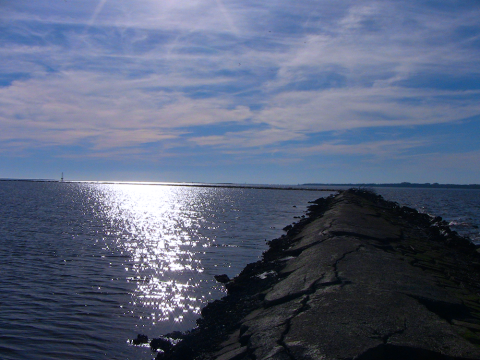
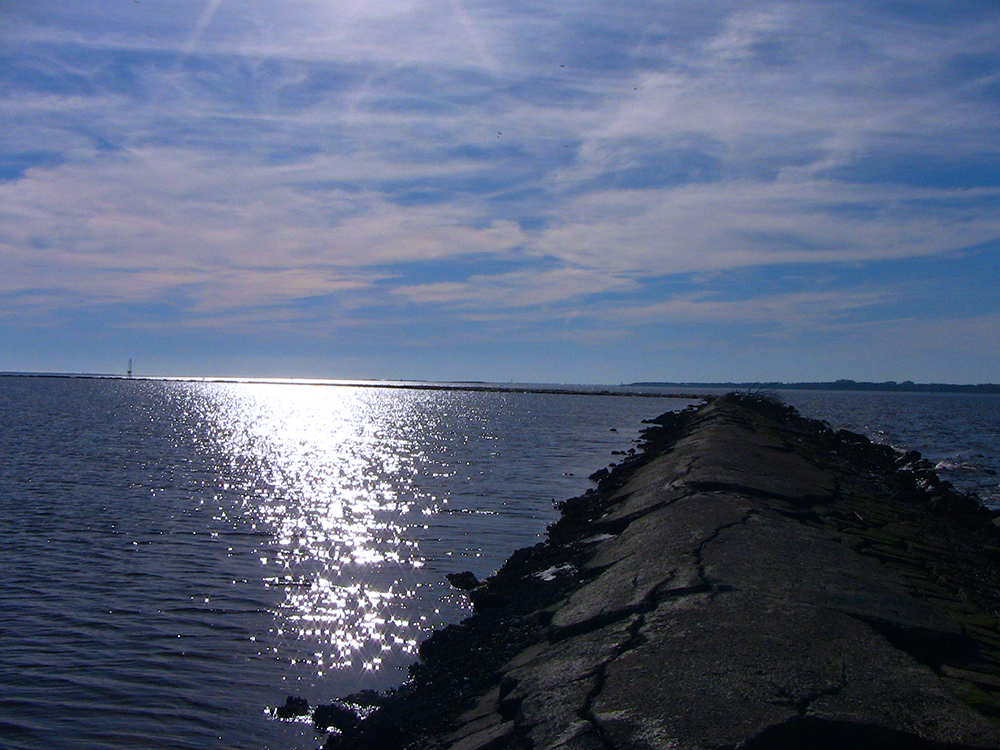
There’s a man-made jetty that arcs out to a small island on the beach south of Wilmington.
The photograph draws your eye inward— just as standing there drew me into myself.
Time collapsed. Suddenly I was not just in a place— but in a moment.
Our first day together, our first real outing— and the life we were about to build had just begun.
Today, the wind off the water and the hush of waves surprised me.
The place held the memory— and the memory held me.
Post Traumatic Stress Disorder
I like to believe I'm just like anyone else— that we all have limits.
There’s only so much pain, fear, loss— trauma— we can carry and still remain ourselves.
Still hold on to our values, our sense of self, the person we hoped to be.
But when the weight exceeds that limit, something breaks.
We drift. Not into sleep, but somewhere else. A fogged place. Out of time. Out of reach.
Sometimes, if we’re lucky, we come back.
But not everyone does.
Reflection: This poem echoes the confessional tradition of poets like Anne Sexton and Sylvia Plath, whose work dared to name the raw edges of psychic pain. Sexton’s To Bedlam and Part Way Back still haunts me. I sometimes wonder if she ever could make it all the way back.
I did. At least, I think I did.
But some nights, the line between coming back and simply existing feels paper-thin.
Introduction to the poem
*“Dissociative fugue,” once called “psychogenic fugue,” is a rare phenomenon marked by sudden, unexpected wandering or travel, combined with amnesia for one’s identity and past. It sometimes involves taking on a new identity.
After recovery, memories typically return, and further treatment is often unnecessary. *
I felt this idea of a fugue state was a good metaphor for a time in my life.
Fuge State
I come to, or awake, finding myself already walking somewhere unknown.
I’m not sure how I got here, where here is, or even where I meant to go.
A misty rain drifts down, mingling with tears that blur my eyes, slide warm down my cold face.
Fog lifts off the street like smoke as day slips toward night, unwinding the edges of everything.
Street signs leer at me — unrecognizable, taunting with names that mean nothing.
I want to run. Back. Back in time.
Somewhere in this haze, my mind glimpses what can’t be real, must be the dream within this dream.
Hours slip by. My hands have gone numb. Cold seeps through my coat and down my back. There is no sidewalk. The winter streets slick with rain or ice — I can’t quite tell.
Cars whip around corners, far too fast — their headlights slicing through me. Each time I tell myself they will miss me, just like the last did. Just like the lightning will wait — let me reach somewhere.
Not home — that was long ago. Home is gone.
Dogs bark in the distance. I hope they keep to their fences, hope I’m invisible.
No one knows where I am. No one is waiting. No one needs me to get home safe.
Awareness trickles in, thin as the lifting fog. I stumble, knees hit the cold asphalt — not in reverence, only weakness — and I whisper into the wet dark, “Please help me.”
How pointless. Even if belief could matter, what would it change?
Walking again, I see a convenience store glowing ahead. A phone inside. A roommate’s number I can almost recall.
Being alone, lost, is a state of mind that endures.
I will keep walking unknown streets in unknown towns, alone with no identity.
At first, I thought I recognized the road. A curve, a sign— faint echoes of somewhere I’d been.
But then— nothing familiar. The signs made no sense. The darkness deepened.
So I drove faster. “Eventually something will make sense,” I told myself.
Fear crept in— not ordinary fear, but an existential kind. The kind that whispers you might not be real, that no one is coming, that even you don’t know where you are.
My palms sweated. Heart raced. I was alone, in a dream wearing the face of a nightmare.
So I turned off the road— onto another, even more unfamiliar. No signs. No map. Just an instinct, like something inside me screaming, Anywhere but here.
But the fear didn’t fade. It grew. A new kind of terror - not just from being lost, but from knowing I had once been found... and still ended up here.
I’ve had this dream before. Always the same turn. Always the same ending.
The moment before waking, I whisper inside the dream, No. I can’t face this.
And I wake. Still unsure how I got so far from myself.
I met Lynn and started seeing her around the 4th of July of 1992. I had been grieving the loss of Celta when I came to Wilmington in April of 1992.
I found love briefly with Celta and yet she died so suddenly and at such a young age. I was devastated. I didn't think I would feel, or experience love again. Then I met Lynn in 1992. We fell madly, and passionately in love. The poems that follow are about that love. I wanted to tell the story to all those who would ever follow me in the later generations about some epic love to rival any husband and wife or any couple.
We lived as husband and wife and were married in every way that mattered. As a Catholic at the time, I sought the sacrament of Holy Matrimony from the Church, but they denied us—the disgusting attitude that someone born with a debilitating illness should be denied access to the sacred! This treatment of Lynn, among many other harmful attitudes, pushed me away from religion.
Lynn was willing to embrace any way of symbolically representing our everlasting devotion, even though she wasn't Christian. We both wanted to formally move from engagement to the next stage of formal commitment to one another forever. Now, no longer religious, I can see that if the sacred exists at all, no secular piece of paper could make our bond more holy than it already was.
For years we had a normal relationship, and the fact that she had a chronic genetic illness did not define our relationship.
Our love created a sense of tranquility and serenity at its core—a deep peace and contentment that existed at all times, even when I was depressed, which was merely a transitory feeling that would pass.
In its purest form, love is distinguished from addiction, which is momentary and transitory. We do not pursue a high that we once had and cannot reach again—that would be like implying that once we discover an awe-inspiring sunrise we need a more beautiful sunrise to feel that same sense of awe.
Love is also like beauty in the sense that it's best experienced as opposed to merely being stated like some universal truth. Creative people express these experiences of awe and wonder in many forms.
These poems capture more than fleeting moments—they hold experiences where physical sensations became markers of something profound, eternal, and awe-inspiring. Each moment contained vastness, pointing to the spiritual that even non-believers in the supernatural can embrace. They are signifiers of what endures and give ultimate meaning to what really matters.
An Infinite Beach
On some beach that never ends I'm with her and just for a moment I pretend that things never change that sometimes, in moments like this we walk hand-in-hand forever. This is my greatest desire - to stop time like this... when there is just this place, just these beach sounds and just she and I.
What Really Matters
Moments frozen in time.
That is what love seems to be... these moments you remember something in these moments (takes my breath away) has a certain meaning that endures -
a feeling... an image... something said... or shared... certain sounds in the background... whatever it is that you remember is all that really matters.
Introduction:We walked into the Coastline Convention Center that Sunday evening in 1995, hand-in-hand as usual, overlooking the Cape Fear River where the weekly poetry readings were held. Lynn had no idea I had a surprise for her.
We took our seats at a table with other regulars—all friends and acquaintances who knew us as the couple we were, always like newlyweds, never afraid of public displays of affection. The sun was sinking low, and the room was getting slightly dark with just a dim light up front near the podium.
When my time came, I stepped boldly to the microphone. As I read this new poem, I could sense the knowing glances from people in the room—casual looks toward Lynn as everyone understood what was happening. I wonder if she noticed those glances, waiting for her reaction to this declaration of love.
Dreamlike Visions
In this dreamlike vision I lay in her lap, while her golden hair flows in the gentle wind, On the beach.
Is this real? I reach up to touch her but she is gone... gone... gone and I am laying on the sand.
Looking skyward I see her in a vision. She searches for me, calling my name, saying, "I am his and he is mine."
I try to get back to find her and that infinite beach where we would walk hand-in-hand or lay on the sand holding each other together forever.
The vision - the dream - (incomplete) the love never ends... The dream never ends.
Follow-up to the poem: I sat back down next to Lynn as someone else prepared to read. I noticed she was doodling. One of our mutual friends commented on how much he liked the poem. I turned to Lynn and asked, "So, what do you think?"
"What?" she said, looking up confused. "I'm sorry, I wasn't listening."
I shook my head and smiled. She was embarrassed, her face blushing. "I thought you were only reading poems I already heard," she said. "Oh, I'm so sorry sweetie. Let me read it."
I handed her the poem and leaned in close, my arms resting on her chair. I tilted my head and slowly brought my lips to hers. She held my lips there with her hands on both sides of my face—just for a moment, mindful of the others around us.
"It's okay," I said with a smile. "You know what... I really love you."
"I love you too, honey."
She read the poem, visibly moved by this surprise declaration of love.
This became an inside joke for us. I would tease her: "If I share a poem about our love, I hope Lynn is listening?" Her way of making up for it was to read this poem at future poetry events when she didn't have anything else to share. I can't count the number of times that happened, it demonstrated her appreciation and recognition of the value of our love.
I explained that the poem was inspired by the Song of Songs from the Old Testament and a song by the Electric Prunes called "I Had Too Much To Dream (Last Night)." I was drawn to the sensual imagery in both—the biblical celebration of love between two people committed to each other, and the dreamlike quality of the song that captured something both beautiful and haunting about love and longing.
In Love
Some would say they understand that it is not that uncommon... a word that is overused because I can't find another word.
People walking past us might have seen us holding hands they might have known there was love.
Yet they would not understand... the miraculous experience of her hand in mine as we walked by the ocean. They would not understand the experiences – physical and emotional signifiers of something worthy of belief.
When we sat side by side facing the ocean waves, hearing them in the background seeing them - moved by something unseen - our bodies were touching and the best analogy for what I experienced was electrical signals moving at each point where our bodies our legs, arms, thighs were in contact.
This was not merely something physically pleasurable, not merely biological emotional, chemical.
No, I knew that. I have felt passion but rarely have I felt love – though I have been mistaken more times than I can count... Meaningless encounters where the emptiness remained.
That core Self within me ready for connection was not fulfilled like it was now.
Waves of excitement, peace, serenity, joy, clarity flowed through moments pregnant with meaning. Each moment was vast in duration each moment held eternity.
I had an epiphany and knew what mattered, what gave life meaning what filled that emptiness within that brought forth the fullness of the Self.
The feelings, moving in waves were markers of the profound - physical sensations that pointed beyond themselves to something transcendent, something that could not be reduced to chemistry or biology alone.
I have known alcoholics that look to a higher power. I have known the religious who speak of a God who alone can fill that emptiness within.
Everyone is looking for what will complete them, searching for transcendence in substances, in faith, in achievement, in escape.
But I have found something - I believe in something - I believe in love.
I can't prove it exists beyond hormonal desires beyond biological drives beyond what science can measure.
But I know what I experienced: love that is true and real and right...
Love that transforms without diminishing, that changes you without erasing who you are, that asks you to grow but never to disappear, that leads toward transcendence while keeping you whole. It shows you eternity in peaceful moments yet never asks you to sacrifice the fire of excitement, the expansion of joy, the sharp clarity of being fully alive, the creative force that moves through two people connected in the deepest way possible - embodying what it means to be complete while remaining yourself.
I Wrote a Love Poem Once
I wrote a love poem once... I felt it was good - I remember how good it felt - the love... to write the love poem, to share it, to dedicate it. I felt the poem was good.
It was many years ago... lost - lost in the fire, as it were, the love... the love poem.
I forget how it goes the love... the love poem.
I just cannot remember the words I wrote... but I know I wrote a love poem, once... or twice or more...
I can't quite remember how it goes - that feeling, that certainty, that desire to feel that again.
Introduction to Poem “The Whole Story”
Our mutual friend Jean once observed that he saw us argue often, and I was shocked by his concern. Years later, after experiencing a relationship where disagreements felt threatening, where conversations could end with hang-ups, where love itself seemed in jeopardy over differences of opinion - I finally understood what Jean had missed.
With Lynn, I never hung up the phone. When she said, 'I'm not done talking,' I never said we couldn't keep talking. The cognitive dissonance I felt when Lynn challenged my beliefs didn't threaten our bond—it transformed my thinking, because I respected her completely and knew she respected me. Isn't it strange and amazing when you can become so frustrated and irritated in a relationship with someone special but still maintain that pervasive sense of happiness and contentment! Even despite all the fights and arguments, there was always an underlying joy. That is the ineffable nature of what we had—something taken out of context might look like conflict, but within the whole story, it was actually love expressing itself freely.
The Whole Story
Our love is now like an epic novel, thousands of pages in length, with most pages torn others burned - in the tragic fire.
I tried to save what I could believing it was worth saving or worth holding onto - believing that nothing dies but in the end, what do I have?
Just scraps of the book...
Even the ring that symbolized the bond of husband and wife is gone.
We wrote the book together - I remember how it was, page after page, chapter after chapter, lie scattered around a room in a forgotten home in a forgotten place like dark shadows under a hazy sky.
Page after page, written with a purpose written with love.
Sure, there were chapters that didn't seem to belong or have any purpose that could be understood but every part of the story had a purpose and place, whether good or bad within the larger narrative.
This was a story to be told for generations to come - passed down within the family and as part of a cultural tradition.
Looking back, at the whole book and not just a chapter here or there, taken out of context, you see a theme which emerges out of the many unplanned chapters.
It was always about love and that matters more than the quality of the narrative... it matters more than how things might have seemed at any one moment in time.
Before I met Celta, I was 23 — out of a childhood of emotional deprivation, past undergrad where I somehow believed I was becoming confident — an extrovert on campus, but not at parties, not in groups of more than six, still too shy to speak in class, still escaping to the movies alone on Friday afternoons.
I thought I was becoming someone. Still, I was mostly surviving. Still needing to grow.
Then there was her.
She was the first to see me in a way that made everything before feel like a long, dim dream — a story I try to tell about life before 23, but it’s mostly devoid of detail.
It’s not that I have a bad memory. Some things are still vivid — like being four years old, floating in the YMCA pool, held in someone’s arms, and feeling certain I didn’t deserve to be held.
But most of those years blur together.
Maybe because I hadn’t really begun to live yet.
Another Place, Another Time, Another Life
We used to walk hand-in-hand at the Botanical Gardens — in Athens, Georgia, following the paths.
This was my escape, my other life.
And what I felt is hard to put into words, but I can say that this... this sustained me.
(The feelings remained and echoed throughout the upcoming week) — until I could see her again a week later.
We lived in different cities. I lived with abusive parents — I suppose I chose this. I was an adult.
What I felt not just holding her hand, or wrapping my arms around her — but the way she held me, chose to be close to me...
Perhaps there’s something else I am leaving out...
Maybe it has something to do with love.
Her love? Mine? Both.
I don’t know... maybe because I had not known love — from anyone, at all, ever, before I was 24.
The Swing
Three of us are walking in a small field— the girl I loved, myself, and her friend, whom we had come to visit.
We came upon a swing, and as I remember it, I am in front of her pushing her gently— away, knowing she would return.
It wasn’t the way her hair was caught in the sunlight before me, nor the smooth, calming, undulating motion of the swing.
It was what happened in the quiet that fell— a pause in time— when our eyes locked, and everything else faded from our awareness.
David’s voice grew distant, his presence dissolved. She saw only me. And I saw only her.
In that moment, there was no one else. No labels. No explanations. Only knowing.
After so many years— decades— I still remember this moment.
That’s what love is. The kind you feel in the body, in the silence, in the return of the swing.
Where the Love Was
They said you were an angry woman — but where was your anger at me? Could you be so angry at the whole world but not at me? Not ever? (We had only a year.)
I guess that has something to do with love — our love. I kept waiting for that anger to turn on me, for me to do something to provoke it — yet I only saw your smiles at me.
That’s where the love was.
And what about the I love you’ s we exchanged? I’d never heard those words or said them so many times. I never felt so moved to say “I love you” until then.
That’s where the love was.
Or maybe it was in certain snapshot memories... Like that day in the park — I was telling a story from my past, not even a remarkable one. But when I looked up, your eyes were on me — captivated, hypnotized, transfixed.
I still remember it decades later, along with so much more.
That’s where the love was. Or is.
And finally, it was in all the tears I shed when I heard you died. I never cried before that.
The love, it’s in the memories — in the knowing that you are always a part of me, and I, a part of you. There’s comfort in that.
I guess love isn’t just a place long ago.
Maybe I really didn’t believe that someone could love me — or be so deeply interested in me.
These days, or in the past few years, I seem to have needed something more than just a touch to feel anything as intense.
And most importantly — it’s not the intensity that matters,
but the overall mood, the mindset of the relationship — that is what matters.
I’d like to begin this collection with an introduction written by my dear friend Thomas Childs Jr. back in 2010. When I first published these poems in January of that year, I asked Thomas if he would write something for me, and he graciously agreed.
By the end of that same year, I had remarried and returned home, only to receive the devastating news that Thomas had died suddenly of a heart attack. We were both still in our forties. Just weeks earlier, I had spoken to him. It was surreal — like a nightmare I could not accept. Losing Thomas left a hole in me that will never be filled. It’s a wound I keep open, in a way, so that he remains alive inside me.
Below is Thomas’s introduction, exactly as he wrote it.
An Introduction
I first met Bruce nearly twenty years ago. Looking back, we were both idealistic young men with high hopes for the future and a shared passion for poetry. Over the years, we got older and lost touch with each other. However, I feel an affinity with Bruce because even though over the years, we may have gone through trials and tribulations, we have BOTH learned from them. We may have been beaten down but not defeated. We have not let our demons that haunted us have the last word… And one thing I can say about Bruce is that he has channeled all the hurt and pain he experienced into his poetry.
In the wistful “Dreamlike Visions” and “The Whole Story”, he talks about a hopeful vision of love that is over too soon and the possibilities of what could have been… but will, instead, never be. “Tears for Grandmother’s Passing” is a coming to grips with a loss of a loved one. The collection of Christian poems paints a picture of rediscovered spirituality. My personal favorite, however, is “Post Traumatic Stress Disorder.” In his reflection of that poem, Bruce mentions the poet Anne Sexton’s struggles with depression and psychiatric hospitalization and says “She (Sexton) never made it all the way back. I am so glad I did.” That makes two of us, my friend… I CAN relate.
In conclusion, it is my hope that you enjoy this collection of Bruce Whealton’s poems. In fact, Bruce, I thank you for asking me to write this introduction. It was a singular honor to grant your request. You put your heart and soul for all to see into your writing and we, as readers, are richer for it.
Wow, I cannot thank my friend enough.
Addendum
This book is a testament to what really matters. It holds poems inspired by the people I have loved most deeply — and by the unthinkable pain of losing them.
What are we when we give ourselves fully to another — become one life, one heartbeat — only to have them torn away by death or by forces beyond our control? I know now it wouldn’t have mattered if we had shared a single week or fifty years as husband and wife; the pain of losing that love is exquisitely unique, the most profound wound I have ever known.
The title What Really Matters came from words I once wrote to Lynn. In 2000, my entire life collapsed under the weight of losing my home, my job, and the career I loved as a therapist. But even then, I realized none of it compared to losing her. This collection is my way of saying that — of carving those words into some solitary rock the way a desperate lover might, hoping someone will see.
I think of Don Henley’s song, “New York Minute,” with its haunting lines:
Harry got up, dressed all in black, went down to the station, and he never came back. ... On some solitary rock, a desperate lover left his mark: "Baby, I’ve changed. Please come back."
If I had written that song, I would have told you exactly who Harry was, who the girl was that he loved and who loved him. Because for reasons I can’t fully explain, I want you - my reader, my witness - to know these people. I want you to know Celta Camille Head, the first woman I ever loved, who died so tragically young. I want you to know Lynn Denise Krupey, whose tears of joy when I gave her our engagement ring remain the brightest moment of my life.
This is how I cope. By naming them. By refusing to let them vanish.
There is more to say, always more — stories layered with survivor’s guilt, self-blame, longing, and awe. But it’s a long story. And so, I’ll leave you now with the poems.
In the last chapter, I told you about the joy I found in finding someone to love and someone who loved me. I told you about the experiences I had, and I hope it was clear just how meaningful this was in my life's trajectory. It was so important to present the profound and positive impact this had on my life.
This was life-altering.
The experiences I had growing up, in my home environment were toxic to the development of the kind of self-confidence and self-worth that I would need to achieve my career goals. Something had been missing despite all the improvements I had made in my sense of worth.
It's hard to know what you need to overcome a problem that has existed throughout your life. My therapist or counselor in college was very talented, competent, and profoundly helpful. However, we failed to fully appreciate all the negative impacts of abuse and devaluation that I had experienced in my home life from my parents.
Then I met Celta, and something happened. She seemed to delight in me. She was so interested in my experiences. She also was concerned about my well-being and happiness. I knew she was thinking about me for most of the day each and every day! Her diary-style, stream of consciousness letters told me this.
I knew she was thinking about me for so much of her day, each and every day, because of the letters she wrote to me - her diary of sorts composed with me in mind as someone she wanted to share her life with. I had realized that I previously thought that I was not that important to anyone. This is what I meant by seeking a relationship with some aspect of exclusivity or the idea that I could be the most important person to someone.
I knew that I was the only one that Celta loved the way she loved me. Previously, I had friends, but they all had a boyfriend/girlfriend or spouse or the relationship wasn't as close.
After I was with Celta, I felt like I was ten feet tall... confident... worthwhile, and deserving. My self-esteem was higher than it had ever been in my life. I also felt safe trying new things. This idea might seem unexpected. She was just a small girl (woman). I sensed that she deeply cared about me and thought about me and that was transformative.
It's important to underscore these important points before I move on with this story.
When I say that our relationship was platonic, I mean that we were not boyfriend and girlfriend. We didn't have a physical relationship. That being said, we did exchange "I love you" on a daily basis or whenever we talked on the phone or saw each other. We were close and perhaps somewhat intimate and physical but not in a sexual way.
Late in December, something happened. I had moved to kiss her as I was leaving. It was impulsive. Her lips were so thin that I didn't feel what I imagined I would feel. This was my first kiss. I felt confused. She had not turned away or signaled in any way that she didn't want me to proceed. So, why was I uncertain? I didn't have to be shy with Celta. But I didn't want to use her for my own personal "experience."
I would play this back in my mind as I drove away. Yes, I wanted to kiss her. Having decided now for sure what I wanted, next time I would kiss her.
Sometime later I pictured my face turning to the right and moving closer to her as she moved toward me. I had been in sync with her and felt so comfortable. I knew that she might have said that one time that she was not in love but when we were together there were so many times when she had that look of someone who was so happy, comfortable and it sure looked like she was in love. Well, she definitely had "romantic" feelings.
Also, when I was with her, I could see myself and my feelings. You just know those things. There were so many subtle behavioral cues that told me what she was feeling and how she was responding to my touches... how I held her... where I touched her. Everything had been welcomed. I played back memories of how when I touched her she moved closer to me.
As I replayed the imagined kiss – next time - I would begin to tilt my head to the right, bend down, she would be acting on instinct, without taking the time to over-think it – that's what I would do, and she was my mirror. Sometimes we do things as if the moment is such that it is inevitable. She would move to meet my lips... she would be transfixed upon my eyes and I hers. I felt excited as I replayed this in my mind.
It was as if it had happened already, almost.
It would never happen.
On New Year's Day of 1991, I got the worst news of my life. A phone call. I was in my room on the second floor of the house owned by my parents. "Celta died last night," I was told.
"How?" I asked as if this wasn't possible or real. I was stunned. I wanted my willpower to make it not real!
"There was a fire... she died from smoke inhalation." It started from an exposed electrical cord on a TV.
My mind registered information about the funeral, its location, and time but I could not find the words to begin to convey any sense of what I was feeling. I had spoken a few times to the man previously. He was a friend of the family. Tears were flooding my eyes. I just said, "Okay, I'll be there but I can't talk..." my voice breaking. I needed the family to expect me.
I dropped the phone and began to cry so bitterly.
I hurt so much!
I cried so much as I drove the way to the funeral. Just before the funeral, I looked at the closed casket and was overcome. Someone was standing by it and for a brief second, some part of me wanted to open the casket and find out that it wasn't Celta that was inside.
At the funeral, I cried more than everyone else combined. I didn't care how I looked.
It was at the Episcopalian church where I went with Celta and where I would sit down next to Celta's mother and Celta. I was still Christian, meaning I went to church on a regular basis.
Standing outside after the funeral people were talking. I was looking at the closed casket unable to believe this was real. I was still crying. Celta's mother instructed me not to come to the burial. She could tell that I was not going to make it through that event. My state of mind was such that I needed to be told what I should do now.
At the burial the one person who loved Celta most, who felt a visceral sense of grief above and beyond that felt by the others... that one person would be missing. I would not be there. I had followed the directions of Celta's mother and left Athens (Athens Georgia).
I certainly felt betrayed and abandoned by God. However, I did go to grief counseling at the Catholic hospital in Augusta, Georgia. A nun was leading a grief counseling group – spiritual counseling. She was using guided imagery, relaxation techniques, prayer, and biblical references. I met with her a few times and asked for tape recordings of the sessions.
In the group sessions, she spoke about the stages of grief. We were encouraged to bring in things that were mementos of our experience with our loved ones. I listened intently as others spoke. I was by far the youngest. I had studied the grief process in a psychology class at Georgia Tech. I read some more about this from a "clinical" standpoint. I was keeping reality at a distance.
I was in denial at times and at other times I would be overwhelmed with the idea of not being able to see Celta ever again and I would cry and cry.
So much is strange about this time period. The struggles with my parents were never intentionally instigated by me out of anger for anything. They just seemed uninterested in me and my life, other than to tell me what I ought to do.
I suppose I wanted to share the fact that someone had loved me to explain what had changed. It was surreal that there was such denial that anything had happened or changed. I might be in denial as a symptom of grief but I wanted to celebrate the relationship that I had. Where would I begin?
To cope with the tragic loss, I started drinking. A lot.
I was put on a tricyclic anti-depressant by a psychiatrist. I had developed panic attacks as well. The anti-depressant had the effect of creating a sense of positive feelings even with my mother standing there one morning ironing something for work with my father getting ready too. Those fake feelings were only transitory. It is reminiscent of the song by REM titled "It's the end of the world as we know it."... and I feel fine. I guess I felt "high."
The days flowed around me like a mystical experience in which I flowed in and out of my body. I wasn't fully alive or so it seemed... betrayed even by God.
It was all a blur. My entire existence.
Somehow, I did get a job finally that could have made my parents satisfied. Everything was always about them. They never asked about anything that was happening to me. So, they never inquired about why I was going for grief counseling because they had no knowledge of this.
Anyway, I got a job at the National Science Foundation as a contractor. I was developing a network for the museum and that involved network programming in the C programming language. I was a software engineer. I did accomplish a great deal in that job capacity and my supervisor was very impressed with my talents.
Again, this was not at all interesting to me. Yet, I was making sure that I successfully met all deadlines and deliverables.
I vaguely remember a summer trip to Las Vegas. The company paid for this to cover some training related to my work. It was amazing. I had this incredible per-diem rate where I was paid my salary plus extra money for expenses that exceeded the cost of the hotel room.
Vegas was probably the worst place for me to go with so much free cash and free drinks in the casinos. Somehow, I made all the presentations for the training that I was sent there to attend. In the evenings and free time, I hit the casinos and made some decent money. Nothing to write home about. Gin or vodka was an escape but somehow, I didn't drink so much so as to get sick at night or even the next day.
As I try to write this now, I have only momentary snapshots with no full-running narrative memory. Just random disconnected sensations. My hands were unable to touch the leather inside a car. The sun shimmers on the pavement. Casinos. Drinks. Sitting at a poker table. Pulling a lever on a slot machine.
I must have done what was expected of me. I don't remember any complaints from my boss.
Yeah, I moved through time like a robot.
The job was going well, as I said. I was proud of how well I was doing.
I was drinking more and more during this time period after the trip to Las Vegas. Everything except beer. Vodka with tonic or orange juice. Gin and tonic. Whiskey with ice, water, or coke. Not so much wine.
I was passing out and once or twice I would puke. I really hated throwing up, always.
I did meet this girl from the home office of the company that was paying me. She lived in Alabama and I was in Augusta, Georgia and we decided to meet in Atlanta, Georgia where I had graduated not long before that.
My supervisor was joking that I had "jungle fever" because I was a white guy who was going to date a black woman. He was black, as well. I didn't let that bother me. Spike Lee's film "Jungle Fever" had been out, and it was an important film. I have always been fine with having a conversation about race if that was something that was desired.
My mother actually asked about my date. I suppose her name sounded ethnic and my mother asked about that guessing that she might be Italian. I said, "no, she's black."
I remember that this was the first time I kissed anyone other than a brief kiss that Celta and I shared back in December of the last year. I mentioned that above.
This was extremely passionate. She brought her kid and left him in the car and parked near the Student Center - the same building where I worked on the bottom floor in the post office.
We were looking for someplace to sit or be as private as possible outside after dark. I remember making out at a few locations here and there. I could feel her large breasts against me, and I was aroused.
My first passionate kiss. Before Lynn. We'll get to that later.
Did I feel guilty about dating so soon after Celta? Maybe. But I wasn't actually feeling nor was I "aware" during this time period. I was so numb that I needed to feel something. To wake up! I was trying so hard to wake up. The tricyclic antidepressant made me feel good for a few moments. That didn't make it a meaningful experience.
Then later there was the fact that she said in December that she loved me but wasn't in love with me. I had only known her for one year, from January through December 31 or 1990. I do know that countless times she had that look like someone in love when she looked in my eyes. I was fairly certain she was trying to protect me from being hurt. But I never got a chance to ask her.
And that kiss? I had stopped, not her. It was my first time kissing anyone and I should have been aware that her lips were so small that if I didn't feel anything at first I should wait or stay there. I was always comfortable with Celta. She had never rejected any of my touches.
My mother had made me feel so not okay and so had my father somewhat. This "date" was a way to get out of the home and to appear normal to my mother. If I was going out with someone from the company that employed my services, it made me appear less worthy of the criticism I had been getting from my parents. That's how I figured it. It was an escape.
Some people with Borderline Personality Disorder or trauma disorders will cut their own skin with razors or something sharp just to feel something. The date was something like that.
There wasn't a second date. I had expressed my concerns about pre-marital sex. We weren't even in a committed relationship. I drove to Atlanta to meet her for a second date, but she never showed. I was frustrated out of embarrassment. Then I just forgot the entire matter by the next day and never thought about the matter further.
The various medications and the alcohol impeded grieving and dare I say reality testing. People who are grieving are in such a state of denial that it is almost like a temporary psychosis. From what I was reading and hearing in the stories of grief that I studied, "normal," healthy people did for a while embrace denial to such an extent that it bordered on delusional thinking.
The loss of Celta could not be washed away with alcohol, grief counseling, or an intimate date.
Poetry as an outlet...
I can thank my mother for introducing me to Martin Kirby, who went to our church and he was a professor of English Literature and related subjects at a college in Augusta, Georgia. He would become my writing/poetry mentor.
I would show up on a regular basis for poetry readings where I shared my poetry and got feedback, advice, and guidance on writing good poetry. He also heard me write about my experiences with Celta and listened to my experiences. This was very helpful because I had no other outlet for this or place to talk about Celta and my relationship with her.
He said he thought it would take about 10 years for me to be able to write good poetry about Celta because the feelings were too raw.
I was living in a difficult environment with my parents. I was dealing with a major tragedy and yet the name Celta wasn't even being mentioned.
Between drinking, the different medications I was put on, and the panic attacks, I had to go to the Emergency Room (ER) on two occasions.
The psychiatrist tried me on a major tranquilizer, and I had these horrifying muscle spasms that twisted my body up into contortions that made me think my bones were going to be broken in my neck and elsewhere. The doctor said that in higher doses the drug is used for psychotic disorders but somehow it would help with my depression, I guess. That was the reason I was taken to the ER once. My father took me.
Another time I had a panic attack and again my father took me to the ER. It's strange that they weren't asking why all this was happening. Nothing like this had ever happened to me. NEVER!
The only ones listening to my stories about Celta were Martin Kirby and his wife as well as the attendees at the grief support group. Again, my parents were not interested to learn anything about this matter. They never seemed to have any awareness that I was even going to grief counseling.
This is so utterly astonishing! I had not deliberately been trying to keep everything a secret about what was going on with me. On the contrary, I looked for an opening to discuss the matter. I wanted to repair and improve the relationship. I wanted to share the fact that I had found someone who loved me.
With all this going on, all the problems I was having, I began to doubt that I could achieve my goals in life, my career goals. I wondered how I could help others when I had so many problems myself.
It should be noted that while I was put on a major tranquilizer, my psychiatrist NEVER said he thought I was psychotic. We knew I had problems coping with overwhelming stressors.
After the job with the National Science Foundation ended, another opportunity presented itself in March of 1992. I was offered a job in Wilmington, North Carolina, to work with Corning as a Technical Writer. They wanted someone with a technical background.
This would change everything. I was about to be on my own again. Finally!
My perception that I had long-term "problems" would disappear as if by magic, literally - it was unbelievable. My problem had been living in a toxic environment and that was complicated by the grief and the effort I had made to ignore, suppress, or deny the natural process.
My own doubts about my ability to achieve my career goals in life were contributing to the problems I was having.
It's hard to believe that I had only known Celta for one year – the year 1990 and when that year ended, so had Celta's life.
The tragic loss of Celta did not erase the positive impact she had on my life. There were other positive experiences during this time. I had become more confident.
I had been writing poetry about the experiences I had with Celta and I wanted to share that with others. I had been sharing that with Martin Kirby my poetry mentor but now I wanted to share this with others. It was so important and meaningful!