
poetry

Chapter 4: Lost & Haunted: Poems of Trauma, Loss and Dissociation
Having grown up with emotional neglect, I thought I had finally woken up when I saw myself through the eyes of love—with a girl, a young woman named Celta. That moment cracked open a new self. And still, the impulse to explain myself never left me. Maybe someone here knows that feeling too.

There was a time when I thought I had finally arrived—at love, at home, in a life of success, accomplishment, and peaceful contentment. Lynn was that life. Our love gave shape and meaning to everything else. It buffered me from old wounds, from the shadows of emotional neglect, and let me believe that, maybe, I was no longer invisible.

But then a meteor came crashing down upon my life. Lynn’s illness caught up with her. I was a healer—but only for the mind. All I could do was watch. It was like watching a fire consume everything I had built.

In the smoke and ash of that loss, I turned to my family of origin. I held out the ruins, hoping they’d see the devastation I couldn’t hide. But the truth is—I couldn’t even hide from it. The grief was all-consuming, like a fire itself—burning through everything I was, everything I’d built, everything I thought would last.

Instead of comfort, I received a bizarre sense of blame. As if I deserved it. As if I had brought it upon myself.

That was perhaps the cruelest wound—not the fire itself, but the silence that followed. I was no longer just grieving Lynn and the life I had. I was confronting that ancient, familiar ache: I am not worthy. I am not welcome. I spent a lifetime explaining myself to those who never intended to understand.

The moment I knew everything had changed was the day I walked into our home - Lynn’s and mine - and saw it being packed up. Her mother, who once bought us that house, was now preparing it for sale. It was too real. Too final. I stepped into the computer room—just to be out of sight of the boxes—and felt my legs give way. My body needed support; I slipped down the wall to a sitting position. The life force was gone.

This is the place these poems come from:
A world where identity collapses,
where memory stings like smoke in your eyes,
and where love, once lost, becomes a ghost you chase in dreams.

The Poems

Dreamed I was a ghost 

I dreamed I was a ghost,
seeking you... screaming your name.
But you would not answer.

Then I could not find you.

I was alone,
an invisible spectator...
watching everything around me,
unable to be heard or seen,
haunting the once familiar spaces.
Now haunted - terrified - by the strangeness
of it all.


In the Boat 

This time it felt
just like a premonition.
In the dream,
I felt like a ghost -
I was there with you
transparent to your sight;
you looked right through me
not seeing me.  

My love for you
keeps these dreams alive.

There is something familiar
about the place.

There, by the water 
we stood,
yet you did not see me.
I watched you enter your sailboat.

I tried to call out to you;
I was scared
of losing you.

I watched you drift away,
fading out of sight.

The boat I enter
takes me back in time - 
back to you. 


Not Even Footprints Remain

Sometimes it seems that
I'm writing these words
on the sand,
like in that quaint picture,
"footprints in the sand."*


The wind is in my face...
Is this all there is?
Words that fade as fast as I write them?
My words dry as sand
that blows in my face
blinding me?


If only I could get you to look
before my words are lost.

In my vision, on the sand,
there are no footprints...
As if I'd never come here,
and never written these words.

Or it never mattered
what I said,
you would not see...
you are not here to see.

You are gone,
like our footprints,
like my words.

Gone!


FlashbackThe Jetty
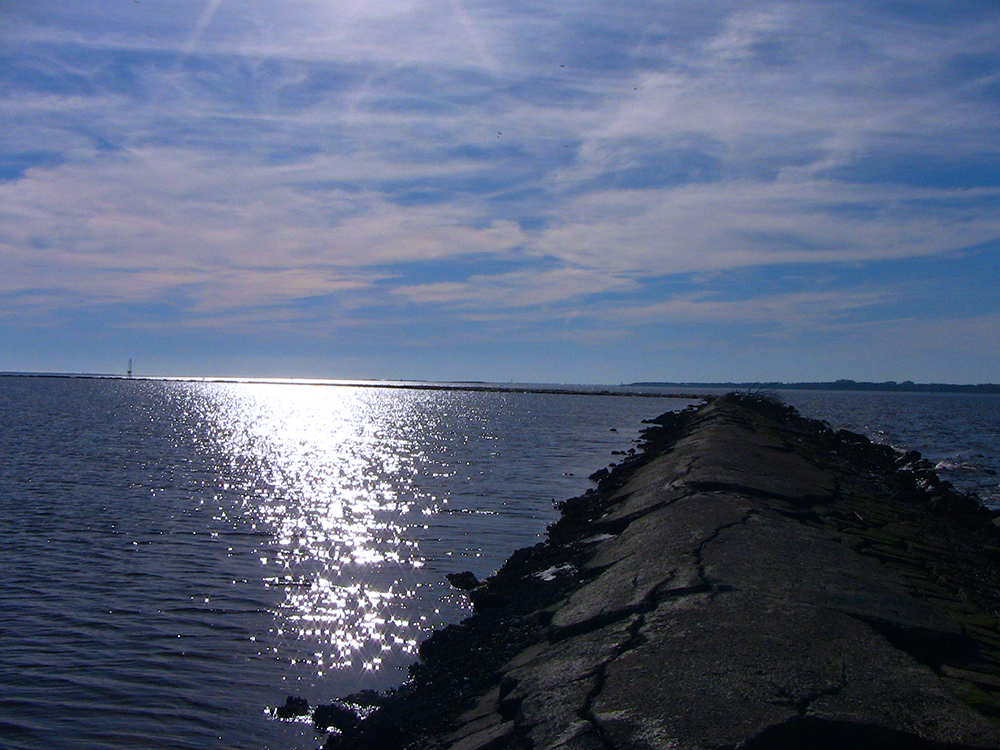
It’s strange how a place
can age-regress you—
fold back the years in an instant.
That’s what happened
when I stood there again.

There’s a man-made jetty
that arcs out to a small island
on the beach
south of Wilmington.

The photograph draws your eye inward—
just as standing there
drew me into myself.

Time collapsed.
Suddenly I was not just in a place—
but in a moment.

Our first day together,
our first real outing—
and the life we were about to build
had just begun.

Today,
the wind off the water
and the hush of waves
surprised me.

The place held the memory—
and the memory held me.


Post Traumatic Stress Disorder

I like to believe
I'm just like anyone else—
that we all have limits.

There’s only so much
pain, fear, loss—
trauma—
we can carry
and still remain
ourselves.

Still hold on
to our values,
our sense of self,
the person we hoped to be.

But when the weight exceeds that limit,
something breaks.

We drift.
Not into sleep,
but somewhere else.
A fogged place.
Out of time.
Out of reach.

Sometimes,
if we’re lucky,
we come back.

But not everyone does.

Reflection: This poem echoes the confessional tradition of poets like Anne Sexton and Sylvia Plath, whose work dared to name the raw edges of psychic pain. Sexton’s To Bedlam and Part Way Back still haunts me. I sometimes wonder if she ever could make it all the way back.

I did.
At least, I think I did.

But some nights,
the line between coming back
and simply existing
feels paper-thin.

Introduction to the poem

*“Dissociative fugue,” once called “psychogenic fugue,” is a rare phenomenon marked by sudden, unexpected wandering or travel, combined with amnesia for one’s identity and past. It sometimes involves taking on a new identity.

After recovery, memories typically return, and further treatment is often unnecessary. *

I felt this idea of a fugue state was a good metaphor for a time in my life.

Fuge State

I come to,
or awake,
finding myself already walking
somewhere unknown.

I’m not sure how I got here,
where here is,
or even where I meant to go.

A misty rain drifts down,
mingling with tears
that blur my eyes,
slide warm down my cold face.

Fog lifts off the street like smoke
as day slips toward night,
unwinding the edges of everything.

Street signs leer at me —
unrecognizable,
taunting with names that mean nothing.

I want to run.
Back.
Back in time.

Somewhere in this haze,
my mind glimpses
what can’t be real,
must be the
dream within
this dream.

Hours slip by.
My hands have gone numb.
Cold seeps through my coat
and down my back.
There is no sidewalk.
The winter streets slick with rain
or ice — I can’t quite tell.

Cars whip around corners,
far too fast —
their headlights slicing through me.
Each time I tell myself
they will miss me,
just like the last did.
Just like the lightning
will wait —
let me reach somewhere.

Not home —
that was long ago.
Home is gone.

Dogs bark in the distance.
I hope they keep to their fences,
hope I’m invisible.

No one knows where I am.
No one is waiting.
No one needs me
to get home safe.

Awareness trickles in,
thin as the lifting fog.
I stumble,
knees hit the cold asphalt —
not in reverence, only weakness —
and I whisper into the wet dark,
“Please help me.”

How pointless.
Even if belief could matter,
what would it change?

Walking again,
I see a convenience store glowing ahead.
A phone inside.
A roommate’s number
I can almost recall.

Being alone,
lost,
is a state of mind
that endures.

I will keep walking
unknown streets
in unknown towns,
alone
with no
identity.


* https://en.wikipedia.org/wiki/Dissociative_fugue


Lost

How did I get
so lost?

At first,
I thought I recognized the road.
A curve, a sign—
faint echoes of somewhere I’d been.

But then—
nothing familiar.
The signs made no sense.
The darkness deepened.

So I drove faster.
“Eventually something
will make sense,”
I told myself.

Fear crept in—
not ordinary fear,
but an existential kind.
The kind that whispers
you might not be real,
that no one is coming,
that even you don’t know
where you are.

My palms sweated.
Heart raced.
I was alone, in a dream
wearing the face of a nightmare.

So I turned off the road—
onto another,
even more unfamiliar.
No signs.
No map.
Just an instinct,
like something inside me screaming,
Anywhere but here.

But the fear didn’t fade.
It grew.
A new kind of terror -
not just from being lost,
but from knowing
I had once been found...
and still ended up here.

I’ve had this dream before.
Always the same turn.
Always the same ending.

The moment before waking,
I whisper inside the dream,
No. I can’t face this.

And I wake.
Still unsure
how I got
so far from myself.

Chapter 3: Haiku Moments

People have come and gone from my life.
There have been girlfriends.
But when something brings back an eternal memory —
the hush of waves, a hand on my skin, even a massage table —
it is never of them.

There are no gentle memories from childhood waiting to rise.
When my body recalls love, it returns only to Celta or Lynn.

These small poems are glimpses of that:
moments so deeply rooted they still live, waiting to be awakened.

Haiku Moments:


💍
The ring —
and her tears
of joy.

━━━━━━━━━━━━━━━━

The ocean sounds.
Her lap beneath my head,
fingers soothing my headache.

━━━━━━━━━━━━━━━━


At twenty-three,
through the eyes
of love,
I awoke.

━━━━━━━━━━━━━━━━

Watching the sun set
in my eyes,
in her eyes.

━━━━━━━━━━━━━━━━

Her voice on the phone.
I tremble.

━━━━━━━━━━━━━━━━

Walking hand-in-hand,
feeling cotton’s warmth
against my bare arm.

━━━━━━━━━━━━━━━━

In the moonlight
waves
from
waves.

━━━━━━━━━━━━━━━━

Bare trees on a silent night —
like my memories of her
and love itself.

━━━━━━━━━━━━━━━━

Silent winter night.
The sound of waves,
the comfort of her arms.

━━━━━━━━━━━━━━━━

Feeling numb,
my face where
tears have frozen.

━━━━━━━━━━━━━━━━

Curled up like an infant,
alone,
remembering her.

━━━━━━━━━━━━━━━━

The memory of her voice,
indistinct like the sound of waves,
takes my breath away, still.

Chapter 2: Meaning, Memories and Poems About Lynn

I met Lynn and started seeing her around the 4th of July of 1992. I had been grieving the loss of Celta when I came to Wilmington in April of 1992.

I found love briefly with Celta and yet she died so suddenly and at such a young age. I was devastated. I didn't think I would feel, or experience love again. Then I met Lynn in 1992. We fell madly, and passionately in love. The poems that follow are about that love. I wanted to tell the story to all those who would ever follow me in the later generations about some epic love to rival any husband and wife or any couple.

We lived as husband and wife and were married in every way that mattered. As a Catholic at the time, I sought the sacrament of Holy Matrimony from the Church, but they denied us—the disgusting attitude that someone born with a debilitating illness should be denied access to the sacred! This treatment of Lynn, among many other harmful attitudes, pushed me away from religion.

Lynn was willing to embrace any way of symbolically representing our everlasting devotion, even though she wasn't Christian. We both wanted to formally move from engagement to the next stage of formal commitment to one another forever. Now, no longer religious, I can see that if the sacred exists at all, no secular piece of paper could make our bond more holy than it already was.

For years we had a normal relationship, and the fact that she had a chronic genetic illness did not define our relationship.

Our love created a sense of tranquility and serenity at its core—a deep peace and contentment that existed at all times, even when I was depressed, which was merely a transitory feeling that would pass.

In its purest form, love is distinguished from addiction, which is momentary and transitory. We do not pursue a high that we once had and cannot reach again—that would be like implying that once we discover an awe-inspiring sunrise we need a more beautiful sunrise to feel that same sense of awe.

Love is also like beauty in the sense that it's best experienced as opposed to merely being stated like some universal truth. Creative people express these experiences of awe and wonder in many forms.

These poems capture more than fleeting moments—they hold experiences where physical sensations became markers of something profound, eternal, and awe-inspiring. Each moment contained vastness, pointing to the spiritual that even non-believers in the supernatural can embrace. They are signifiers of what endures and give ultimate meaning to what really matters.

An Infinite Beach

On some beachA couple at the beach
that never ends
I'm with her
and just for a moment
I pretend
that things never change
that sometimes,
in moments like this
we walk hand-in-hand
forever.
This is my greatest desire -
to stop time
like this...
when there is just this place,
just these beach sounds
and just
she and I.

Couple in love in silhouette
What Really Matters

Moments
frozen in time.

That is what love
seems to be...
these moments you remember
something in these moments
(takes my breath away)
has a certain meaning
that endures -

a feeling...
an image...
something said...
or shared...
certain sounds
in the background...
whatever it is that
you remember
is all that really matters.

Introduction: We walked into the Coastline Convention Center that Sunday evening in 1995, hand-in-hand as usual, overlooking the Cape Fear River where the weekly poetry readings were held. Lynn had no idea I had a surprise for her.

We took our seats at a table with other regulars—all friends and acquaintances who knew us as the couple we were, always like newlyweds, never afraid of public displays of affection. The sun was sinking low, and the room was getting slightly dark with just a dim light up front near the podium.

When my time came, I stepped boldly to the microphone. As I read this new poem, I could sense the knowing glances from people in the room—casual looks toward Lynn as everyone understood what was happening. I wonder if she noticed those glances, waiting for her reaction to this declaration of love.


Dreamlike Visions

In this dreamlike vision 
I lay in her lap,
while her golden hair
flows in the gentle wind,
On the beach.

Is this real?
I reach up to touch her
but she is gone... gone... gone
and I am laying on the sand.

Looking skyward I see her
in a vision.
She searches for me,
calling my name, saying,
"I am his and he is mine."

I try to get back
to find her
and that infinite beach
where we would walk hand-in-hand
or lay on the sand
holding each other
together
forever.

The vision -
the dream -
(incomplete)
the love
never ends...
The dream never
ends.

Follow-up to the poem: I sat back down next to Lynn as someone else prepared to read. I noticed she was doodling. One of our mutual friends commented on how much he liked the poem. I turned to Lynn and asked, "So, what do you think?"

"What?" she said, looking up confused. "I'm sorry, I wasn't listening."

I shook my head and smiled. She was embarrassed, her face blushing. "I thought you were only reading poems I already heard," she said. "Oh, I'm so sorry sweetie. Let me read it."

I handed her the poem and leaned in close, my arms resting on her chair. I tilted my head and slowly brought my lips to hers. She held my lips there with her hands on both sides of my face—just for a moment, mindful of the others around us.

"It's okay," I said with a smile. "You know what... I really love you."

"I love you too, honey."

She read the poem, visibly moved by this surprise declaration of love.

This became an inside joke for us. I would tease her: "If I share a poem about our love, I hope Lynn is listening?" Her way of making up for it was to read this poem at future poetry events when she didn't have anything else to share. I can't count the number of times that happened, it demonstrated her appreciation and recognition of the value of our love.

I explained that the poem was inspired by the Song of Songs from the Old Testament and a song by the Electric Prunes called "I Had Too Much To Dream (Last Night)." I was drawn to the sensual imagery in both—the biblical celebration of love between two people committed to each other, and the dreamlike quality of the song that captured something both beautiful and haunting about love and longing.

In Love

Some would say they understand 
that it is not that uncommon... 
a word that is overused 
because I can't find another word.

People walking past us 
might have seen us holding hands 
they might have known 
there was love.

Yet they would not understand... 
the miraculous experience 
of her hand in mine 
as we walked by the ocean. 
They would not understand 
the experiences – physical and emotional 
signifiers of something worthy 
of belief.

When we sat side by side 
facing the ocean waves, 
hearing them in the background 
seeing them - 
moved by something unseen - 
our bodies were touching 
and the best analogy for what I experienced 
was electrical signals moving 
at each point where our bodies 
our legs, arms, thighs 
were in contact.

This was not merely something 
physically pleasurable, 
not merely biological 
emotional, chemical.

No, I knew that. 
I have felt passion 
but rarely have I felt 
love – though I have been 
mistaken more times than I can count... 
Meaningless encounters 
where the emptiness remained.

That core Self within me 
ready for connection was not 
fulfilled like it was now.

Waves of excitement, peace, 
serenity, joy, clarity 
flowed through moments 
pregnant with meaning. 
Each moment was vast in duration 
each moment held eternity.

I had an epiphany and knew 
what mattered, what gave life meaning 
what filled that emptiness within 
that brought forth the fullness of the 
Self.

The feelings, moving in waves 
were markers of the profound - 
physical sensations that pointed beyond 
themselves to something transcendent, 
something that could not be reduced 
to chemistry or biology alone.

I have known alcoholics that look 
to a higher power. 
I have known the religious who 
speak of a God who alone 
can fill that emptiness 
within.

Everyone is looking 
for what will complete them, 
searching for transcendence 
in substances, in faith, 
in achievement, in escape.

But I have found something - 
I believe in something - 
I believe in love.

I can't prove it exists 
beyond hormonal desires 
beyond biological drives 
beyond what science can measure.

But I know what I experienced: 
love that is true 
and real 
and right...

Love that transforms 
without diminishing, 
that changes you 
without erasing who you are, 
that asks you to grow 
but never to disappear, 
that leads toward transcendence 
while keeping you whole. 
It shows you eternity 
in peaceful moments 
yet never asks you to sacrifice 
the fire of excitement, 
the expansion of joy, 
the sharp clarity of being fully alive, 
the creative force that moves through 
two people connected 
in the deepest way possible - 
embodying what it means 
to be complete 
while remaining yourself.

I Wrote a Love Poem Once

I wrote a love poem once...
I felt it was good -
I remember how good it felt -
the love...
to write the love poem,
to share it,
to dedicate it.
I felt the poem was good.

It was many years ago...
lost - lost in the fire,
as it were,
the love...
the love poem.

I forget how it goes
the love...
the love poem.


I just cannot remember
the words I wrote...
but I know I wrote
a love poem,
once...
or twice or more...

I can't quite remember
how it goes -
that feeling,
that certainty,
that desire to feel
that again.


Introduction to Poem “The Whole Story”

Our mutual friend Jean once observed that he saw us argue often, and I was shocked by his concern. Years later, after experiencing a relationship where disagreements felt threatening, where conversations could end with hang-ups, where love itself seemed in jeopardy over differences of opinion - I finally understood what Jean had missed.

With Lynn, I never hung up the phone. When she said, 'I'm not done talking,' I never said we couldn't keep talking. The cognitive dissonance I felt when Lynn challenged my beliefs didn't threaten our bond—it transformed my thinking, because I respected her completely and knew she respected me. Isn't it strange and amazing when you can become so frustrated and irritated in a relationship with someone special but still maintain that pervasive sense of happiness and contentment! Even despite all the fights and arguments, there was always an underlying joy. That is the ineffable nature of what we had—something taken out of context might look like conflict, but within the whole story, it was actually love expressing itself freely.


The Whole Story

Our love is now like an epic novel,
thousands of pages in length, 
with most pages torn 
others burned - in the tragic fire.

 I tried to save what I could 
believing it was worth saving
or worth holding onto - 
believing that nothing dies 
but in the end, 
what do I have? 


Just scraps of the book...

Even the ring that symbolized 
the bond of husband and wife 
is gone.

We wrote the book together - 
I remember how it was, 
page after page, 
chapter after chapter, 
lie scattered around a room 
in a forgotten home 
in a forgotten place 
like dark shadows 
under a hazy sky.

Page after page, 
written with a purpose 
written with love.

Sure, there were chapters 
that didn't seem to belong 
or have any purpose that could be understood 
but every part of the story 
had a purpose and place, 
whether good or bad 
within the larger narrative.

This was a story to be told 
for generations to come - 
passed down within the family 
and as part of a cultural tradition.

Looking back, 
at the whole book 
and not just a chapter here 
or there, 
taken out of context, 
you see a theme 
which emerges out of the many 
unplanned chapters.

It was always about love 
and that matters 
more than the quality of the narrative... 
it matters more than 
how things might have seemed 
at any one moment in time.

Chapter 1: Remembering Celta

Before I met Celta, I was 23 —
out of a childhood of emotional deprivation,
past undergrad where I somehow believed
I was becoming confident —
an extrovert on campus,
but not at parties,
not in groups of more than six,
still too shy to speak in class,
still escaping to the movies alone
on Friday afternoons.

I thought I was becoming someone.
Still, I was mostly surviving.
Still needing to grow.

Then there was her.

She was the first
to see me in a way
that made everything before
feel like a long, dim dream —
a story I try to tell
about life before 23,
but it’s mostly devoid of detail.

It’s not that I have a bad memory.
Some things are still vivid —
like being four years old,
floating in the YMCA pool,
held in someone’s arms,
and feeling certain
I didn’t deserve to be held.

But most of those years
blur together.

Maybe because I hadn’t really begun
to live yet.


Another Place, Another Time, Another Life

We used to walk
hand-in-hand
at the Botanical Gardens —
in Athens, Georgia,
following the paths.

This was my escape,
my other life.

And what I felt
is hard to put into words,
but I can say
that this...
        this sustained me.

(The feelings remained
and echoed throughout the upcoming week) —
until I could see her again
a week later.

We lived in different cities.
I lived with abusive parents —
I suppose I chose this.
I was an adult.

What I felt
            not just holding her hand,
or wrapping my arms around her —
but the way she held me,
chose to be close to me...


Perhaps there’s something else
I am leaving out...

Maybe it has something to do
with love.

Her love?
Mine?
Both.

I don’t know...
maybe because I had not known love —
from anyone, at all, ever,
before I was 24.

The Swing

Three of us are walking
in a small field—
the girl I loved,
myself, and her friend,
whom we had come to visit.

We came upon a swing,
and as I remember it,
I am in front of her
pushing her gently—
away, knowing she would return.

It wasn’t the way her hair
was caught in the sunlight
before me,
nor the smooth,
calming, undulating motion
of the swing.

It was what happened
in the quiet that fell—
a pause in time—
when our eyes locked,
and everything else faded
from our awareness.

David’s voice grew distant,
his presence dissolved.
She saw only me.
And I saw only her.

In that moment,
there was no one else.
No labels.
No explanations.
Only knowing.

After so many years—
decades—
I still remember this moment.

That’s what love is.
The kind you feel
in the body,
in the silence,
in the return
of the swing.


Where the Love Was

They said you were an angry woman —
but where was your anger at me?
Could you be so angry at the whole world
but not at me?
Not ever?
(We had only a year.)

I guess that has something to do
with love — our love.
I kept waiting for that anger
to turn on me,
for me to do
something
to provoke it —
yet I only saw
your smiles at me.

That’s where the love was.

And what about the
I love you’ s
we exchanged?
I’d never heard those words
or said them
so many times.
I never felt so moved
to say “I love you”
until then.

That’s where the love was.

Or maybe it was in certain
snapshot memories...
Like that day in the park —
I was telling a story from my past,
not even a remarkable one.
But when I looked up,
your eyes were on me —
captivated, hypnotized,
transfixed.

I still remember it
decades later,
along with so much more.

That’s where the love was.
Or is.

And finally,
it was in all the tears
I shed when I heard you died.
I never cried before that.

The love,
it’s in the memories —
in the knowing
that you are always a part
of me,
and I, a part of you.
There’s comfort in that.

I guess love isn’t
just a place
long ago.

Maybe I really didn’t believe
that someone could love me —
or be so deeply interested
in me.

These days,
or in the past few years,
I seem to have needed something
more
than just a touch
to feel anything as intense.

And most importantly —
it’s not the intensity
that matters,

but the overall mood,
the mindset of the relationship —
that is what matters.

What Really Matters: Poems about Love, Loss & Trauma

This is the story of a life told in poetry—of a boy once invisible who came to feel seen through love, and of a man who lost everything when that love was torn away.

It began when I met Celta, the first person who looked at me as if I was worth loving. Through her eyes, I woke up from the long fog of emotional neglect. After her tragic passing, I met Lynn—my soulmate, my home, my reason to believe that healing was possible.

Nihilism

Some look to a God.
They say our endless striving
to fill the emptiness within
is misguided—
because only God
can fill the void inside.

But—

Stop looking for meaning.
There is none.

It is not within.
It is not without.

Can a newborn baby
love itself into existence?
Does it exist
before it knows itself?
Without language,
without thought—
is it truly real?

There is nothing outside.
There is nothing inside.

There is—

Nothing.

In Love

Some would say they understand. 
That it is not uncommon— 
a word overused 
because no other word 
will do. 

People walking past us 
might have seen us holding hands. 
They might have known 
there was love. 

Yet they would not understand— 
the miraculous experience 
of her hand in mine 
as we walked by the ocean. 

They would not understand 
the moments— 
physical, emotional— 
signifiers of something worthy 
of belief. 

When we sat side by side, 
facing the waves, 
hearing them crash, 
seeing them— 
moved by something unseen— 
our bodies were touching. 

The best analogy I have 
is electricity: 
signals moving 
at each point of contact. 

This was not merely 
physical, 
not merely biological, 
not merely emotional 
or chemical. 

No. 

I have felt passion before. 
But rarely—so rarely— 
have I felt love. 

How many times have I 
mistaken one for the other? 
How many times 
has the emptiness remained 
after meaningless encounters? 

That core Self within me, 
always ready for connection, 
was never fulfilled— 
until now. 

Waves of excitement, peace, 
serenity, joy, clarity 
flowed through moments 
pregnant with meaning. 

Each moment was vast, 
each moment held eternity. 

And I had an epiphany: 
I knew what mattered. 
I knew what gave life meaning, 
what filled that emptiness, 
what brought forth the fullness 
of the Self. 

The feelings, moving in waves, 
were markers of the profound. 

I have known alcoholics 
who look to a higher power. 
I have known the religious 
who speak of a God 
who alone 
can fill that emptiness within. 

Everyone is looking. 

I believe in something. 
I believe in love. 

I can’t prove it. 
I can’t tell you it is different 
from passion, 
from hormonal desire, 
from biological drives. 

But I believe in love. 

It is real. 
It is true. 

Transformative. 

And it leads toward transcendence, 
showing you 
serene eternity— 
without sacrificing 
excitement, joy, 
expansiveness, calm, 
clarity, creativity. 

Love embodies connectedness. 

And that is enough. 


Darrin is Happy And the Meaning of Life

Samantha asks Darrin,
"Are you happy?"

Darrin says,
"I have a beautiful wife,
a beautiful daughter,
a nice home, a great job…
Yes, I am happy."

Darrin believes Sam loves him.
But is he happy because Sam loves him
or because he loves Sam?

Earlier, he was stressed—
a demand from work,
pressure from his job.

So, does his job make him happy?
Or does his job only make him happy
because of the love of Sam,
his love for Sam,
and his love for Tabitha?

But Darrin doesn’t need Tabitha
to love him.
She is too young
to love in a way he would notice.


They say you shouldn’t need a relationship
to be happy.

They say you must first love yourself.
That you must already be happy.
That no relationship
can give you
what you don’t already have.

If that’s true,

then would Darrin still be happy
without Sam?
Would Sam still be happy
without Darrin?

Could they lose each other
and be just as fulfilled?


Darrin was happy before he met Sam.
But this happiness is different.
This happiness is more.

Darrin cannot say
that life would be just as good
without their love.

Would Sam say the same?

If they lost each other,
wouldn’t they grieve?
Wouldn’t they ache?
Wouldn’t they know, undeniably,
that what they had
was greater
than what they were alone?


Since Darrin loves Sam,
and since Darrin believes
that Sam loves him,
and since Sam believes
that Darrin loves her,

then neither must have needed
to be in a relationship to be happy.

And yet—

if they lost their love,
would they be happy?

Wouldn’t that happiness—
the happiness they were told
had to exist independently—
collapse under grief?

Then was it ever separate at all?


What is the meaning
of Sam’s love for Darrin?
What is the meaning
of Darrin’s love for Sam?

What is the meaning of each’s love
for themselves?

What is the meaning of happiness?

What is the meaning of life?

To Be A Ghost In the Community

I heard Michael Jackson singing,
"I always feel like,
somebody's watching me." 
 

Is he paranoid?
I'm curious about that concept.
To believe that one is so noteworthy
that others would stare. 

I think it is more frightening
to hold as a belief or
to be a ghost - invisible -
to walk these streets,
to walk into places,
to go about your day,
and have no one notice you
at all 
nothing you do,
good or bad,
great or small
gains the attention
of anyone...

or so you believe...

And you are not on the mind
of anyone
who will wonder
when you are getting home,
or worry if you are late...

To be invisible
is more frightening.