
memoir

Chapter 32: My Other Family and Sexual Discovery with Lynn

My Other Family

I was still maintaining a relationship with my parents and siblings. But I only saw them for part of a day most of the time when they did visit.

I think that when my brother and/or sister came they came for part of the day only, as well. I guess they were too good for us.

While I had sought their advice regarding the moral dilemma of living with Lynn and how we couldn’t get married, it seemed clear that they understood I had no other options available to me. And it seemed infinitely clear that we were living as husband and wife and that we made love routinely (almost every day).

Then we went to visit for Christmas, and Lynn suggested that we sleep in different beds because we were under their roof. Symbolically, this felt so uncomfortable. It cheapened the relationship, made it seem less than the union of two becoming one body and one soul.        

In my mind, we had been married in the eyes of God. When Lynn said that we should sleep in different beds at my parent's house around Christmas, that seemed to only confuse me. 

In retrospect, if I had said that they must see us as two people who are committed to one another like any husband and wife, she would have been open to my reasoning. I should have said, “well, if they dishonor our union, I am not going there!”

I should have said to them that if they want me to visit for the holidays, we will be sleeping together like any married couple.

To be honest, our union seemed more holy or special than anything I saw in my grandparents, cousins, parents, or even with my brother and his wife.

I would be so affectionate with Lynn everywhere and all the time. I had seen my parents kiss, but it was so perfunctory. I am not saying that a couple should make out in front of others, but they should look like the kiss says something like Lynn and I did. We took the time to meet each other’s gaze and slowly moved toward one another, letting our lips meet and pause for just a moment.

I don’t remember my brother ever showing that kind of affection when he brought his wife for the holidays. 

With Lynn and me, it was inescapable and unavoidable… for us to hold one another, hold hands. I also loved this because it was a declaration that said, “I love Lynn!” 

Actually, I NEEDED to be close to her and feel her body when I was visiting my parents. I had never felt completely comfortable with them. 

Despite knowing that what we shared was so right, so blessed, so holy, somehow, I sometimes couldn’t shake the religious brainwashing I had experienced.

I don’t know what I said but it gave Lynn the impression that I had doubts about what we should be doing.

Then Lynn would ask, "do you regret what we did?"

I would answer, "no, of course not."  

I don't think she understood what I was saying because I didn't quite understand what I was saying.         

In my mind, this was not any less holy than the union of my parents, or grandparents, or less holy than any union of any husband and wife. If anything, this was more special than what I had seen. In my extended family, I never saw anything that said, “I can tell they are in love.”   

Intimacy Issues as a Form of Discovery

I do know some things about how couples make love. As a psychotherapist that is something that is discussed. I learned about the male and female sexual responses. I studied master’s and Johnson’s research on activities that are practiced by couples. 

What was unique about our relationship, the one Lynn and I had was that neither one of us expected the other person to have any experience in this area or to be sexually compatible. It was more of an area of discovery for both of us. 

Some though not all gay men do enjoy anal sex. Often among heterosexual couples, this is more pleasurable to the male because they think the anal passage is tighter. While some females may want this, it is more common for males to ask for this. 

This was not something I was seeking in my relationship with Lynn nor was she. 

Speaking of same-sex relationships, oral sex is another way that people express love and is commonly practiced by gay men. I would learn this from my clients in the future.

I knew that this fluid is made up largely of the same components as mucus. That fact made oral sex seem unappealing. Previously, I mentioned when Lynn was in the hospital or at the clinic and she was asked to provide a mucus sample, I noted that I had a weak stomach, meaning it made me queasy.

These observations about mucus meant that I did not expect, nor did Lynn expect oral sex despite the fact that this is “normal” and commonly enjoyed by the recipient. 

No part of our bodies was “taboo” though. We both endeavored to explore anything that would increase the pleasure of one another in bringing about an orgasm. So, we did everything short of activities that would involve tasting each other’s bodily fluids. 

I felt such incredible love for Lynn that I wanted to demonstrate that in every way possible. I knew she wanted to do the same for me and with me. 

But it was more of a case of exploration and discovering what brought us the greatest pleasure and what we were both comfortable doing. 

I felt so lucky that this was happening. I felt lucky to know that I wasn’t expected to do anything with some level of competency as I had heard discussed later in couples therapy or with my individual clients. 

I felt lucky also that we weren’t talking about sexual competency. 

Sex was for us a way of expressing our love and it was intense and intensely pleasurable as a result of the love that we felt for each other. 


After we knew what activities, we were comfortable doing we could offer or ask for certain things. I was still a believer (a Christian), and so I saw this as a blessing, a miracle, and a true sense that we were one body. Our bodies were our gifts to one another. And that was holy! More holy than I could have imagined.

As an atheist, I still see things in the same way, but I use different words to describe things. I know some atheists, such as Sam Harris, describe spiritual experiences, but I still associate that with the supernatural and I do not believe in such things. 

I’m a romantic and I believe in the concept of the two become one and are united forever, which is as long as we exist. 

Chapter 31: Living as Husband And Wife without Marriage But With Cystic Fibrosis

As I mentioned, Lynn and I couldn’t have a wedding because our combined income might make her ineligible for the insurance that would cover her treatment.

Okay, so this speaks to just how madly in love with Lynn I was. Anything happening to her was terrifying. I had asked her to marry me, given her a ring, and committed myself to her forever. But without a wedding or a “legal” marriage. 

We even tried going to the Catholic church to get married but without a marriage certificate and they would not allow that. The fact that we didn’t have a wedding didn’t change anything.

If you are thinking that I imagined getting married to someone else someday, the answer is NO! I had found the one for me! Lynn. So, my commitment to Lynn was forever.  

Let this all sink in for a moment. We were in a rush with time hoping that they find a cure for Cystic Fibrosis - a genetic illness - so that she would live past her fifties. That's what I needed!  

Treatment can cost several thousand dollars per year during good years. Even her mother could not afford that. 

What do I mean by a “bad year?” And what was it like in general, even during good years?

Occasionally, she would use an inhaler but that didn’t seem to happen very frequently. 

I drove her or we drove together to her clinic appointments in Chapel Hill. From Wilmington, that was a drive of over two hours. It happened for the most part only once a year. 

They would check her oxygen saturation… take X-rays to see the scarring and the buildup of mucus in her chest. 

Lynn was good about letting me sit in on every meeting, such as when she was taken to a room to be examined by first a nurse and then a doctor. 

Most of the time we were very lucky because she was so very healthy for someone with this very serious and debilitating disease. 

I might have turned away or left a room when they wanted to collect a mucus sample. Lynn understood that I had a weak stomach. 

Anyway, so much of this was becoming routine. Most of the time. 

I asked so many questions all the time. “What is that dark spot in her chest area that you described in the X-Ray? Is that mucus or scarring?”

The doctor would answer, “well, here is some excess mucus that needs to be cleared, and here is some scarring?”

“Wait how do we clear that mucus?” I asked.

“Have you learned how to do the tapping?” the doctor asked.

“Yes, we learned about that from the physical therapist.” I answered, adding a question “but it’s still worrisome?”

Then I asked, “What about that device that she is supposed to wear, is that better?” 

“Not necessarily,” the doctor answered. 

Then Lynn said, “it doesn’t clear it out for me, I can tell it’s still there.” Then she turned to me and said, “I told you about the problems and asked for your help the other day.”

I felt so guilty. “Oh, my God, Lynn, I am so sorry.” Adding, “it’s scary for me. I know you need me and I’m trying. I’m scared when you are not well. That makes me feel guilty because I should be there for you… but I get sad and scared about the meaning of these problems.”

I paused and added with tears running down my face, “I want a ‘normal life’ … and if anything happens to you… I just love you so much, you make me feel good and happy. I can’t imagine not having you with me.”

“I know sweetie, I have had more time to deal with this,” she said.

“Okay, so I still have a lot of questions,” I said. 

“Okay, ask away,” answered Lynn with a smile that said she knew I really cared.

Then turning to the doctor, I said, “so, how often and for how long should I do the tapping to clear up the mucus as it builds up?”

“Well, about 15 to 30 minutes at a time in the evening would be good,” answered the doctor. 

“And the scarring, that looks big, what…” I could barely get my words out I was so full of anxiety and sadness… trying hard to be strong for Lynn. 

It is SO MUCH easier to do this with clients or patients at a psych hospital. 

Dear reader, I hope that is somewhat intuitive but maybe I shouldn’t assume. I wasn’t in love with my clients or the patients I served. We weren’t sharing our lives together. They were not in love with me either. At least I hope not – that’s another issue for later.

Also, the big secret that I have been avoiding is that Cystic Fibrosis is a deadly disease! I could lose Lynn forever!

My blood runs cold when I think of this as it did at the time. It’s interesting how similar sensations can feel so different. When we were at the clinic discussing these matters, I could feel chills running through me… not the kind that I felt at the touch of Lynn’s hand or her lips on mine.

I was, for the most part, able to push these issues out of my mind and not think about the reality of it. But on these visits, we had to look at this darkness in our life. Scarring and mucus appeared as dark patches on the X-Ray of her lungs.

In answer to the question I posed about the scarring, the doctor said, “her lungs still have a capacity to breathe and get enough oxygen to function in many normal activities.”

During the visits, I would learn about how the scarring makes the lungs less elastic and that makes it harder for them to expand and get enough air to engage in certain activities that we take for granted… running, hiking, or walking long distances. And scars don’t heal.

So, even if they had a cure that doesn’t mean that everything would be fine.

When her health got worse…

There was a time in late 1996 when Lynn had to go into the hospital. Her lung functioning had gotten poorer or weaker and they wanted to put her on IV antibiotics in the hospital. 

The doctor had explained that they wanted to go after the infections in her lungs. They had to try some of the latest antibiotics that were thought to be more effective in people with Cystic Fibrosis (CF). They were always learning new things about the disease and people were living longer. 

It was scary for both of us. Waiting there in the lobby of the hospital I tried to stay positive and tell myself that things would be okay. 

Then she was brought to an inpatient unit that was used for treating individuals with CF. 

When Lynn asked me to get her something from downstairs – a drink and a candy bar – I was somewhat glad to have that opportunity. I was struggling to stay still. That’s how anxious I was. I had a strong urge to walk. I couldn’t sit still hardly. I was also sick to my stomach. That’s what happens when I am anxious or scared. I felt queasy or nauseous. 

I held her hand as they inserted the IV. I asked the nurse “what is that?” referring to the fluid that was being introduced into her IV. 

“This is just saline solution,” she answered… adding, “the doctor will give us an order to tell us which medications to give her.” 

I was sitting on the bed looking at Lynn. No words were spoken for a few moments.

“Do you want a book, or to play cards?” I asked, “or how can we pass the time?”

Lynn asked for a book by Anne McCaffery, one of her newest books that she had not read.

“I want to stay with you,” I said. 

“I understand,” she answered. “I am glad you are with me.”

“Me too.”

I added, “I can just be reading something too with you.”

“Okay, that sounds good.” 

“You can go meet my friend Carolyn,” she said. This was a friend who also had CF and she lived in Chapel Hill.

“Yes, we will see her when you get out too,” I said. “Before we go home.

Visiting hours don’t usually allow people to stay all night. That night I was in bed next to Lynn, on her left. She was asleep with my arm resting on her stomach or her chest. I just wanted to feel her breathing. We made sure the IV was out of the way.

I heard the door open, and I looked up to see a nurse checking in. She didn’t say anything. 

This finally ended and she came home. Our life went back to normal.

Chapter 30: Doing Therapy During My Internship

My tasks allowed me the opportunity to get to know others in a therapeutic setting. Recall that when a person is admitted to the hospital there is a short period of time during which the intake assessment for each department must be completed.  

Unlike during my first year when it seemed like they were making work for me to learn as a requirement for an internship, this was a setting where I was being asked to do something that was required by and for the hospital.  

This wasn't busywork. If I was asked to complete this, I was being counted on to do this. It was necessary and required. This made me feel so much more useful than during my first year where it was hard to see that I was making a difference. Also, as I said, Chris knew what I was learning from him and through my studies.

Instead of feeling bad about volunteering my knowledge, wisdom, and insights, I saw that what I was offering was valuable information to consider when evaluating what a patient was experiencing and perhaps how they could be helped. 

I had mentioned that during my first internship I had some doubts about my competency. I chalked up every "mistake" as a learning experience. 

Okay, so during the intake assessments we try to get a lot of information from a patient. Why they are in the hospital as they understand it... what has been going on in their lives... are they married? Do they have children? Can they describe their symptoms and problems? And so on.  

The ability to gather information from a person requires building rapport, creating trust, demonstrating empathy and compassion. The quality and nature of what you learn, what information you are able to gather, are a reflection of your skills and talents in this area. It’s also important to ask very open-ended questions as much as possible because the patient knows things that we don’t.

As you can see, I have come a long way from the young man who needed counseling to learn social skills, communication skills, and how to control my anxiety - social anxiety.

I constantly reflected upon how good I felt about having accomplished so much. Over a decade of hard work had been invested in getting me here where I am in my late 20s.  

It also seemed that when you do demonstrate respect for others, empathy, and concern, they want to talk about their experiences. That was my observation time and again. Chris recognized my growing talent and eagerness and let me start doing some brief therapy with patients. Because the patients were not in the hospital very long, the therapy had to be brief.  

Chris gave me some pointers as to what I might want to do when I sat down with a patient - what kinds of interventions might be helpful. I discussed what I had been learning in my classes and other studies. 

What might I do in a session with a patient? Well, if they are dealing with major depression, we could try Cognitive Behavioral techniques where we learn to challenge automatic thoughts that create negative emotions.

With trauma issues, deep relaxation techniques are very helpful in talking about a disturbing event. I would demonstrate or guide a person in the use of guided imagery and deep breathing to create relaxation. 

By that time, I was clearly demonstrating empathy and powerful listening skills. I received that kind of feedback from Chris when I turned in notes about my activities, but I also had that impression from the feedback that I received from the patients. I’m not saying they gave me a score on empathy and listening skills but there were so many times when I noticed how much people wanted to share their stories and feelings with me.

There were various opportunities when I was on the unit where patients had a chance to approach me and ask to talk about an issue that had come up in a group or from our earlier conversation when I did the intake assessment for example. Sometimes all I did was just listen with empathy. The experience of being in the hospital is not likely to be a pleasant experience. 

This kind of listening may not sound like a technique but in the psychological theories that were developed by Carl Rogers, unconditional positive regard and empathy are valuable tools.

I would tell them when I met with them for therapy that I was going to write up notes about what we discussed in therapy to see if it could be helpful to others who might be offering treatment for them. I instinctually felt that I could and would offer to let them tell me something and ask that it not be recorded in the notes.  

Gender issues were never relevant. I mean the fact that I was male was not a factor in a patient choosing to disclose any details about what they had experienced. Sometimes you might think that a woman might only talk to another woman about something traumatic, especially if they were victimized by a man.  

What probably intrigued me the most was the experiences that people with schizophrenia or psychotic disorders might be having. I thought that if I could demonstrate empathy, understanding, and compassion, and be able to help people struggling with these issues that would be something amazing. 

In seeking to help someone with a psychotic disorder, treatment might include active listening which means summarizing or rephrasing what someone just said to see if we can understand one another. That connection is so important. It’s sad but some people with schizophrenia will develop serious problems with communication and what they say might not make any sense. I believed I was making a difference by listening and trying to understand.

There is a great deal of research that demonstrates a genetic predisposition for various psychiatric disorders. However, it seems from my own experience that being confronted with major life stressors, even stressors that might not seem like traumatic events, and any person can develop a range of different symptoms – hopefully, that is temporary. 

I did file away the observation that so many people were coming to the survivor groups, even though trauma was not an issue that necessarily had an impact on why they were admitted to the hospital. 

Often Chris was present in the group sessions even when he allowed me to lead the group. I would talk about relaxation techniques as Chris had done. I would employ the kinds of guided imagery exercises that were used in the groups that Chris led, meaning, I invited them to follow along with my suggestions or guidance.

I know that I have covered a great deal here and may not have been overly specific when describing theories and techniques or what I specifically did. I'm not trying to give psychology or psychotherapy lessons, per se... but I will go into greater detail later in the book.  

Chapter 27: Working with People with Mental Illness

There was one other job that was very rewarding and fun. I worked the weekend shift at Sherwood Village, an Independent Supportive Living Apartment Complex. There were roughly 30 apartments that housed 30 individuals.  

I was on-call with a beeper for a 48-hour shift from Friday at 6 PM until Sunday at 6 PM. It was a supportive independent living facility in the sense that everyone lived independently but someone was on staff 24 hours per day 7 days per week. This was a place for persons with severe and persistent mental illness. It was called Sherwood Village.

By now I was a graduate student with so many other responsibilities and things going on in my life – a life with Lynn.

I was responsible for transporting the residents to the movies or other similar events. They had a van for me to transport the tenants. I didn't go with them to the movies most times because tenants that chose not to go on an outing might need my services.  

I was allowed to go home with the pager that any of the residents could call if they needed me.  

It was a great job, and I was well-liked by everyone. I stayed on with this position until I got my master’s degree and could move up into a more professional level position.  

It was fun to get to know all the residents. They said they liked me better than the staff member who worked from Sunday at 6 PM through Friday at 6 PM. So, that felt good to know.  

The only activity that I had to do as someone who is "in charge" was to do some inspections of the apartment - mainly that was inspecting the A/C filters and other things like that. Obviously, there were some things that are important to promote a person's overall health that I had to oversee.  

They knew I had a job to do for the landlord and the managers that maintain the apartments. I obviously had to make sure people were okay, but it wasn't like in a hospital unit where someone might come by every few hours. Most tenants were relatively high functioning, so they weren't going to wander away and disappear.  

They had their own cars in some cases and there was no curfew or anything like that.  

It was extremely rewarding because I NEVER had an issue with any of the tenants not liking me.

This would be a common theme in my career overall where the greatest challenge was with paperwork/charting, bureaucracies, staff expectations, and in my role as a member of the staff. 

During this entire decade and into 2000, I NEVER had negative feedback or opinions expressed by anyone I served or helped – with clients, patients, or tenants everything went so smoothly. 

The job was awesome overall. I mean I was getting to know these people and feel like I was part of a family. I considered them part of my family in a way. I mean I liked everyone there. One or two residents were distant and didn't talk much but most everyone was great to know.  

I didn’t think the staff for whom I was working had too many rules. I was on my own for most of the entire weekend and for most weekends. The only people contacting me were tenants/residents.  

I could visit them inside their apartments. Obviously, that could be problematic with female tenants, but it never became an issue. If there was more than one person in the apartment, I didn't feel too concerned about spending some time in any of the tenant's apartments. Sometimes there were emergencies, and that required spending extended time with a particular tenant who was in a crisis situation.  

These crises rarely happened. I do remember one woman having a seizure and I was on the phone with EMS. I had to return to Sherwood Village because I had gone home with the pager when I got the message to call the tenant's phone number.  

Residents of Sherwood Village had disorders such as schizophrenia, Major Depression, Bipolar Disorders, and so on. These disorders were characterized as severe and persistent mental illnesses. That is likely a designation that is necessary to obtain funding.  

I obviously was made aware of the diagnoses of each resident. I also had to know what medications they were taking, physical problems, and other important information. This was all on file in the office. I was given a couch in the dayroom or I could sleep on the couch in the office if I needed more privacy at night.  

I ran the tenant meetings which were held about once a month. Most of the tenants came for the meeting that was held in the dayroom which was a place where people could visit during most hours such as 9 AM to 9 PM. I could certainly spend additional time with tenants in that room if they needed to talk to someone.

Hopefully, you can imagine why this job was awesome for me. And why they all felt like my family.  

It also is important to note how comfortable I felt running the tenant/resident meetings. Unlike reading my poetry to a group, this was more like directing a group event.

Yes, I felt so comfortable interacting with everyone as the person that everyone turned to for help whatever their problems were. I was starting my graduate studies during this time period, so I had been learning other skills in college (graduate school) to help me in counseling individuals in need and how to run group sessions.  

I wasn't actually doing therapy yet but some of what we do as therapists is to listen to others with empathy. To help people feel safe. To be someone who others turn to for help and support.  

We also had a Christmas party on the weekend when I was there. It was so nice. I felt needed and important.  

It felt so right. I mean I was doing a great job, and I could tell that I was. I could tell that I was someone that people felt very comfortable talking to. 

I also know that I was more liked than the young woman who worked there during the week.  

I also have no doubt that both the men and the women felt more comfortable talking to me about anything than they did talking to Donita, who worked during the weekdays. I knew that people there were glad to see me arrive on Friday - they told me.  

What people most want, and I can speak from experience is someone who truly listens and demonstrates empathy. Notice that I said, "demonstrates empathy."  You cannot just feel comfortable believing you have empathy for another person and their situation. People will let you know how they feel when you are working with them or they will be distant, closed off, or reserved as they had been with Donita.

It seems like common sense that people won't be coming to you or repeatedly seeking your help and support if you are not demonstrating empathy. People here were coming to me to discuss everything that concerned them. 

I felt a powerful connection.

Donita seemed to be held out as a role model for me by my supervisor at least until he started talking to the tenants about me.  

The tenants on the other hand did complain to me about Donita’s "attitude." She wasn't approachable, I was told. It wasn't anything that was serious enough for them to complain, for the most part.   

It's important to note that some people in a situation like this do not feel empowered to complain. Having a chronic and persistent mental illness carries with it some stigma and it doesn't lend itself to creating feelings of self-esteem and self-confidence. Low self-esteem can go hand-in-hand with various psychiatric illnesses.  

That being said, I know I made a difference and the tenants at Sherwood Village didn't want me to leave when I had to move on with my career and take on more professional opportunities. That was happening as I completed my graduate training.          

Unfortunately, due to confidentiality, I could not ask them for letters of recommendation for any job outside the mental health center/clinic. I did have complete confidence that each of the tenants, when and if asked about my performance had nothing but good things to say.  

In the next chapter, I will begin to discuss the next stages in my education. More specifically, I am going to discuss my graduate studies at the University of South Carolina in the Department of Social Work. 

Chapter 26: Working with People With Developmental Disabilities

Prior to starting graduate school, there were limits as to what I could do in the field. I was not able to work as a mental health professional yet. However, there are jobs where one can work as a para-professional.  

I found opportunities to do work with clients who have developmental disabilities as well as in some cases, mental illness and/or physical conditions/disabilities. There has been some overlap between the fields.  

The Mental Health Center in New Hanover County was also the Center for Developmental Disabilities.  

With my job ending at Corning, I had to find other work. I had been spending all my time with Lynn and my self-esteem had grown tremendously as a result of that relationship and as a result of the experience, my time with Celta before that, and my various experiences as a volunteer in the psychiatric field.

I'm not saying there were not struggles, worries, or uncertainty. Had my mental health not improved from where it was before I moved to Wilmington, I might have been more panicky about the job ending after six months.  

Instead, I just looked for opportunities and bounced ideas off Lynn. It was very helpful to have someone who could hold me in her body... someone I could cuddle up next to whenever I was anxious or fearful. Plus, she was very practical, as I described earlier, so I felt confident that I could find answers and solutions to meet the challenges I was facing, whatever they might be. 

As I was saying, I needed to find employment after the job at Corning ended. I had worked as a technical writer and had saved up a great deal of money in just six months. Since the job was contracted through an employment agency in Augusta, Georgia, the salary was paid as per diem – similar to when a company pays you for going to a conference. This way most of it was not taxed at all!   

Eventually, I found a job with an agency that treats individuals with developmental disorders such as autism, and various levels of mental retardation. The latter is measured by results on IQ tests when a person scores at least two standard deviations below normal - which is an IQ of 70 or less.  

I started working with a client who had autism and some degree of mental retardation. I met him at the day program that existed in Wilmington and which was affiliated with the Southeastern Center for Mental Health/Developmental Disorders/Substances Abuse Services. Adults would come for several hours to the facility where they would be taught various skills for coping in the environment.  

The guy I was working with was very big, about twice my size, and he could not speak as a result of his condition or disorders – that is commonly the case for individuals with autism. He used sign language. So, I had a chance to learn sign language. It was so very important to be able to sign various words to communicate with him. 

I had goals and things that I was supposed to do with him every day. One such goal might be to accompany him for walks around the area. Obviously, I had to make sure he didn’t run out into traffic so I mainly walked on the sidewalk closest to the street to ensure that this would not happen. 

He also had a problem with repetitive behaviors where he would swing his arms and risk injuring himself. This is troublesome because I was afraid that he would hurt himself. No one spelled out what exactly I should do when this happened. 

 There was at least one other individual there who was a client of the same company and I worked with him as well. 

I knew that case managers had developed the goals which were put into a treatment plan that I was responsible for implementing. I also knew that case managers are usually social workers – not typically social workers with an MSW (master’s in social work).

I wondered if I was helping these people. I knew I was helping their families, but I wasn’t getting direct feedback from the clients I was serving.

Jumping Ahead To When Lynn And I Were Living Together…

The relationship with Lynn was growing, I was beginning graduate school and working several jobs. 

In late 1994, Lynn and I moved into a nice neighborhood in northern Wilmington, and one of the clients with whom I was assigned to work lived in that neighborhood. I worked with him through the Southeastern Center for Mental Health/Developmental Disabilities and Substance Abuse Services and with a company with whom they contracted.

This client’s name was James. 

I worked with James both in the community and at his home. James lived in a home that was staffed 24/7 – all the time every day. Unlike a “group home,” he lived in a home where the rent was paid by the state as were the staff and other services that he received. 

I had been “networking” with employees of the Southeastern Center for Mental Health/Developmental Disabilities/Substance Abuse Services as well as agencies with which they contracted for direct-care services to clients. I worked at group homes and in the community including at the Day treatment center as I described earlier in this chapter.

While James had his own residential placement, I was also working at other residential locations where individuals with a mental illness and/or developmental disability were staffed 24/7 365 days per year. A “shift” at these residential locations was 8 hours straight and you had to bring a meal with you or eat food that was available for staff because sometimes you were alone on duty. 

James was unique and that’s why he had to be placed by himself instead of with others at a “group” home. He had Cerebral Palsy, Intermittent Explosive Disorder, and an Intellectual Disability. I can’t give his last name for confidentiality purposes.

"Intermittent explosive disorder" is just what it sounds like.

I had to learn how professionals in the field restrain a client who might get combative. In all my years of experience that only has been an issue in cases in which a person has a developmental disability like autism or some form of mental retardation and a mental illness. 

Unfortunately, when you combine intellectual disabilities, problematic or limited social skills, and certain psychiatric conditions, there is a potential for aggression. 

A foreshadowing of things to come…

As an aside, it is possible to be hurt by someone with a mental illness without the mental illness causing a person to hurt you. I would learn that many years later, when things happened.

I started working with James shortly after Lynn and I moved into our home on Brucemont Dr. This would be OUR home for years after this.

Getting back to working with James…

Our goals with James were to help him to fit into the community and to go places within the community. This could include the library, restaurants, the park, the beach, shopping, and maybe the movies among other things. 

At least, I knew that these were goals that James desired. The challenge was to teach him socially appropriate behaviors, so we didn't get thrown out of places where we went.  

Indeed, that was a challenge. He was the opposite of shy. He would approach anyone and everyone and start talking to them as well as a great deal of touching – potentially sexually inappropriate, hugging and putting his arm around people. Everyone. And he was loud. So, everywhere we went he knew people and he would hug them or otherwise touch them. 

James loved to see Lynn when I took him by the house where we were living. As it turned out his residence was less than a quarter-mile from where we lived.

I didn't leave James alone with Lynn because he might get inappropriate. I am sure he saw me as more than just a staff person giving him directions about how to act appropriately in a particular setting. He saw me as someone who would protect Lynn from ANYTHING that bothered her. 

I did get approval from Lynn and confirmation that she was comfortable with me bringing James there. 

I didn't disabuse James of the notion that I would treat him the same way I would treat anyone who dared to do anything Lynn didn’t want them to do. He would struggle to keep his urges in check… moving to touch Lynn on the shoulder and then start to invade her personal space. Lynn would put up her arms and say “James!”

I wasn’t far away, obviously. Instantly, I looked up and James would look at me. Then James would say “uh, oh, he’s mad now” with an uncomfortable, low rumbling laugh. 

I’d say, “Okay, we are leaving now.”

Lynn would say “he’s okay, right James?”

“Well, we need to go anyway,” would be my response because he had to learn. I was a bit uncomfortable whenever he did these things but not everyone was as forthcoming and understanding as Lynn.

Then Lynn would say “when will you be home, honey?” and Lynn would give me a kiss, unaware of what kind of reaction this was eliciting in James. I knew from his low rumbling laughter. 

He wanted another hug or something. So, I would turn and guide him out the door before he or Lynn knew what was happening.

Chapter 25: Pursuit of Career Dreams – Psychiatric Social Work

In the last chapter, I was discussing the primary accomplishment of my life - building a family with Lynn. As husband and wife, we were a family.  

Prior to that, during college, I had spent five years trying to overcome my shyness which manifested as social anxiety and a lack of social and communication skills. To even meet Lynn and to express my interest in her required skills that I did not have previously.  

I was preparing to be a social worker even when I was studying engineering at a school that didn’t even offer a major in social work. I just didn’t know at first that I was preparing to be a clinical social worker or a psychotherapist.

As I described in earlier chapters of this book, engineering wasn’t even close to being a good choice. In high school, though, they didn't give us any psychological tests, aptitude tests, nor did a guidance counselor sit down with us and help us figure out what career might be a good match for us.

Because of the benefits that psychology offered me in making radical changes for the better in my life, I wanted to bring those same benefits to others who might be struggling in life. If it could transform a guy who was paralyzed with or by shyness into a person who would choose social work, then imagine the possibilities.  

Having realized just how rewarding it had been to work with the social work team at Georgia Regional Hospital, a psychiatric hospital, I was looking for a similar opportunity when I moved to Wilmington in 1992. I had arrived for a 6-month contract at Corning as a technical writer as I had indicated previously.

Wilmington had just the right opportunity at "The Oaks" which was part of "New Hanover Regional Medical Center."  The Oaks was a psychiatric hospital. It was a locked unit because many people are there under involuntary commitment orders.  

When I approached “The Oaks” I was introduced to Chris Hauge, DSW, LCSW. DSW is for Doctor of Social Work and LCSW is for Licensed Clinical Social Worker. Most people with an LCSW have a master’s in social work (MSW) as that is typically considered a “terminal degree” – the furthest one needs to go in in one’s education to work as a psychiatric social worker. Usually, a person will get a DSW so they can teach at the university level.

Anyway, I volunteered to work a few hours every week. I also explained to Chris my long-term goals and my journey up to this point. Chris would end up being a mentor of mine. He supervised me during my second internship about 3 years later. He also helped me get started in private practice even later in my career. In other words, he knew me quite well and he was very instrumental in my success.

His style was also very refreshing.  Chris encouraged the use of self-disclosure by the staff at the Oaks when they were interacting with patients and he modeled that. This is not very common in the field. Many mental health professionals are very guarded about disclosing personal details, their own experiences. There is a risk that some clients or patients will use some personal information to make us feel bad or to get under our skin.

As another example of what I found unique about Chris was that in his groups he encouraged the staff to be very genuine and to share their own honest feelings. Imagine a client or patient is feeling very down about themselves and feeling worthless. Now imagine that with what little time you’ve spent with a person it occurs to you that you can think of at least one positive thing that you like about the person as a fellow human being. To even get to this point might seem impossible to some mental health professionals.

I actually had such an experience not long ago in 2020. I was talking to a psychiatric nurse at the University of North Carolina at one of their clinics. It was awkward for her as she stated that it would not be proper for her to tell me if she felt there was anything positive that she recognized about me or in me. The question and the interaction were rather uncomfortable for both of us. But really, does it need to be? If such a question was posed to me, I’d have offered some positive feedback before I put that much thought into the matter.

To think that you can’t offer any positive feedback to a client is strange to me.

As a social work volunteer at The Oaks, I was assigned to complete an intake assessment, not unlike the ones I had done at Georgia Regional Hospital.

There are some interesting things that I wanted to add about the intake assessment. This was the case when I was a volunteer at Georgia Regional Hospital as well. Chris encouraged me to make a diagnosis of the patients and to do so without looking at what the psychiatrist had listed as a diagnosis. I’ll explain what it means to make a diagnosis later in this book. 

The point is that the information that you gather is used to make a diagnosis. Patients were not given a battery of psychological tests (or any psychological test for that matter) in most cases. I could see how I was gathering more extensive information than what the psychiatrist had available previously. 

I got the sense that the clinical social workers like Chris were providing crucial information that would inform the treatment plan while they are in the hospital – outpatient settings are like that as well.

Later, while I was working at a public mental health center after getting my degree, it seemed, in that particular setting, that the doctors were less receptive to considering the additional information that I offered or to read or listen to my explanation for why my diagnosis might be different. I was never chastised for offering my own diagnosis into the chart, but they seemed less receptive than the psychiatrists here (I am using doctor and psychiatrist interchangeably). 

I was not even an intern yet and had not started my formal training but the information I was gathering seemed valuable to the entire staff. 

Anyway, I would come in and meet Chris. We would sit down, and he had a list of new patients. He would say that we have to finish a certain number of intake assessments that day – there was a requirement to complete them within a certain period of time after admission. So, Chris would say, “I will do the assessment on these people, and could you meet with these others.”

I was given a key to an office somewhere that I could use to meet with and gather information from a patient. 

It’s important to note that this was not “busy work.” These intake assessments had to be completed in a certain period of time, as I just said. I felt like I was doing something important.

I had an opportunity to sit in on various group sessions as well. I told Chris that I wanted to do my second internship at The Oaks, and he agreed to that plan.

I learned even more under the supervision of Chris than I had as a volunteer in a similar situation previously.

I continued to grow in my social and communication skills. 

I felt the contentment that goes along with continuing knowledge that I was on the right path in life.

I had been intrigued by the ways that mental illness took a toll on the lives of others. If I could apply those same skills to help others, that would be something. To heal others afflicted with debilitating disorders or to help them cope and find joy in life would be the most appropriate career direction for me. The relationships I was forming even before I graduated from Georgia Tech were so powerful and meaningful to me! 

Everyone has different preferences and things that motivate them. I had found what mattered to me and what kind of activities I wanted to perform on the job. You might say that these were activities that I NEEDED to do if life was going to be meaningful.  

This was about helping others and working with others. That’s what mattered to me.  

I mention all this to make it clear that having made one mistake regarding my education and career direction, I didn’t want to make another.

In retrospect, as I write these words decades later, I know that I had made the right decisions back then. I had been on the right path and doing everything right.

Chapter 24: Word Salad Poetry Magazine – A Shared Project

The worldwide web was still fairly new in the 90s. Lynn and I were both interested in poetry, and I had the idea of publishing a poetry magazine on the web. This was in 1995.

I  had a goal of becoming a psychiatric social worker and I was learning a great deal about psychiatric issues at this time. I will describe this in greater detail later.

Anyway, we were thinking of a title and I thought of a term that I heard in the psychiatric field – word salad. The definition from dictionary.com is as follows: incoherent speech consisting of both real and imaginary words, lacking comprehensive meaning, and occurring in advanced schizophrenic states.

I had remarked that at one time, years ago, I had struggled to make sense of poetry… like when I was growing up. I once had the impression that poetry was hard to understand. Maybe I just had bad teachers.

This seemed like a good name that we both liked. So, we called the magazine “Word Salad” or “Word Salad Poetry Magazine.” I got a domain name online and started creating a static website. This was prior to WordPress and so I had to work with Microsoft Word or perhaps WordPerfect (yeah, back then both programs were equally popular). 

I would then create a list of pages for each poem with links on the main page which would serve as a table of contents. 

Lynn let me do this part. 

I also did what was required to try to get submissions. Back then, newsgroups were very popular, and your internet service provider included a list of newsgroups that you could subscribe to. It is similar to a forum today, but they were more open and not controlled by any particular owner… meaning there weren’t strict rules about what you could post. 

Consider something like this today. We might join groups on Facebook, but someone is an owner and creator of the group or there are a small group of administrators for the group. Unsolicited requests for submissions posted to a group might get you kicked off for sending spam. 

Newsgroups were not like that and you could find appropriate groups where you could find creative people who are writers and poets. That’s what I did.

Poetry submissions started coming into our email account for the magazine. 

Keep in mind that at the time this idea of an online magazine was very new as well. That is no longer the case.

We decided to publish four times every year. Around the time when we were getting ready to publish an edition, I first asked Lynn to sit down in front of the computer and see what she thought of some of the poems we were getting – which ones did we want to publish?

She said she wanted me to print out all the poems that I got. I did that and she started creating piles for rejects, those we might want to publish and those she or we liked. She might show me ones she liked right away along with the ones that were in the “maybe” stack or I would look later… sometimes I would start off indicating which ones I liked. 

This was really taking off and it was amazing. 

At one point, we got an interview with Ben Steelman who is a reporter with the Wilmington Star-News. He sat down together with him outside near his office in town. It was memorable. 

We got some submissions from our friends as well. 

A similar process occurred when Lynn would edit/proofread my papers for graduate school. She would ask me to print out the paper and she would go about marking up typos or other stupid mistakes I would make in my writing. It’s strange how easy it is to make all these errors even if I was a much better writer than might be indicated by some early drafts of my papers.

In the next chapter, we will go back in time. I will pick up the story of my career journey. That journey might have started in the 80s when I decided I was going to go into social work, but it took off in 92. That just happens to be the same time when I met Lynn.

It was the best of times, a period of great success and accomplishments. 

Section Three: A Love Story: A Connection: The Role of Cystic Fibrosis

This section of my book covers building a family as an adult. Beginning in April of 1992, I would move out on my own leaving the life I had living with my parents. You will notice that the "problems" that I had described when I was living with my parents and dealing with grief will almost magically disappear. The environment in which I was living with my parents had become very toxic. 

In this section, I am writing stories that read like a love story when taken together. When I speak of starting a family, I mean sharing my life with another person, eventually as husband and wife. So, this is about falling in love. I had dated a little but no one other than Celta played a role in my history. There was a moment when we almost kissed – do you remember what I described?

I suppose some it can be confusing. Nothing “sexual” happened. That being said, I never held hands with my male friends, or cuddled with them, or stared into their eyes, felt the need to repeatedly tell them “I love you.” You get the idea. 

The book overall is about my interest in building connections – social connections. For me, this is a form of self-actualization!

It's important to note that the same efforts involved in overcoming shyness in order to be able to find someone to love were helpful in my career journey. So, this section is a very important part of my overall autobiographical story. It offers a background for the other later chapters of the book.  

While these chapters within this section can stand alone in part, the best way to understand everything and appreciate the love story here is to have read every chapter that has come before these next chapters in this section of the book.  

For a brief moment, before I moved out on my own, I worried about my own mental health and whether my "problems" would have an impact on my career plans. That was where things were left at the end of the last section. Never again would I wonder about this. Clearly, the environment where I was living with my parents had been extremely toxic. That narcissistic household would be left behind and replaced with brighter days.       

At this same time in my history, I would embark on my career goals and dreams. I am going to describe that aspect of my life in Section Three where I will have to back up in time to cover that aspect of my life.  

Regarding shyness, I would say that I was a "shy person in recovery." I made up that term and you will come upon this later in this section of the book. I use that phrase to indicate that I had accomplished so much with regard to overcoming the paralyzing effects of shyness, but it has been an enduring aspect of my life story.  

Cystic Fibrosis and My Life with Lynn Denise Krupey

It's also important to note that the girl of my dreams, the love of my life, the one person I would fall madly and passionately, totally and completely, in love with, had a chronic illness called Cystic Fibrosis. I will discuss that later in this section of the book including the implications this had on our life together.  

The Role of Religion as A Toxic Influence

For the longest time, I was still a believer in religious ideas – the ones I had been exposed to growing up. God, spirituality, heaven, and sin of course. We can’t leave that out. I would come to feel such great shame for things I said to Lynn when we were living together. She would ask if I regretted the things, we did. I would answer “no, of course, not.” I knew we had an incredible relationship, and we were committed to each other forever, we had an incredible connection.

Everything we did was so right!

Being an atheist like I am now, would have been easier. I can be philosophical without looking for supernatural answers.

Lynn was always open- minded and curious… practical but curious. I’ll explain the practical part. By curious, I mean she listened to our friend Jean as he discussed and applied to the tarot. Her mother went to someplace on Sundays that didn’t preach any particular faith or religious dogma.  

Where the Story Begins and Where it Leads

 I pick up the story when I turn twenty-six and move to Wilmington, North Carolina - my home. Things are much different than when I arrived in Atlanta Georgia for college. It's true that I didn't know anyone in Wilmington when I first move there. However, I am not paralyzed by shyness and social anxiety – I had developed social skills as well.   

The experience of being in love was more amazing than I had imagined. I could not have known what it is like to be in love until it happened. I suppose no one does... but no one tried to convey the happiness and serenity that comes from being loved and being in love.

Please join me... this promises to be exciting.   

Chapter 1: The Shy Boy

That's me in the photograph accompanying this chapter. What do I feel when I see that photograph now? I feel a sense of what was missing, and I feel a sense that he was hurt at one point and he was scared. Self-compassion allows me to recognize these things in myself.

Many of the details of the abuse have been processed by me in therapy over the years. Other aspects of child abuse were healed through the relationships I had with friends and those I loved, including those who I loved emotionally.

We were physically assaulted/abused by both of our parents when we were growing up. The details of this have been processed by me through counseling, in conversations with and I have moved on with the support of people I have loved. So, I'm not going to describe actual incidents. I don't think it is necessary to go into detail about this. 

Growing up, we used to discuss this, my sister, Carrie, and me. I don't know what happened to that relationship with my sister. We used to be close.

Not too long ago, I realized that I had some residual problems related to this abuse. Just last year I tried to talk to her about this. Her response was shocking! She acted like she didn't remember the last emotional thing she had shared with me decades earlier. She acted like I was doing something wrong by even talking about these things.

I can't say what she felt about me talking to my therapist about these issues. I just know that she had not demonstrated any empathy, compassion, kindness, or understanding. She was angry at me!

Based on my years of experience and education, I might have some theories that might explain her reactions but that's material that is not important in this particular book. Those theories are not relevant. She isn't my client or patient seeking my assistance. In fact, tragically, we aren't in touch with each other now.

One of the first memories that left an impact on me and which is relevant to this book is a memory I had when my mother's mother heard me in distress and heard what she recognized as abuse. My grandma yelled at her own daughter and her son-in-law to leave Bruce alone.

You see she was weak at this point in her life. She got around with a walker. She and Grandpa moved in with us when we were very young children because their health had deteriorated relatively early in their lives. They first moved into our home when Grandma was about 70 and Grandpa was about 78.

Sometime later, when I was about 8, that's when something was happening as I was on the stairs leading to the second floor of our home. I don't even remember all the details. I only remember Grandma yelling "leave Bruce alone." And I remember thinking "but Grandma, I'm bad."

That was NOT true. I most certainly was not a bad boy. I had tried so hard to do everything right. I was just that small, skinny, fearful, little boy like the one you see in the photograph above. The southerners would say that Grandma cussed out her daughter and son-in-law. I don't believe it was a physical assault, but it had bothered Grandma enough to shout those words as a command – a command that she could not enforce other than with shame, which she hoped would work. Maybe Grandma still believed she commanded authority over her daughter.

Grandpa used to be so protective of me too. We would take out the garbage and do other chores together. He would call me "Brucie" until I was almost 13 until he died. He was nearly blind it had seemed to me. Grandpa died at age 86. One of the ways he was protective or how he demonstrated concern was the way he cautioned against me lifting too much weight when we were doing chores. He said I might get a hernia.

As an immature boy, I was still trying to live up to the standards of how boys are not supposed to be wimps or sissies. We are socialized to be strong as boys and tough. Grandpa's wisdom was good though. I had a hernia operation when I was very young – in the part between the legs. It makes me uncomfortable to just think about getting any more specific.

The earliest years of my life are somewhat relevant to this book. I have no fond memories from growing up. I don't remember having had such memories. Maybe I once did.

A story about something very early in my life will illustrate some important issues that I want to describe. It's a story that I heard from my mother when I was growing up. Unless this story was not related to us later, I would not have known about this because I was so young. So, in the story, I was about two and my parents bought a fire engine. It made a loud noise and I got terrified. I can imagine myself reaching for comfort and consolation and I will tell you how I can imagine that in a moment.

The response of my parents was one of frustration. They had bought a gift and it was about them and how my fear affected them. It was like I wasn't showing any appreciation. Now, I think of my cat getting startled by a loud noise and what do I do even though my cat cannot understand my words. I say in a soothing tone, "it's okay, you're okay." I just noticed this recently. My interpretation and the examples I might use might be different if I was writing this at a different period in my life.

So, I was a "sensitive baby" and that was what was conveyed to me. Here's the thing that we know from psychological research. Babies and children need to bond with their parents so they can feel safe to explore the world. It's like we are on a ship and when the waves come and rock the boat, we need guardrails to feel safe. If we don't have that we are fearful.

This would explain why I was shy growing up. I didn't feel like I had a safe harbor.

I do know from my memories of Elementary School that I didn't feel like I could turn to grown-ups for safety or protection. The only memory of being picked on is a memory I have from when I was in Kindergarten or 1st grade. We were outside for recess and I was last to come back into the building. There were three or four other boys who taunted me and kept me from coming back and returning to class on time.

These four boys seemed to enjoy the bit of fear that I demonstrated. It's okay, kids can be mean and I'm not holding it against them. But I felt so embarrassed for even wanting help and for being picked on. I didn't tell the teacher.

In third grade, a new guy moved into my neighborhood named Paul Plourde. He was a big guy in my eyes. We became friends that year and I felt like I had a protector, so I really came out of my shell. It was amazing. In the mindset of me as a pre-teen kid, strength was what I thought I needed most. 

Only later would I discover that I didn't really need a physically strong protector to overcome my shyness. I didn't need a protector as much as I needed nurturing and comfort.

What do most parents do that was missing for me and what had I wanted? I wanted to be hugged. I wanted parents that snuggle with their children. I wanted to be spoken to with soothing words. I wanted to feel special. I wanted to be nurtured.

When I was about six or seven, I was at the YMCA learning how to swim and I was in the deep end. I had learned some things about swimming, but I was still a little scared. My swimming instructor was a teenager who was 17 or 18, as I remember it. I remember getting scared as I swam toward her and grabbing her around the neck. I thought I had done something wrong or maybe I just felt embarrassed that I needed this. Maybe someone would laugh at me for being weak and needy.

But at that moment, I got what I needed – soothing, comfort, and assurance that nothing would happen to me. I was okay. What I was doing was okay.

It would take me until I met Celta and started cuddling with her to realize that I had hungered for this my whole life so much. I was starving for affection by the time I reached adulthood. I needed caressing, nurturing, closeness, and physical contact.

I'll talk about the need for validation and other forms of comfort in the next chapter, including empathy.

Introduction: Starting At The End & Suicidal Ideations

Dear reader: This book is a true story of the life I have known. I am writing to you to share this story in the hopes that we can make sense of things. I will share with you this story on the web, and you will have a way to respond to the questions that will arise.  

I do have a favor to ask you though as we discuss these events. Please, be very specific. I will do the same for you. What I mean is that I won’t use platitudes about how “there is hope” or “things will work out.”  I am going to tell you about some very specific experiences that I have had, and I am going to speak with brutal honesty. I am going to be detailed and explicit - meaning, I must apologize if you are someone who thinks in terms of certain abstract ideas.     

Something amazing happened to make it possible for me to bring this story to you. It was Monday, December 16, 2019, and someone saved my life tonight. So, if I sounded bitter in the previous paragraph, I apologize. Let me tell you how someone saved my life. Then we will see how that relates to love, kindness, nurturance, compassion, and empathy.

I was in the hospital at the University of North Carolina Medical Center in the psychiatric unit. I had meant to end my life a few days ago. My ex-wife found out because I told her. I had expected that it would be too late when she got the message.

On this Monday morning just after midnight, I was absolutely convinced that nothing can be done to change my circumstances and that there is no hope. I knew that I would be released soon and then I won’t fail in my next suicide attempt. Visions of a slip noose swings in my mind along with other ideas – pills.

I can’t sleep. I’m restless… sitting in a large, darkened room just past midnight – a common room. The hospital is quiet. 

My ex-wife had been angry that I considered suicide, but she understood why I had been that desperately depressed. Yes, I have been through hell but that was in the past. This is not about past pain. That doesn’t matter. No one can help remedy the situation because no one understands. 

This is what was going through my mind when this girl came out. 

“You can’t sleep either?” she asks and takes a seat next to me to talk. A simple question that started a process that made this book possible!

This is interesting… because for some reason, I am thinking that I should tell her my story. I have no idea where that idea arose. I am listening to her. I remember her name is Kirra. No, I’m not going to tell you her last name or why she was there. Confidentiality is important. 

She seemed at the time to be drawing a story out of me. I felt compassion and empathy for her situation as well. There is something about the problems she has been facing that reminds me of someone who was very special in my life in the past. I can’t say what that is because it would reveal something about her that should not be made public with this book.     

I felt an overwhelming need to tell her how I had been harmed in the past. I told her how I had been victimized by a woman who brutally attacked me and then lied and said that I attacked her!  And if that lie was not bad enough, she said I tried to undress her which meant that I was charged with a sexual offense! 

I explained how I would NEVER do anything to hurt someone. I was a therapist who understood how traumatic events affect people. And in fact, dear reader, you will see this when I show it to you throughout this book. 

She said, “I believe you, one hundred percent.” She had demonstrated understanding of what I had been feeling – empathy.

My first reaction was a thought that floated through my mind, “of course you do… what person who has spent any time at all with me would think I would harm a person.”  That is what I was thinking.   

I had held the weight of this pain for more than a decade and a half. I held it almost all alone. I asked questions about how it is that we come to know these things about a person. Indeed, there are subtle cues or clues that we pick up that tell us about danger. She used the word “vibes.” 

She seemed like she wanted to help me and to be my friend. She was much younger than me, so I wasn’t thinking in romantic terms about this friendship. She just said she wanted me to join her and sit with her at breakfast in the morning and at other meals. Love takes many forms.

She also understood why events from the past did have a tremendous impact on my life in the present. I had described my passion for helping others and working as a therapist… and working in the mental health/psychiatric field. 

I wondered why this wasn’t so clear to everyone. 

My plans to end my life suddenly evaporated. I had hungered for this as truly as we can be starving for food or air! 

I came alive. So much more was offered to the patients on the unit during the week. I arrived on Friday night and there were not many therapy groups over the weekend. I started connecting with others during therapy groups, at meals, and as we, the patients, socialized.

 It was a transformative experience. The world had seemed like a very dark and cold place devoid of human compassion, but I was observing how caring people here were. I’m talking about the other patients that I was meeting. 

A couple of days later, we were asked to pick a feeling word to describe how we feel or what we were experiencing. For some reason, I chose to use words like “outsider,” “alone,” “unnoticed,” and “invisible.”

The response from the group caused my jaw to drop. I was told that I was actually like a “social butterfly.”  That I had been at the center of all the action. Another person said I persuaded and encouraged him to come to the group. 

Indeed, this was a transformative experience. I had been noticing others and listening to them. I had encouraged someone to come to the “group” because I was concerned and also, I felt that it works better if we can be there together for each other.

There was one other important and memorable event. Some of us were watching Law & Order: SVU. There was an episode that portrayed a teacher who loved teaching children who were falsely accused of sexually molesting one or more children. The visceral pain of this was exquisite. As someone who worked as a clinical social worker, I could recognize that pain from the way it was portrayed to the way we think about having that happen to us or another person.

I wanted to tell some others the experience I had and how I had been harmed by a lie of this nature. I approached two people who stepped out during a commercial break and I said I wanted to share something with them.

I explained how I had been falsely accused and falsely convicted. By that time, they knew that I had worked as a therapist. They knew how much I loved that kind of work or those kinds of activities and experiences. 

Beginning with Kirra and then with others I was telling my story and finding the support that I had needed for so long. I had tried to carry this burden all alone and now I was finding opportunities to unburden myself of this exquisite pain. They and others in the hospital, patients, and staff showed love, compassion, and empathy which is precisely what motivated me to go into psychiatric social work.

So, many people would tell me that the terrible events were in the past and that I shouldn’t let it bother me now. I shouldn’t dwell on the past.

Excuse my language dear reader, but that is such bullshit! The lies of that woman who attacked me in 2004 – the false accusations, the false conviction – affect every aspect of my life in the here and now. Those lies are etched into stone metaphorically speaking. Before we talk more about love and empathy let me add a few points. Bear with me just a moment.

The pernicious lie suggests that people should worry about did or might do in the future. It’s on a North Carolina Public Safety website. This is the modern equivalent of something being etched in stone.

The criminal record presents me as the perpetrator of the crime, but it has no basis in reality. I had been the victim! It’s still out there and I had been told by a law firm that there was no hope for me that I would ever get justice… When I heard that cold statement from a lawyer that no one could do anything, I didn’t hear the full story. I just heard no one can do anything – there was no hope!

You may disagree strongly with my choice to try to end my life in 2019 but ironically that was the only way that I was able to have this transformative experience. The world had seemed to be dark, cold, and devoid of caring people… devoid of compassion and empathy. The empathy, love, compassion, I developed over a lifetime would not be available to anyone were it not for what started with “a story.”

So, that’s what I am giving to you as a gift – a story.

Over the next year I continued to write “my story” and this is what you are reading now. I hope you understand, dear reader, why abstract ideas and platitudes are not every helpful to me. When I hear “things are going to be okay” said to me without first acknowledging the pain and without pragmatic statements about how things are going to be okay, I just think you are not offering empathy and compassion. 

In my life experience, I have learned how to specifically figure out what a person needs or desires. I have learned to understand how that changes from moment to moment. I have learned how to recognize needs, things that we hunger for and desires almost instantly. 

This is how I act from a place of love!

As a psychotherapist, I have developed certain instincts that are almost like common sense for me now. I would NEVER imagine telling a client or a patient what I think is good or a good life. I learned about active listening.

I know for a while there it seemed like I was angry but that’s not the full story! We haven’t gotten to love if we stop at anger and that’s all you see or hear.

Human beings are imperfect and the systems we create are imperfect. So, it’s not good enough to just go home and say we didn’t break any rules. The bigger issues begin with a question like did we act with love? Did you consider that you could be wrong? Did you consider how that might affect another person?

I would argue that love can be a quality that is the foundation of all societies and all people everywhere in one form or another. A psychotherapist or psychologist might use the word unconditional positive regard.

Certain social workers will speak of social justice because we recognize what happens to people and how they feel, how they experience life when it is lacking. That’s empathy.

True empathy, true love, and true compassion reject ideas like “nothing can be done” or “that’s just the way it is.” That’s injustice. 

Love comes in many forms though. A mother and father's love are demonstrated in the way they nurture a child. I know I didn’t have that growing up. So, I hungered for it. You will hear about some special people in my life. A special friend, a girlfriend, a fiancée, a wife. Sadly, there was some tragedy in my life so you will hear about a second wife.

When I was immature, I thought I wanted a strong protector. The seed of change in that regard was planted in my mind first by a grandmother that was very week and an elderly grandfather. Their strong love and concern for me showed me there was more than strength that matters – at least more than physical strength.

You’ll hear about my first special love with a young woman named Celta who cuddled with me, nurtured me, comforted me – loved me. We were drawn together by the love language of physical contact and spending time together. By physical contact, I am not necessarily speaking of sensual contact.

In my twenties and thirties, the love of my life, Lynn Denise Krupey, like me, recognized that we felt love through physical contact and spending time together.

There are many ways forms of love but those needs, desires or what I hunger for, may have influenced my choices when it came to romantic or certain forms of emotional love that we feel with someone of the opposite sex.

Obviously, I played other roles in life. I was a Clinical Social Worker, a psychotherapist. I didn’t cuddle with my clients. However, I did recognize the strivings and desires of people – the motivating forces. I recognized desires and needs that change from moment to moment. As a social worker, if someone is hungry for food, you try to get them food. You get the idea.

You will notice a theme in this book related to my exquisite awareness of the needs, desires, feelings, and emotions of others. These are things that can change very rapidly. Believe me, I have seen people’s emotions change in fractions of a second. I had those capacities firmly in place when the bad things to which I alluded to above occurred. Someone like me would not be the cause of harm to another because I would know what another person is experiencing.

I will show you how I instinctually react to the needs and desires of others instantly.

As a way to help you get a sense of the many experiences of love, we can start with an example. There are many forms of love. However, if I tell you I’m going to tell you a love story, you get an idea as to what I mean. Maybe you are already feeling a sense of anticipation. Yes, love stories feel good. So, let’s start there.

A Love Story

I was once so paralyzed by shyness that I honestly never believed I would EVER find anyone to love. Luckily, I was wrong - I fell madly and passionately in love.  

July 4, 1992. Nearly three months since I moved to Wilmington, North Carolina.  

I was with Lynn.  

There is a jetty that runs out to a tiny island south of Carolina Beach where the Cape Fear River meets the ocean. It is the farthest point south if you drive down Highway 421/Carolina Beach Road from Wilmington, North Carolina.

It was our first date. Sort of. If you can call it that way. I never had any dating experience, mind you. And I reckon Lynn never had a great deal of experience either. Since I was driving, I asked if she wanted to go to this scenic spot. She agreed.

So, I parked the car near the beach there near that jetty.

We were talking about how during low tide the jetty acts as a bridge over to a tiny island that is like a mini-animal conservation area. The water gently washes against and over the rocks but if the tide is low, like today, we could walk out to the island.

The jetty is not on the open ocean, so the waves only gently lap against the beach and the rocks that form the jetty. It is just a bunch of rocks that have been stacked against one another to make a bridge of sorts. The pavement that layered the stack of rocks made the bridge more accessible.

A photo of one such jetty/bridge is shown below.
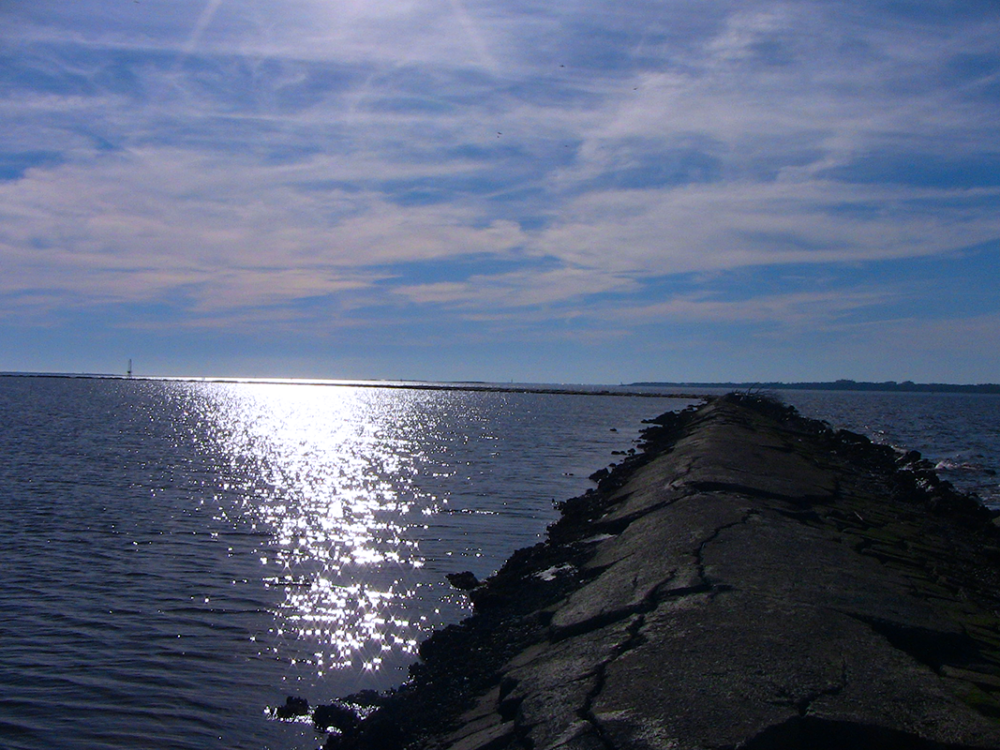
The Jetty visited Lynn and Bruce Visited on their first date

I had just moved to Wilmington in April and I wanted to get to know the people there. So, I started attending poetry reading sessions. They were held at the lounge on the fourth floor of the convention center which overlooks Cape Fear River.

There was something serene about the setting that made it comfortable for me to get up in front of a group of people and read my poetry. The sun would reflect across the Cape Fear River casting the soft rays into the room. Dusty, the emcee for the poetry reading sessions who works at the center, made it easier too. She has that magical quality of attending to the guests of the Convention Center whether they were there for the poetry or not. Her caring ways equivalent to that of a loving mother always make us feel welcomed and comfortable.

Sharing my poetry in front of a group was an impossible accomplishment. As a psychotherapist, I would have to lead therapy groups so being able to read my poetry to a group was perfect evidence of my ability to accomplish something that had seemed impossible. My ability to get up in front of a room of people every week was an amazing feat. This was something I never had the guts to do when I was younger. I never wanted to place myself at the center of attention.

I would see Lynn every Sunday at the poetry readings at the Coastline Convention Center. For me, she stood out among all the attendees that were present there. She was thin but shapely.

Cystic Fibrosis – a genetic disease. I overheard her talking about that. That was why she was coughing all the time.

I had come sharing poems about Celta, someone I had loved, and lost. I wasn’t expecting to make a romantic connection. Something about Lynn caught my attention.

What was it about her? Did I already think that she was the most beautiful girl imaginable? Do I dare admit to myself that I am entertaining such irrational thoughts? I never thought of it as some kind of love-at-first-sight but there was something about her that intrigued me. Of all the people I held in high regard, Lynn was that one person that seemed to challenge that perspective.

Her voice was hypnotic and alluring. She had all the things that one considers in feminine beauty and shape or so it seemed to me early on. She seemed perfect. I loved her voice - both when she was at the microphone and when I was close to her. And her face, her skin, her legs seemed like gentle features I might have created in my own mind if I had the imagination to do such a thing.

Yet, I noticed she was alone. I guess that was one of the reasons why I was so lucky.

It took me some three months to find the courage and the right words to ask her out. I waited to see if she already had someone else. I wanted to avoid being rejected. I can still feel the fear now as I write this some twenty-eight years later. I guess that was a sign of how much I wanted this to work out. It was scary.

Asking Lynn if she would spend time with me was an accomplishment.

So, here we are, at this gentle beach on July 4th.

I did not expect the pavement to be this slippery. It was a cause of concern for me but not because I was afraid of falling. It was imperative that I must not let her slip and risk bruising or scratching her perfect skin. Putting my nervousness aside, I offered my hand.

She took my hand.

She took my hand!

Wow!

You must be thinking that I am exaggerating but this was amazing! Her gentle hand around mine!

“Do you want to keep going?” I asked.

"Sure," she said, pausing to take in the scene with me. Her straight blonde hair swayed in the gentle wind.

We walked a little further but then decided that this was getting too slippery. And dangerous.

What's next, I thought. Jean works at Fort Fischer, a Civil War museum site, and they have a tour around the historic site. We could go there.

It was an amazing day. The first of an amazing weekend that we would spend together.

We saw the fireworks in downtown Wilmington that night, over the Cape Fear River and near the Battleship. My friends regarded me as a pacifist. I suppose Lynn was too.

After the fireworks, we were walking back to the car, passing by the place where she worked along the way. Some co-worker asked her if I was her boyfriend. “No, we are just friends,” she said.

Darn. I thought this was a date. Nevertheless, we were still just friends.

I can wait.

It was the 4th of July 1992, and everything would change from this day forward.

Time has a way of changing fates. We became more than just friends. Over time, we fell madly and passionately in love. Two years after this day in July of 1992, we were picking out an engagement ring for her.

Oh, and I was in graduate school in Social Work. Everything was falling into place. It was perfect.

More than that, I felt things I never knew I would or could feel. It is impossible to comprehend what I felt that day when she first held my hand.

The world was full of hope for me. Anything seemed possible. I had clear ideas about what I wanted and where I was going. So, while it might seem that this was just about my social life and making friends, it was also a vision of life for me in some sense of the bigger picture of what really matters to me.

We would get a home together north of Wilmington on Brucemont Drive. Her mother bought the home and we rented it from her.

I became successful in social work. I became a Licensed Clinical Social Worker - a psychotherapist. I opened my own private practice. I gained respect from my colleagues who told me that Wilmington was a saturated market, meaning there was no need for an additional therapist in the area. The person who warned me that Wilmington was a saturated market and that an additional therapist is not needed had the best of intentions, but it was so great to know that despite all the challenges I found success.

I saw a life with Lynn Denise Krupey. I proved to myself that I could accomplish my dreams. It was all built around me and my family. I dedicated my life to helping others to get back on their feet. I had everything I wanted. I certainly had no intention of changing anything at all. I could not imagine anything different or anything better than this other than more of the same.

Halfway through 2000, a meteor would come crashing down on this life I had tirelessly built upon. The shocking events that began to transpire that year would incinerate everything in my world leaving ashes to blot out the sky. I saw only darkness, the fog of ashes blowing fragments of the familiar home, the furnishings, the words, and dreams.

I was in desperate need of compassion, empathy, kindness, and love but I wasn’t thinking too clearly about where to look for these things and where to find them.

I still believed my so-called family had a capacity for providing what I was needing. I wasn’t thinking clearly. To understand why I should NOT have turned to my parents or siblings, we need to consider what life was like growing up.