social skill building

Introduction to Part I – When Love Was Still Unimaginable

Watch This Chapter from the Video Audiobook

Introduction to Part I – When Love Was Still Unimaginable

There was a time in my life when I didn’t even know how to dream.

Not because I lacked imagination, but because I had never known joy - the kind of joy that opens the heart to possibility. Before college, I wasn’t thinking about what I wanted, or what might make me happy. 

When I first sat down with a counselor at Georgia Tech in 1984, I didn’t know that I was beginning a journey that would lead to love, healing, and a life beyond anything I’d known.

I was just trying to survive.

College felt overwhelming. I had no real social skills. I had spent my adolescence in silence, invisible in my classrooms, uncertain in my own skin. I didn’t know how to connect. I didn’t know what it meant to belong. And so I found myself, at age eighteen, walking into a campus counseling office - not because I had a vision for the future, but because I felt I wouldn’t make it on my own.

I had no idea then that this search for support would lead me not just to stability, but to profound transformation.

If I had ever taken the time to dream, I would never have been at Georgia Tech and studying engineering.

I’d like to say that I experienced joy and success beyond my wildest dreams, but the fact is that when I walked into the Counseling and Career Planning building and into the office with my counselor, I had never thought about what I wanted. Nothing could be more meaningless for me than engineering. No career direction could be more inappropriate for me than engineering. 

In addition, what my parents had given me was fear. That was their greatest gift. Initially it was fear of them. I guess they took the verses from the Bible that said that “beginning of wisdom is fear of the Lord” literally and they used that as a template for what they were seeking. Not respect but fear of one’s parents. 

Undoubtedly, there are obviously more disturbing stories of abuse. Stories that would inspire almost anyone to value the role of Child Protective Services, even those who otherwise are hesitant to see the goodness of what Child Protective Services (CPS) is tasked with doing. My second wife would tell me about how much more brutal and violent her father was. Undoubtedly there are arguments about overzealously involving CPS and those who think that a child is just oppositional when it comes to any rules. That wasn’t me. I did wish that CPS would have come to examine the things that were happening to us. 

Let me state that again. I don’t want there to be any confusion or uncertainty. As a child, I wanted CPS to get involved and ask us, as me, if I was a victim of child abuse! If that happened, I would have been talking for hours and hours describing things that were happening, and I would have been put in foster care. It would have been far from ideal, but it was what I desperately needed. 

It wasn’t just fear of them that I learned but fear of the world. I was made to fear all the things that could go wrong if I didn’t do everything right - get into a great college/university. For this to happen I had to get straight A’s. It’s ironic that I didn’t question this wisdom since my brother and sister could not begin to approach my begin to approach the grades I was achieving in much more advanced courses. By high school I was taking advanced placement classes for those on track to enter a prestigious and challenging university and I was getting straight A’s. 

Looking back, I now understand that what I was really searching for was attachment - the kind of secure, mutual, loving connection I had never experienced growing up. My family, though outwardly intact, was emotionally barren. The messages I received from them - explicit and implied - taught me not to trust closeness, not to expect to be wanted, and not to believe I mattered.

But slowly, that would begin to change.

This first part of the memoir traces that journey - from a shy, uncertain person to someone who not only found their voice but found love. First in the brief but life-changing relationship with Celta. Then, more fully and enduringly, with Lynn. It was through these relationships that I came to understand what safety, intimacy, and joy truly felt like.

This is the story of earned secure attachment. Of discovering what I had never known to want. Of realizing that life could be more than survival - it could be beautiful.

I didn’t know, then, that it wouldn’t last forever. And I certainly didn’t know how deeply it would hurt to lose it all.

That part comes later.

However, one cannot know or appreciate loss without first discovering joy, expansiveness, connection, and a life where one is allowed to dream because one has no idea that those dreams can’t come true. So, the first half of this book is a love story. But it doesn’t start that way. I have to tell you where I came from and what life was like from the earliest days of my life. 

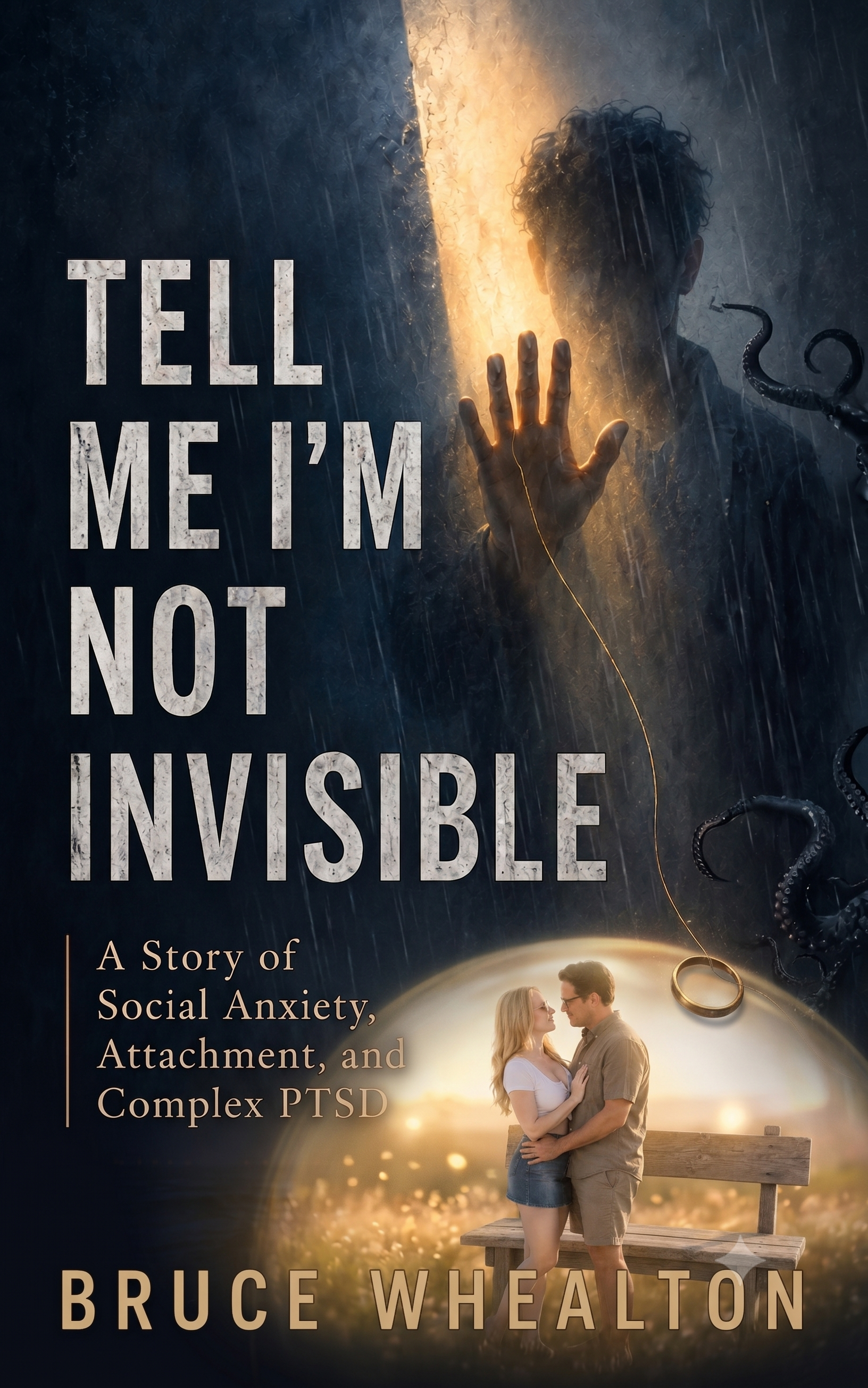
Tell Me I Am Not Invisible: A Story of Social Anxiety, Attachment, and Complex-PTSD

A Memoir About the Necessity of Connection


Tell Me I’m Not Invisible is a memoir for anyone who’s ever felt unseen, unloved, or alone.


Bruce Whealton grew up in silence. His childhood was defined by emotional deprivation, physical abuse, and a family that made him feel like a ghost—unseen, unwanted, unworthy. For years, he believed what that world taught him: that he wasn’t enough.


That he wasn’t loveable.


And then something miraculous happened.


He found love.


Chapter 30: Doing Therapy During My Internship

My tasks allowed me the opportunity to get to know others in a therapeutic setting. Recall that when a person is admitted to the hospital there is a short period of time during which the intake assessment for each department must be completed.  

Unlike during my first year when it seemed like they were making work for me to learn as a requirement for an internship, this was a setting where I was being asked to do something that was required by and for the hospital.  

This wasn't busywork. If I was asked to complete this, I was being counted on to do this. It was necessary and required. This made me feel so much more useful than during my first year where it was hard to see that I was making a difference. Also, as I said, Chris knew what I was learning from him and through my studies.

Instead of feeling bad about volunteering my knowledge, wisdom, and insights, I saw that what I was offering was valuable information to consider when evaluating what a patient was experiencing and perhaps how they could be helped. 

I had mentioned that during my first internship I had some doubts about my competency. I chalked up every "mistake" as a learning experience. 

Okay, so during the intake assessments we try to get a lot of information from a patient. Why they are in the hospital as they understand it... what has been going on in their lives... are they married? Do they have children? Can they describe their symptoms and problems? And so on.  

The ability to gather information from a person requires building rapport, creating trust, demonstrating empathy and compassion. The quality and nature of what you learn, what information you are able to gather, are a reflection of your skills and talents in this area. It’s also important to ask very open-ended questions as much as possible because the patient knows things that we don’t.

As you can see, I have come a long way from the young man who needed counseling to learn social skills, communication skills, and how to control my anxiety - social anxiety.

I constantly reflected upon how good I felt about having accomplished so much. Over a decade of hard work had been invested in getting me here where I am in my late 20s.  

It also seemed that when you do demonstrate respect for others, empathy, and concern, they want to talk about their experiences. That was my observation time and again. Chris recognized my growing talent and eagerness and let me start doing some brief therapy with patients. Because the patients were not in the hospital very long, the therapy had to be brief.  

Chris gave me some pointers as to what I might want to do when I sat down with a patient - what kinds of interventions might be helpful. I discussed what I had been learning in my classes and other studies. 

What might I do in a session with a patient? Well, if they are dealing with major depression, we could try Cognitive Behavioral techniques where we learn to challenge automatic thoughts that create negative emotions.

With trauma issues, deep relaxation techniques are very helpful in talking about a disturbing event. I would demonstrate or guide a person in the use of guided imagery and deep breathing to create relaxation. 

By that time, I was clearly demonstrating empathy and powerful listening skills. I received that kind of feedback from Chris when I turned in notes about my activities, but I also had that impression from the feedback that I received from the patients. I’m not saying they gave me a score on empathy and listening skills but there were so many times when I noticed how much people wanted to share their stories and feelings with me.

There were various opportunities when I was on the unit where patients had a chance to approach me and ask to talk about an issue that had come up in a group or from our earlier conversation when I did the intake assessment for example. Sometimes all I did was just listen with empathy. The experience of being in the hospital is not likely to be a pleasant experience. 

This kind of listening may not sound like a technique but in the psychological theories that were developed by Carl Rogers, unconditional positive regard and empathy are valuable tools.

I would tell them when I met with them for therapy that I was going to write up notes about what we discussed in therapy to see if it could be helpful to others who might be offering treatment for them. I instinctually felt that I could and would offer to let them tell me something and ask that it not be recorded in the notes.  

Gender issues were never relevant. I mean the fact that I was male was not a factor in a patient choosing to disclose any details about what they had experienced. Sometimes you might think that a woman might only talk to another woman about something traumatic, especially if they were victimized by a man.  

What probably intrigued me the most was the experiences that people with schizophrenia or psychotic disorders might be having. I thought that if I could demonstrate empathy, understanding, and compassion, and be able to help people struggling with these issues that would be something amazing. 

In seeking to help someone with a psychotic disorder, treatment might include active listening which means summarizing or rephrasing what someone just said to see if we can understand one another. That connection is so important. It’s sad but some people with schizophrenia will develop serious problems with communication and what they say might not make any sense. I believed I was making a difference by listening and trying to understand.

There is a great deal of research that demonstrates a genetic predisposition for various psychiatric disorders. However, it seems from my own experience that being confronted with major life stressors, even stressors that might not seem like traumatic events, and any person can develop a range of different symptoms – hopefully, that is temporary. 

I did file away the observation that so many people were coming to the survivor groups, even though trauma was not an issue that necessarily had an impact on why they were admitted to the hospital. 

Often Chris was present in the group sessions even when he allowed me to lead the group. I would talk about relaxation techniques as Chris had done. I would employ the kinds of guided imagery exercises that were used in the groups that Chris led, meaning, I invited them to follow along with my suggestions or guidance.

I know that I have covered a great deal here and may not have been overly specific when describing theories and techniques or what I specifically did. I'm not trying to give psychology or psychotherapy lessons, per se... but I will go into greater detail later in the book.  

Chapter 29: Second Year Graduate Studies – Direct Services

My second internship would prove to be the most rewarding. All in all, during my second year of full-time graduate studies, I was feeling good about every aspect of my life. I was doing great in classes, in my internship, and at work.    

A master’s in social work is a two-year program and so the second year is our final year. As I was saying, during our second year, we take classes and work in a setting that closely matches our primary interest area for where we want to work upon graduation.  

An Epiphany - An Answer to a Question

I wanted to start with an insight that I had gained during a class that was titled "Abnormal Psychology." I touched on this a bit earlier, but I wanted to add a few things. Anyway, in this class, we studied and learned about the entire range of psychiatric disorders as they are described in the DSM-IV (the Diagnostic and Statistical Manual of Psychiatric Disorders, fourth edition).  

We used a big book that is used by psychiatrists and other mental health professionals to make a diagnosis.  

Anyway, when we started covering personality disorders, that's when I had an epiphany.

We were considering public figures as examples of people who may have a particular personality disorder. Some people on YouTube seem to walk on eggshells when it comes to speculating about the disorders of public figures. I don't think our professor was quite so worried about making an error in diagnosing someone. I suppose our professor wasn’t speaking to a large audience nor was he making a definitive diagnosis. 

I remember we discussed OJ Simpson as an example of someone with Narcissistic Personality Disorder. We were also encouraged to consider people we might know who might have a variety of different personality disorders. The thinking was that this would make things more clear and easier to understand.

There are some rules in the US that discourage diagnosing public figures. Those “rules” do not seem to be hard absolute rules. 

With regard to personality disorders, it’s not rocket science nor is it necessary that you sit down with someone to make a diagnosis. Another argument is that the person being diagnosed should be seeking treatment. Sometimes people are involuntarily committed to a psychiatric hospital and so they didn’t seek treatment or a diagnosis. 

Mental health professionals make observations, gather information from people other than the person being diagnosed.

Anyway, it was in this class when it hit me!

Narcissistic personality disorder (NPD) is the problem that my mother had. The questions that had racked my brain for decades finally had an answer or an explanation. I don't know if this diagnosis of the problems that Kathy Whealton had would have been helpful earlier but at least I had a sense of clarity as to what was wrong.  

In many ways my father, Bruce Sr. seemed to have the same condition. It wasn't so obvious with him though.  

It was obvious that my mother could not see things from a different point of view.

That is the difference that I noticed with my mother. She NEVER could come forward and say, "I am sorry for the way I acted... that was wrong."  

There is more to it than these observations. Both parents had a condescending and judgmental attitude toward others. Only certain "special" people could meet their high standards for being worthy of their attention. 

These are symptoms of NPD or characteristics of a narcissistic family. 

Anyway, I do not say these things with an angry heart. Nor is this an effort to make my parents look bad. This epiphany was an answer to a question I have been asking for the past 15 years or so. 

Getting back to the topic of second year graduate studies.

We had courses that covered a variety of techniques for group, individual, family, and couples therapy/counseling. I won’t give you an education here into a typical second-year graduate program in social work. While learning the “basics” we were also encouraged to learn more about certain theories, therapies, and techniques. This is not unlike the way that psychotherapists will specialize in the use of certain types of therapy that they do best. No one can know everything about every form of therapy. 

In graduate school, during our second year, we take classes that ask us to research different treatment techniques and therapies. For example, in one class I did a long paper on treatment options for people with dual diagnoses like a mental illness and a substance use disorder. I felt that the 12-step programs of Narcotics Anonymous (NA) and Alcoholics Anonymous (AA) had some limits and potential flaws.

My concern with NA/AA is that people get advice from others who have no specialized training. On top of that, I had noticed from the literature that these people will tell a person that the main and primary consideration is to avoid the addictive substance. That discounts a person’s overall suffering and pain.

So, I looked for recent scientific journal articles that presented research findings that might be relevant to this topic. I remember my paper was 30 pages long.

I was learning about a variety of treatment techniques and theories. 

My Internship at The Oaks

During this second year of my education, I did my internship at "The Oaks" psychiatric hospital under the guidance and supervision of Chris Hauge. Yes, he is the same Dr. Chris Hauge that I mentioned when speaking of my volunteer work at "The Oaks" in an earlier chapter.  

The doubts that I had during my first year, however infrequent they were, now were non-existent. I had no doubt that I had made all the right choices to get me here finally. Chris had worked in the field for decades, longer than anyone I ever knew, and he was very well respected. 

Chris was happy to have me do my internship there at "The Oaks" as we discussed previously. He saw my passion and drive to help others who were hurting, in distress, or having problems in life. He nurtured that hunger and drive giving me opportunities to do the things that I wanted to do... For example, it wasn't long before I had a chance to do some therapy with patients in the hospital.

I was participating in groups led by Chris - therapy groups.  

What I loved about the way Chris did the groups is that the "staff," psychiatric nurses, other interns, medical students, and others were expected to participate in the group. What I mean is that they were not there to just observe what others were doing.  

I'm going to have to be more specific to describe what I mean. Patients were in the hospital in most cases for no more than about two weeks. So, we had to figure out what could be accomplished in a brief period of time. Chris happened to be skilled in the use of experiential therapy techniques, which I will describe below.

Let's consider some examples. In a relaxation group, we might talk about natural ways to relax and deal with anxiety. In a survivor's group, we would start with deep breathing for relaxation and then Chris would guide us into a guided visualization exercise with our eyes closed. As an example, we might visualize a younger version of ourselves sitting in a chair in front of us.

It was really powerful and amazing. As the name implies, a survivors’ group was for those who experienced abuse and/or trauma. This younger version of ourselves was our wounded inner child... or it could be a younger version of ourselves when we were younger adults. 

Technically, it’s important to note that we were younger a month ago and if something traumatic happened at that time, we would say that we were psychologically wounded. We could also call this wounded inner part of ourselves an “ego state.” It’s almost as if a part of our “self” is frozen in time. Our task is to help a person move past the experience and find closure.  

The use of self-disclosure was also encouraged by Chris. That means that the staff or a group leader will share personal details about themselves. To me, it seemed that this would encourage or make it easier for patients to open up as well.

Think about it. You are a patient in the hospital, maybe there against your will if you were committed involuntarily. For whatever reason, you decide to go to the group to see what is happening, and maybe in the back of your mind, you are thinking that you were hurt at some time in the past and it still bothers you.  

As long as you don't have to talk about it, you will come. You enter the room with chairs that are in a circular formation with an opening in the middle. You are invited to close your eyes and take a few deep breaths. Everyone closes their eyes including those wearing a staff badge/id. So, you feel safe, and something happens.  

What happens? Well, this is called experiential therapy and experiential is a word that is easy enough for the patients to understand because it means what the name says. This is about creating an experience. It's non-directive in the sense that no one is telling you what to focus on or making suggestions about what did or did not happen that was meaningful to you.  

I was able to observe that the therapy did have positive effects on patients during the sessions. This was evidence from the direct feedback from patients during the group therapy sessions and by observing their facial “affect” – displayed emotions.

What was intriguing for me was that people who were in the hospital with a wide range of different diagnoses seemed to be coming to the survivors’ groups and working through past trauma and abuse. The idea that mental illness is only caused by chemical imbalances that occur just because of some genetic predisposition alone must be questioned.  

At the very least, some stressors in life seem to be able to create symptoms that one finds in various disorders.

Chapter 28: First-Year Graduate Studies in the Social Work Department

I began graduate studies at the University of South Carolina in September of 1993 as a part-time student for the first year. This was prior to Lynn and I getting engaged and then moving in with each other.

With my past experience mainly as a volunteer working with the social work team at a psychiatric hospital in Georgia, I was able to get letters of recommendation that were necessary to get into graduate school.

As I think of this, I worry about how I am portraying Lynn. She wasn’t a housewife, homemaker, or anything like that. I didn’t come home and say “honey, I worked all day can you cook me dinner?” She wasn’t living through me and my successes.

As I mentioned previously, she had to keep her income below a certain level to qualify for health insurance to maintain her health and stay alive. That meant limiting her work hours. She did some office-type work and used her proofreading skills. Of course, she had her pottery as well.

She wasn’t sitting at home watching TV while I worked, went to school, and did my internships.

Anyway, after gaining admission to the school in the fall of 1993, I found out that there were a few classes I could take part-time through distance learning. Instead of traveling over three hours to Columbia, South Carolina, I only had to travel to the campus in Conway, South Carolina which was about an hour and a half away. 

This allowed me to continue to get experience working directly with people in the human services field. 

Going part-time wasn’t a “real” college experience. I sat in a room by myself in the evenings. Sure, we could pick up a phone and interact a bit, but it was nowhere near as rewarding as full-time studies with other students in the same room. 

Full-Time Graduate Studies in Social Work

I began full-time graduate studies in the fall semester of 1994.

This was still, obviously, at the University of South Carolina but now I was going to Columbia, South Carolina. This was a three-hour drive from Wilmington, North Carolina. I would drive down on Wednesday and stay in one of the dorm rooms. I would then check out the next day and go to class on Thursday.  

Three back-to-back classes, that were just under three hours long. Hardly a break between classes.  

On Monday and Tuesday, I had my internship. An internship isn't paid work. So, I had to borrow money to cover living expenses, books, travel, and other expenses.    

The Stafford Loans are designed to cover a scenario just like this. During the summer between what would be the first year of my studies and the second, I was able to pick up extra hours working as a paraprofessional.  

Anyway, this was like night and day from my earlier days in college when I had been so shy and quiet. I suppose I was anxious to share my thoughts, speak in class, participate, ask questions and learn as much as possible. That is what I was doing.

I was psyched. This was happening for real! My dreams, my goals, were coming true. 

During the first year, you study both macro and micro-level social work practices. Some colleges call this direct and indirect services.  

Macro-level social work addresses issues that can be looked at from the level of a community, an organization, an agency, or government. So, we learned about the history of social welfare in the United States. Of key importance among the programs that stand out or the periods in history are the FDR years and the "New Deal."  

In terms of macro-level work, we were expected to do a "needs assessment" for a community where you are living. Through my work, I had identified a low-income community that was partially in the historic district of Wilmington not far from the Cape Fear River. I had also been going to a gym in that area. It was a boxing gym, but I wasn’t a boxer. I just went to work out. It wasn’t far from one of my internship placements. 

That area contained a great deal of public housing which is by definition set aside for the poorest individuals and families. Demographically, it was also predominately populated by African Americans.  

While this was macro-level social work, I did get a chance to develop relationships with “community leaders” and similar folks who knew the area and could share information with me.  

With this information, we were tasked with writing a paper that describes the area and the needs that exist in the community. We were also encouraged to present photographs that illustrate important aspects of the community and their needs.

During the second year, we focus on our choice of either micro-level or macro-level social work. Micro-level social work is about providing direct services to individuals, couples, families, and groups.

I remember the theories that guided micro-level (direct) social work practice more than those ideas or principles that define macro-level social work because my specialization was in direct (micro-level) social work. This is what therapists/psychotherapists may do. We provide direct services (treatment/therapy) to individuals, couples, families, and groups.  

There is a range of different pioneers, psychologists, and psychiatrists that have provided the therapies, theories, and techniques that professionals use. I will describe this later in the book.

First Year Internships

Finally, in considering this first year, I want to talk about my internships.  

During the first year, we are expected to work in a setting that is distinct from the setting where we would like to work during our second and final year internship. The second-year internship is intended to be a reflection of the setting where we would like to work primarily in our career upon graduation.

For me, as indicated previously, I intended to work at The Oaks with Chris Hauge, DSW (my mentor). This kind of psychiatric setting has been the kind of setting where things have been the most rewarding and interesting to me.  

During the first semester of my first-year internship, I worked on the children's unit at the mental health center for New Hanover County in Wilmington.  

Things didn't go as well as I would have liked. It was discouraging. This was the first time when I felt like I didn't have the necessary direction and guidance to be successful. I didn't want to be in a setting where I was uncertain about what to do and feeling lost.  

I was a bit hard on myself and expected that I should have figured out what to do. Often, work with children will involve "play therapy" which is harder than it seems. I had no training yet in working with children and I wasn’t getting guidance from my supervisor or others.

I was torn between unreasonable expectations and doubts that I couldn’t just figure things out. I didn’t think they wanted me to come in and just “play” with kids. I suppose it took me some time to get comfortable with the realization that this wasn’t a good match for me. If this wasn’t a job or an internship, it would be great spending time with kids.

You might recall that I had been like a big brother to a girl who was the child of a couple that was friends with my parents. That was so much fun, with laughter, and just hanging out with her. I was the same way with my relatives who had younger children when I was growing up. Often, I was the one who entertained the kids while the grownups socialized.

Doing an internship working with children felt so different to me than spending time with children outside a treatment setting. So far.              

During the second semester, I was placed at the same organization but in two different departments. In the mornings and early afternoons, I worked at a day treatment program for individuals with chronic and persistent mental illnesses. In the afternoon, I worked with the homeless program that was staffed by the mental health center.  

Some of the time I was able to participate and get to know those who came to the day shelter for the homeless. It was interesting because there were classes that covered mental health issues and the format was something like a support group/therapy group.  

I remember seeing in the morning at the day program for individuals with chronic and persistent mental illnesses, some of the same folks that were residents at Sherwood Village where I worked on the weekends.  

Anyway, that need to prove myself didn't go over so well in one instance. I somehow spoke out of turn and corrected someone accidentally about something from the DSM – the Diagnostic and Statistical Manual of Mental Disorders. I was trying to demonstrate my knowledge, but I was not in a classroom setting. So, my supervisor corrected me after that.  

It was disturbing to me that I was having some troubles during the internship placements that I had. Only occasionally did I feel like I was doing something useful and important. I guess I also still had things to learn in terms of social skills. 

Mainly, I felt discouraged. I had switched out of the children's unit/department and given two placements with two other departments. The reason for me to be placed in two departments was to allow me to get the hours required. I don’t remember all the little criticisms my supervisor had done to correct me, but it made me feel discouraged and sad. I had so wanted everything to go right.

My supervisor during that second semester once asked me if I was really had the potential to work in social work. That was the first and only time I have heard that in my career/life. If a job didn’t go well in the future, it was not for reasons related to my skills as a social worker.

The afternoon placement went okay in terms of my interactions with the staff and my responsibilities. It just seemed that I wasn't needed as much as I wanted to be needed. There seemed to be limited opportunities for me to do things.  

I did develop a "street sheet" that would be useful for the homeless in Wilmington. I used our computer at home and the bus maps. Various resources were marked on the map on one side and on the other side there were descriptions of the various resources and services.  

An Unrecognized Foreshadowing…

Years later when my life had become a living nightmare, I would be given that same "street sheet" I had developed… a time when I was homeless and alone.

However, at this time, I had no knowledge of what was coming years later.

Anyway, during this first year, and similarly during the second year, as you can see, I had a very busy schedule.    

Monday and Tuesday I did my internship, then I slept late on Wednesday and drove down to Columbia South Carolina, stayed overnight in the dorms, and went to class on Thursday. Then on Friday evening through Sunday evening, I worked at Sherwood Village.  

On top of that, I had papers and homework, of course. I was extremely motivated to prove myself. Part of me was trying to prove my competency to myself. Self-doubt is very troublesome.  

Despite some challenges and doubts, this was a very rewarding experience and overall, I loved where I was in my journey. I especially loved what I was learning in my classes and I loved the work that I did at Sherwood Village.  

That job didn't require my attention during the entire 48-hour shift. So, I was able to bring my books from classes with me and read. Sundays were especially slow days so I could catch up on my reading.  

Chapter 27: Working with People with Mental Illness

There was one other job that was very rewarding and fun. I worked the weekend shift at Sherwood Village, an Independent Supportive Living Apartment Complex. There were roughly 30 apartments that housed 30 individuals.  

I was on-call with a beeper for a 48-hour shift from Friday at 6 PM until Sunday at 6 PM. It was a supportive independent living facility in the sense that everyone lived independently but someone was on staff 24 hours per day 7 days per week. This was a place for persons with severe and persistent mental illness. It was called Sherwood Village.

By now I was a graduate student with so many other responsibilities and things going on in my life – a life with Lynn.

I was responsible for transporting the residents to the movies or other similar events. They had a van for me to transport the tenants. I didn't go with them to the movies most times because tenants that chose not to go on an outing might need my services.  

I was allowed to go home with the pager that any of the residents could call if they needed me.  

It was a great job, and I was well-liked by everyone. I stayed on with this position until I got my master’s degree and could move up into a more professional level position.  

It was fun to get to know all the residents. They said they liked me better than the staff member who worked from Sunday at 6 PM through Friday at 6 PM. So, that felt good to know.  

The only activity that I had to do as someone who is "in charge" was to do some inspections of the apartment - mainly that was inspecting the A/C filters and other things like that. Obviously, there were some things that are important to promote a person's overall health that I had to oversee.  

They knew I had a job to do for the landlord and the managers that maintain the apartments. I obviously had to make sure people were okay, but it wasn't like in a hospital unit where someone might come by every few hours. Most tenants were relatively high functioning, so they weren't going to wander away and disappear.  

They had their own cars in some cases and there was no curfew or anything like that.  

It was extremely rewarding because I NEVER had an issue with any of the tenants not liking me.

This would be a common theme in my career overall where the greatest challenge was with paperwork/charting, bureaucracies, staff expectations, and in my role as a member of the staff. 

During this entire decade and into 2000, I NEVER had negative feedback or opinions expressed by anyone I served or helped – with clients, patients, or tenants everything went so smoothly. 

The job was awesome overall. I mean I was getting to know these people and feel like I was part of a family. I considered them part of my family in a way. I mean I liked everyone there. One or two residents were distant and didn't talk much but most everyone was great to know.  

I didn’t think the staff for whom I was working had too many rules. I was on my own for most of the entire weekend and for most weekends. The only people contacting me were tenants/residents.  

I could visit them inside their apartments. Obviously, that could be problematic with female tenants, but it never became an issue. If there was more than one person in the apartment, I didn't feel too concerned about spending some time in any of the tenant's apartments. Sometimes there were emergencies, and that required spending extended time with a particular tenant who was in a crisis situation.  

These crises rarely happened. I do remember one woman having a seizure and I was on the phone with EMS. I had to return to Sherwood Village because I had gone home with the pager when I got the message to call the tenant's phone number.  

Residents of Sherwood Village had disorders such as schizophrenia, Major Depression, Bipolar Disorders, and so on. These disorders were characterized as severe and persistent mental illnesses. That is likely a designation that is necessary to obtain funding.  

I obviously was made aware of the diagnoses of each resident. I also had to know what medications they were taking, physical problems, and other important information. This was all on file in the office. I was given a couch in the dayroom or I could sleep on the couch in the office if I needed more privacy at night.  

I ran the tenant meetings which were held about once a month. Most of the tenants came for the meeting that was held in the dayroom which was a place where people could visit during most hours such as 9 AM to 9 PM. I could certainly spend additional time with tenants in that room if they needed to talk to someone.

Hopefully, you can imagine why this job was awesome for me. And why they all felt like my family.  

It also is important to note how comfortable I felt running the tenant/resident meetings. Unlike reading my poetry to a group, this was more like directing a group event.

Yes, I felt so comfortable interacting with everyone as the person that everyone turned to for help whatever their problems were. I was starting my graduate studies during this time period, so I had been learning other skills in college (graduate school) to help me in counseling individuals in need and how to run group sessions.  

I wasn't actually doing therapy yet but some of what we do as therapists is to listen to others with empathy. To help people feel safe. To be someone who others turn to for help and support.  

We also had a Christmas party on the weekend when I was there. It was so nice. I felt needed and important.  

It felt so right. I mean I was doing a great job, and I could tell that I was. I could tell that I was someone that people felt very comfortable talking to. 

I also know that I was more liked than the young woman who worked there during the week.  

I also have no doubt that both the men and the women felt more comfortable talking to me about anything than they did talking to Donita, who worked during the weekdays. I knew that people there were glad to see me arrive on Friday - they told me.  

What people most want, and I can speak from experience is someone who truly listens and demonstrates empathy. Notice that I said, "demonstrates empathy."  You cannot just feel comfortable believing you have empathy for another person and their situation. People will let you know how they feel when you are working with them or they will be distant, closed off, or reserved as they had been with Donita.

It seems like common sense that people won't be coming to you or repeatedly seeking your help and support if you are not demonstrating empathy. People here were coming to me to discuss everything that concerned them. 

I felt a powerful connection.

Donita seemed to be held out as a role model for me by my supervisor at least until he started talking to the tenants about me.  

The tenants on the other hand did complain to me about Donita’s "attitude." She wasn't approachable, I was told. It wasn't anything that was serious enough for them to complain, for the most part.   

It's important to note that some people in a situation like this do not feel empowered to complain. Having a chronic and persistent mental illness carries with it some stigma and it doesn't lend itself to creating feelings of self-esteem and self-confidence. Low self-esteem can go hand-in-hand with various psychiatric illnesses.  

That being said, I know I made a difference and the tenants at Sherwood Village didn't want me to leave when I had to move on with my career and take on more professional opportunities. That was happening as I completed my graduate training.          

Unfortunately, due to confidentiality, I could not ask them for letters of recommendation for any job outside the mental health center/clinic. I did have complete confidence that each of the tenants, when and if asked about my performance had nothing but good things to say.  

In the next chapter, I will begin to discuss the next stages in my education. More specifically, I am going to discuss my graduate studies at the University of South Carolina in the Department of Social Work. 

Chapter 26: Working with People With Developmental Disabilities

Prior to starting graduate school, there were limits as to what I could do in the field. I was not able to work as a mental health professional yet. However, there are jobs where one can work as a para-professional.  

I found opportunities to do work with clients who have developmental disabilities as well as in some cases, mental illness and/or physical conditions/disabilities. There has been some overlap between the fields.  

The Mental Health Center in New Hanover County was also the Center for Developmental Disabilities.  

With my job ending at Corning, I had to find other work. I had been spending all my time with Lynn and my self-esteem had grown tremendously as a result of that relationship and as a result of the experience, my time with Celta before that, and my various experiences as a volunteer in the psychiatric field.

I'm not saying there were not struggles, worries, or uncertainty. Had my mental health not improved from where it was before I moved to Wilmington, I might have been more panicky about the job ending after six months.  

Instead, I just looked for opportunities and bounced ideas off Lynn. It was very helpful to have someone who could hold me in her body... someone I could cuddle up next to whenever I was anxious or fearful. Plus, she was very practical, as I described earlier, so I felt confident that I could find answers and solutions to meet the challenges I was facing, whatever they might be. 

As I was saying, I needed to find employment after the job at Corning ended. I had worked as a technical writer and had saved up a great deal of money in just six months. Since the job was contracted through an employment agency in Augusta, Georgia, the salary was paid as per diem – similar to when a company pays you for going to a conference. This way most of it was not taxed at all!   

Eventually, I found a job with an agency that treats individuals with developmental disorders such as autism, and various levels of mental retardation. The latter is measured by results on IQ tests when a person scores at least two standard deviations below normal - which is an IQ of 70 or less.  

I started working with a client who had autism and some degree of mental retardation. I met him at the day program that existed in Wilmington and which was affiliated with the Southeastern Center for Mental Health/Developmental Disorders/Substances Abuse Services. Adults would come for several hours to the facility where they would be taught various skills for coping in the environment.  

The guy I was working with was very big, about twice my size, and he could not speak as a result of his condition or disorders – that is commonly the case for individuals with autism. He used sign language. So, I had a chance to learn sign language. It was so very important to be able to sign various words to communicate with him. 

I had goals and things that I was supposed to do with him every day. One such goal might be to accompany him for walks around the area. Obviously, I had to make sure he didn’t run out into traffic so I mainly walked on the sidewalk closest to the street to ensure that this would not happen. 

He also had a problem with repetitive behaviors where he would swing his arms and risk injuring himself. This is troublesome because I was afraid that he would hurt himself. No one spelled out what exactly I should do when this happened. 

 There was at least one other individual there who was a client of the same company and I worked with him as well. 

I knew that case managers had developed the goals which were put into a treatment plan that I was responsible for implementing. I also knew that case managers are usually social workers – not typically social workers with an MSW (master’s in social work).

I wondered if I was helping these people. I knew I was helping their families, but I wasn’t getting direct feedback from the clients I was serving.

Jumping Ahead To When Lynn And I Were Living Together…

The relationship with Lynn was growing, I was beginning graduate school and working several jobs. 

In late 1994, Lynn and I moved into a nice neighborhood in northern Wilmington, and one of the clients with whom I was assigned to work lived in that neighborhood. I worked with him through the Southeastern Center for Mental Health/Developmental Disabilities and Substance Abuse Services and with a company with whom they contracted.

This client’s name was James. 

I worked with James both in the community and at his home. James lived in a home that was staffed 24/7 – all the time every day. Unlike a “group home,” he lived in a home where the rent was paid by the state as were the staff and other services that he received. 

I had been “networking” with employees of the Southeastern Center for Mental Health/Developmental Disabilities/Substance Abuse Services as well as agencies with which they contracted for direct-care services to clients. I worked at group homes and in the community including at the Day treatment center as I described earlier in this chapter.

While James had his own residential placement, I was also working at other residential locations where individuals with a mental illness and/or developmental disability were staffed 24/7 365 days per year. A “shift” at these residential locations was 8 hours straight and you had to bring a meal with you or eat food that was available for staff because sometimes you were alone on duty. 

James was unique and that’s why he had to be placed by himself instead of with others at a “group” home. He had Cerebral Palsy, Intermittent Explosive Disorder, and an Intellectual Disability. I can’t give his last name for confidentiality purposes.

"Intermittent explosive disorder" is just what it sounds like.

I had to learn how professionals in the field restrain a client who might get combative. In all my years of experience that only has been an issue in cases in which a person has a developmental disability like autism or some form of mental retardation and a mental illness. 

Unfortunately, when you combine intellectual disabilities, problematic or limited social skills, and certain psychiatric conditions, there is a potential for aggression. 

A foreshadowing of things to come…

As an aside, it is possible to be hurt by someone with a mental illness without the mental illness causing a person to hurt you. I would learn that many years later, when things happened.

I started working with James shortly after Lynn and I moved into our home on Brucemont Dr. This would be OUR home for years after this.

Getting back to working with James…

Our goals with James were to help him to fit into the community and to go places within the community. This could include the library, restaurants, the park, the beach, shopping, and maybe the movies among other things. 

At least, I knew that these were goals that James desired. The challenge was to teach him socially appropriate behaviors, so we didn't get thrown out of places where we went.  

Indeed, that was a challenge. He was the opposite of shy. He would approach anyone and everyone and start talking to them as well as a great deal of touching – potentially sexually inappropriate, hugging and putting his arm around people. Everyone. And he was loud. So, everywhere we went he knew people and he would hug them or otherwise touch them. 

James loved to see Lynn when I took him by the house where we were living. As it turned out his residence was less than a quarter-mile from where we lived.

I didn't leave James alone with Lynn because he might get inappropriate. I am sure he saw me as more than just a staff person giving him directions about how to act appropriately in a particular setting. He saw me as someone who would protect Lynn from ANYTHING that bothered her. 

I did get approval from Lynn and confirmation that she was comfortable with me bringing James there. 

I didn't disabuse James of the notion that I would treat him the same way I would treat anyone who dared to do anything Lynn didn’t want them to do. He would struggle to keep his urges in check… moving to touch Lynn on the shoulder and then start to invade her personal space. Lynn would put up her arms and say “James!”

I wasn’t far away, obviously. Instantly, I looked up and James would look at me. Then James would say “uh, oh, he’s mad now” with an uncomfortable, low rumbling laugh. 

I’d say, “Okay, we are leaving now.”

Lynn would say “he’s okay, right James?”

“Well, we need to go anyway,” would be my response because he had to learn. I was a bit uncomfortable whenever he did these things but not everyone was as forthcoming and understanding as Lynn.

Then Lynn would say “when will you be home, honey?” and Lynn would give me a kiss, unaware of what kind of reaction this was eliciting in James. I knew from his low rumbling laughter. 

He wanted another hug or something. So, I would turn and guide him out the door before he or Lynn knew what was happening.

Chapter 25: Pursuit of Career Dreams – Psychiatric Social Work

In the last chapter, I was discussing the primary accomplishment of my life - building a family with Lynn. As husband and wife, we were a family.  

Prior to that, during college, I had spent five years trying to overcome my shyness which manifested as social anxiety and a lack of social and communication skills. To even meet Lynn and to express my interest in her required skills that I did not have previously.  

I was preparing to be a social worker even when I was studying engineering at a school that didn’t even offer a major in social work. I just didn’t know at first that I was preparing to be a clinical social worker or a psychotherapist.

As I described in earlier chapters of this book, engineering wasn’t even close to being a good choice. In high school, though, they didn't give us any psychological tests, aptitude tests, nor did a guidance counselor sit down with us and help us figure out what career might be a good match for us.

Because of the benefits that psychology offered me in making radical changes for the better in my life, I wanted to bring those same benefits to others who might be struggling in life. If it could transform a guy who was paralyzed with or by shyness into a person who would choose social work, then imagine the possibilities.  

Having realized just how rewarding it had been to work with the social work team at Georgia Regional Hospital, a psychiatric hospital, I was looking for a similar opportunity when I moved to Wilmington in 1992. I had arrived for a 6-month contract at Corning as a technical writer as I had indicated previously.

Wilmington had just the right opportunity at "The Oaks" which was part of "New Hanover Regional Medical Center."  The Oaks was a psychiatric hospital. It was a locked unit because many people are there under involuntary commitment orders.  

When I approached “The Oaks” I was introduced to Chris Hauge, DSW, LCSW. DSW is for Doctor of Social Work and LCSW is for Licensed Clinical Social Worker. Most people with an LCSW have a master’s in social work (MSW) as that is typically considered a “terminal degree” – the furthest one needs to go in in one’s education to work as a psychiatric social worker. Usually, a person will get a DSW so they can teach at the university level.

Anyway, I volunteered to work a few hours every week. I also explained to Chris my long-term goals and my journey up to this point. Chris would end up being a mentor of mine. He supervised me during my second internship about 3 years later. He also helped me get started in private practice even later in my career. In other words, he knew me quite well and he was very instrumental in my success.

His style was also very refreshing.  Chris encouraged the use of self-disclosure by the staff at the Oaks when they were interacting with patients and he modeled that. This is not very common in the field. Many mental health professionals are very guarded about disclosing personal details, their own experiences. There is a risk that some clients or patients will use some personal information to make us feel bad or to get under our skin.

As another example of what I found unique about Chris was that in his groups he encouraged the staff to be very genuine and to share their own honest feelings. Imagine a client or patient is feeling very down about themselves and feeling worthless. Now imagine that with what little time you’ve spent with a person it occurs to you that you can think of at least one positive thing that you like about the person as a fellow human being. To even get to this point might seem impossible to some mental health professionals.

I actually had such an experience not long ago in 2020. I was talking to a psychiatric nurse at the University of North Carolina at one of their clinics. It was awkward for her as she stated that it would not be proper for her to tell me if she felt there was anything positive that she recognized about me or in me. The question and the interaction were rather uncomfortable for both of us. But really, does it need to be? If such a question was posed to me, I’d have offered some positive feedback before I put that much thought into the matter.

To think that you can’t offer any positive feedback to a client is strange to me.

As a social work volunteer at The Oaks, I was assigned to complete an intake assessment, not unlike the ones I had done at Georgia Regional Hospital.

There are some interesting things that I wanted to add about the intake assessment. This was the case when I was a volunteer at Georgia Regional Hospital as well. Chris encouraged me to make a diagnosis of the patients and to do so without looking at what the psychiatrist had listed as a diagnosis. I’ll explain what it means to make a diagnosis later in this book. 

The point is that the information that you gather is used to make a diagnosis. Patients were not given a battery of psychological tests (or any psychological test for that matter) in most cases. I could see how I was gathering more extensive information than what the psychiatrist had available previously. 

I got the sense that the clinical social workers like Chris were providing crucial information that would inform the treatment plan while they are in the hospital – outpatient settings are like that as well.

Later, while I was working at a public mental health center after getting my degree, it seemed, in that particular setting, that the doctors were less receptive to considering the additional information that I offered or to read or listen to my explanation for why my diagnosis might be different. I was never chastised for offering my own diagnosis into the chart, but they seemed less receptive than the psychiatrists here (I am using doctor and psychiatrist interchangeably). 

I was not even an intern yet and had not started my formal training but the information I was gathering seemed valuable to the entire staff. 

Anyway, I would come in and meet Chris. We would sit down, and he had a list of new patients. He would say that we have to finish a certain number of intake assessments that day – there was a requirement to complete them within a certain period of time after admission. So, Chris would say, “I will do the assessment on these people, and could you meet with these others.”

I was given a key to an office somewhere that I could use to meet with and gather information from a patient. 

It’s important to note that this was not “busy work.” These intake assessments had to be completed in a certain period of time, as I just said. I felt like I was doing something important.

I had an opportunity to sit in on various group sessions as well. I told Chris that I wanted to do my second internship at The Oaks, and he agreed to that plan.

I learned even more under the supervision of Chris than I had as a volunteer in a similar situation previously.

I continued to grow in my social and communication skills. 

I felt the contentment that goes along with continuing knowledge that I was on the right path in life.

I had been intrigued by the ways that mental illness took a toll on the lives of others. If I could apply those same skills to help others, that would be something. To heal others afflicted with debilitating disorders or to help them cope and find joy in life would be the most appropriate career direction for me. The relationships I was forming even before I graduated from Georgia Tech were so powerful and meaningful to me! 

Everyone has different preferences and things that motivate them. I had found what mattered to me and what kind of activities I wanted to perform on the job. You might say that these were activities that I NEEDED to do if life was going to be meaningful.  

This was about helping others and working with others. That’s what mattered to me.  

I mention all this to make it clear that having made one mistake regarding my education and career direction, I didn’t want to make another.

In retrospect, as I write these words decades later, I know that I had made the right decisions back then. I had been on the right path and doing everything right.

The Game

We're playing a game.

Does everyone know
we're playing a game?

Does everyone like the game?

If you play the game,
it shows you care—
when you first meet people
in a social situation.

I need you to play the game.

Because I’m nervous,
and the game helps me feel relaxed—
when we play the game.

And it shows you care—
enough
to play the game
with me—
until we know each other.

But I don’t even know you.

Wouldn’t it be fake
to act like I care about you
by playing a game
with you
in this social situation
that helps me feel more relaxed?

Don’t be so serious.

Just play the game.