I told you at the beginning that my childhood survives in me as climate, not scenes. Nowhere is that more true, and nowhere does it cost me more, than here.
I told people, matter-of-factly, that I had been punched in the face many times. I said it at the time — to my cousins, and to my sister and brother — the way you might mention that it snowed a lot where you lived. No one in the neighborhood was bullying me; the weather was indoors. But if you asked me to narrate one specific assault from beginning to end — the date, the room, what started it, how it ended — I mostly cannot. Violence that happens often enough stops filing itself as separate days.
And I have learned that the missing record can be used against you. Were we really abused? — asked in the way that is not a question. As if the absence of eighteen winters of storm-by-storm memories were proof that it never snowed.
It snowed. The reports I made to my cousins were made in the 1970s, not in a therapist's office decades later. And there is one storm with a date on it.
It was 1988. Carrie had just turned nineteen that February. She had graduated from high school in Florida in May 1987, after our family had moved 1,300 miles south from Southington, Connecticut when Dad lost his job at Combustion Engineering. That fall she enrolled in community college in Hobe Sound.
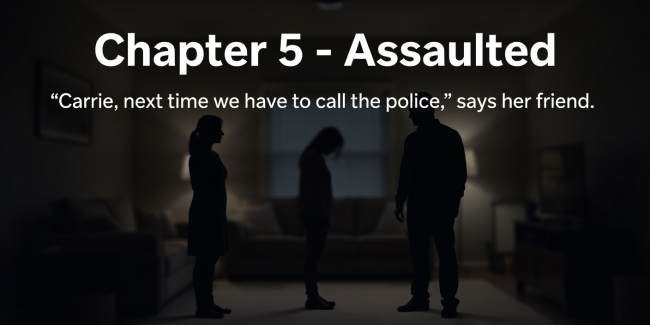
One night she called me at college, crying, telling me both our parents had assaulted her. Afterward she and a friend agreed: "Next time, we'll have to call the police."
I thought about calling the police myself.
What had her friend witnessed?
This wasn't about Child Protective Services, the kind of reports that as minors might have led to parenting classes or anger-management training. This was about criminal assault charges against one's parents. That is rare. Extreme.
And you don't talk about "next time" without a before.
Here is what I need you to understand about that phone call: I was not surprised. Not even slightly. When Carrie told me our parents had assaulted her, I did not feel the floor drop out from under me, did not think how could this happen, did not experience a single second of the disbelief that real news produces. What I felt was recognition. Of course. This was the pattern I had grown up inside, now spoken aloud by the one other person who had lived there. Carrie and I both knew this wasn't new. I was disturbed — but I was not shocked, and the complete absence of shock is itself the most honest testimony I can give. You cannot be unsurprised by news. My calm was not coldness; it was confirmation. I already knew the climate. I had lived in it my whole life.
Soon after, she packed up and traveled 1,300 miles back north to Connecticut. She had no job waiting, no career plan, no invitation. Only the need to get out, to return to someplace familiar. A nineteen-year-old woman driving alone that far because home wasn't safe — that fact stands on its own.
I can't ask Carrie now to confirm the details. Later she would say she had exaggerated, reshaping her memory to fit a story that sounded almost idyllic. But back then we both knew the reality. The dates, the moves, her birthday, her graduation, the community college, the return trip north — all of these hold.
My training eventually gave me a way to understand her retraction that is kinder than calling it a lie. Memory is not a recording; it is a reconstruction, rebuilt every time it is told — and shaped, each telling, by the company it is told in. Researchers call it memory conformity: people who reminisce together converge on a shared version of the past. My sister stayed inside the family, and the family needed a different past. For decades she has been remembering with the people the memories are about. Her archive stayed in rehearsal — and in revision. Mine went thin, because no one rehearsed it with me. But it stayed mine. That is the one strange gift of being the scapegoat: I was never invited to the retellings where the past was softened. The exclusion that cost me so much is also the reason my account survives unedited.
What I didn't realize at the time was that if anything, I may have failed to grasp how bad it was. I knew the pattern. I knew the words. I knew the sound of her voice. But maybe I still understated it.
That's the nature of developmental trauma, what I later came to know as Complex-PTSD. Abuse so repeated, so woven into daily life, that even when you name it, you don't quite see the full weight of it.
During the next year, 1989, my senior year, this event faded from memory. I thought it was understood with my parents that I wouldn't work as an engineer. I thought they understood that the shy person who had entered Georgia Tech would need to explore various paths to enter an entirely new field.
A full year allowed me to forget how toxic and unsafe living with my parents would be — for me, it would only ever be emotionally unsafe.
Despite years of therapy and growth, I had not yet found what psychologists call earned secure attachment — the felt sense of safety in close connection. That would come later, when I met Celta. But for now, I remained in a kind of emotional sleep, still bracing for the worst, still waiting to feel fully real. I didn't know it then, but my 23rd year would mark the beginning of something different: a waking up — not just emotionally, but physically. I was about to become fully embodied, maybe for the first time.